
Emma Watson’s Birth Chart, Numerology, and Name Decoded
Emma Watson’s Birth Chart,
Numerology & Name Decoded
The Soul Blueprint Method — three traditions woven into one personal letter: Western natal astrology, Pythagorean numerology, and the etymology of the soul’s name. Learn the method →
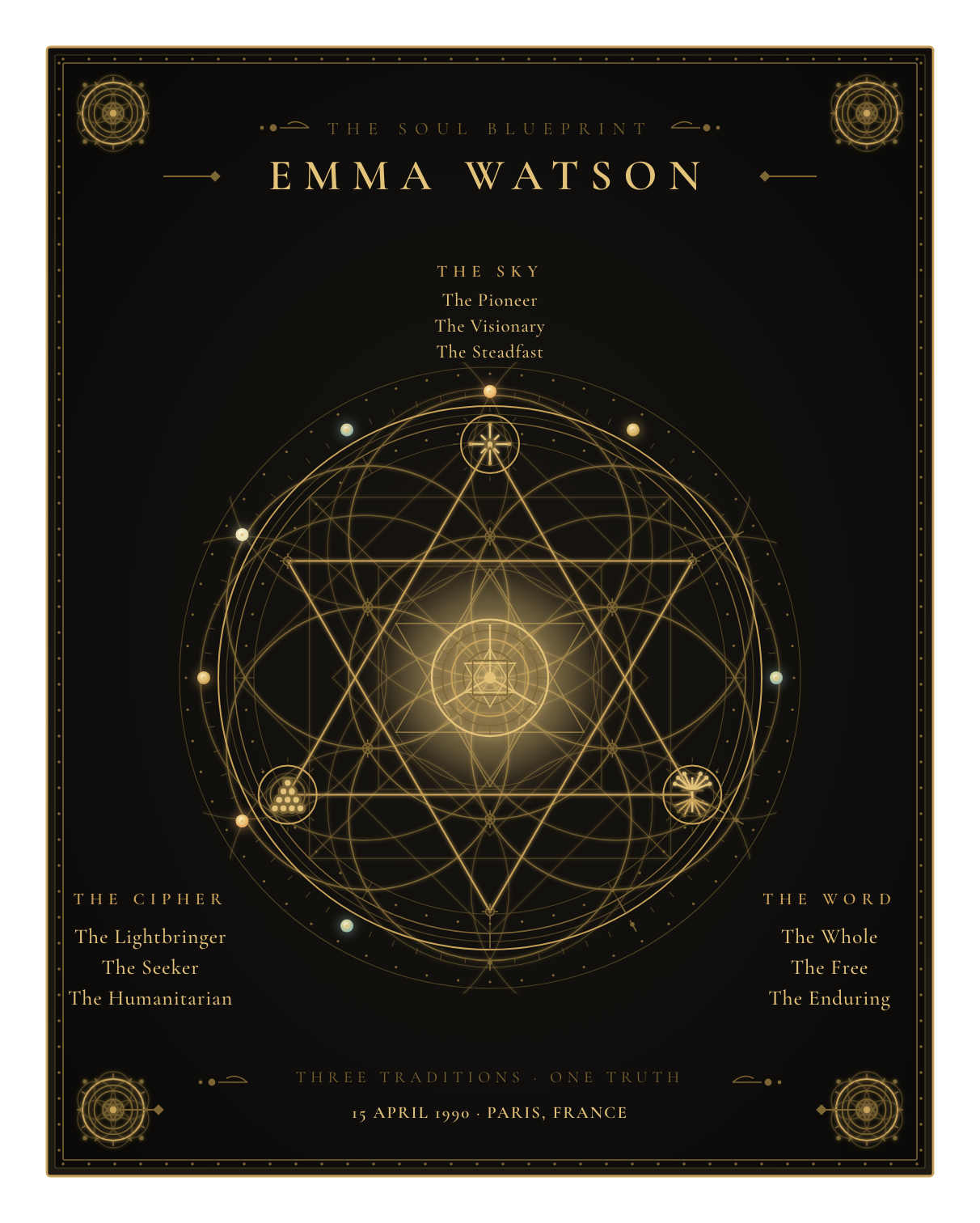
One seal, three languages. The sky she was born under at the apex, the numbers beneath her name at the lower left, the name itself at the lower right — three traditions engraved into one artifact. There is no rising sign, no houses, no angles: without a verified birth time they cannot be honestly drawn. What is true is what is shown.
At a Glance
- Full traditional name
- Emma Charlotte Duerre Watson
- Born
- April 15, 1990 · Paris
- Sun
- Aries 25.2° — the essential fire of the life
- Rising
- Birth time unverified — the Ascendant is offered conditionally, never asserted
- Moon
- Sagittarius 22.9° — the inner life
- Mind · Value · Will
- Mercury Taurus · Venus Pisces · Mars Aquarius
- Discipline · Direction
- Saturn Capricorn · North Node Aquarius
- Life Path
- 11 — The Illuminator
- Title-name Destiny
- 7 — The Seeker
- Birth-name Destiny
- 9 — The Humanitarian
- Master Numbers
- 11
- Soul archetype
- The Seeker who lives the Illuminator’s path
It is September 2014, and she stands before the United Nations General Assembly in a pale blue gown, morning light falling across the great chamber—a woman of twenty-four years, her voice steady and deliberate, speaking into the microphone about a campaign called HeForShe, about the half of the world that has been told to wait, to be quiet, to occupy less space. The cameras are upon her; they have always been upon her, since she was nine years old in an Oxford theatre school, chosen for a film that would reshape everything. And yet something has shifted in her bearing. This is not the face of someone seeking to be seen; this is the face of someone who has learned to see, and is determined that others see too.
The world knows her as a particular thing—the girl who grew into a young woman playing a witch’s apprentice, applauded for her loyalty to a role across a decade. But beneath that name, beneath that carefully managed public inheritance, moves a different current entirely. The fragments the world calls Emma Watson—the actress, the feminist, the activist, the sustainable entrepreneur—these are like the visible tributaries of a river whose true source lies deeper, in some underground spring the eye cannot reach. This reading traces that source. Not the performance, but the blueprint underneath it. Not what she was made to do, but what she came here to become.
The reading moves through the eight chapters of the Soul Blueprint architecture — The Arrival, The Soul’s Inheritance, The Living of It, The Soul’s Calling, The Soul’s Territories, The Name You Carry, The Moment, and The Invitation — and at the end, the same instrument turns gently toward you.
Her soul has a blueprint.
So do you.
The same three languages — the sky, the numbers, the name — are waiting in your own.
The Arrival
She arrived with a paradox burning at her core: the soul that moves first, unburdened by hesitation, yet carries within that initiating fire a need for meaning so profound that action without purpose becomes her crucible. The self-starting will—the capacity to begin, to dedicate wholly to the new by letting the old burn away—is her native Sun, the purest expression of selfhood that exists at the moment of initiation. And yet this power to move first, to act before certainty settles, arrived paired with an emotional nature that cannot rest until the horizon speaks. Her heart requires faith, requires the far view, requires that whatever she begins must point toward something larger than the small self’s applause.
This is why the nine-year-old who was discovered without film experience did not simply become famous—she became driven. The initiating will was triggered by an accident of casting, yes, but the soul underneath would not permit mere fame to satisfy. The arrival contained both the gift to begin and the hunger to justify the beginning with meaning. She came carrying the demand that her own activation serve something beyond the spotlight itself. This tension—between the gift to move first and the absolute requirement that such movement mean something—became the engine of her life. Where another might have coasted on the miracle of youth and fortune, she was compelled to ask: what is this for?
The Soul’s Inheritance
She was born in Paris in 1990, into a lineage of law—her mother Jacqueline Luesby and father Chris Watson both lawyers, holding in their professional inheritance the value of argument, evidence, precision, the weight of words that carry consequence. The family itself was English, though her birth location was the great crossroads city, and there is something in that geography that matters: she began at a threshold, between nations, between languages, between the ordered world of the courtroom and the world beyond it.
Her brother Alex arrived into this same inheritance, and the two of them would later co-found together a gin distillery rooted in sustainability—a gesture that speaks to something inherited and then reimagined. She was trained from childhood in the movement arts at the Oxford branch of Stagecoach Theatre Arts, studying singing and dancing and acting in a systematic way. This is not the story of the prodigy born knowing; this is the story of the disciplined child, the one who trained her instrument carefully, patiently, before the world even knew she would need such training.
The era into which she was born was the cusp of the digital age, of the explosion of franchised entertainment, of the moment when a film about a magical school could become a global phenomenon. She arrived at precisely the moment when such a thing would be possible. Her parents’ world was one of careful argument and responsibility; her childhood world was one of creative discipline. And then, at nine, the accident: a casting call, a role, a threshold crossed.
The Living of It
The living of it began with a discovery that was not earned through years of seeking—it arrived through a casting agent who saw her at her Oxford theatre school in 1999 and opened a door she did not yet know she wanted to walk through. She was nine. She had no film experience. Within two years, her face was known across the world.
This is the cost of such arrival: she grew through adolescence under the gaze of cameras and critics and admirers who had invested their own meaning into who she was. The role she played—the loyal friend, the clever one, the moral center—began to calcify into the public understanding of Emma Watson herself. By the time she was in her late teens, the Harry Potter franchise had generated an estimated ten million pounds of earnings for her, and the trap began to tighten. There was a moment during the filming of the fourth film where the weight of commitment nearly broke her; she almost quit entirely, afraid of the cage that her own success had become.
What she did instead was stay, and finish, and then when it ended, she made a choice that revealed something true about her: she stopped acting in major roles for nearly five years. She attended Brown University, graduated with a degree in English literature, took a year for personal development and activism. She did not simply ride the currency of fame. She stepped back. She asked what was underneath the applause. She transformed the wound—the loss of privacy, the reduction to a single image—into a qualification to speak about something larger: the cost of the spotlight, the suffocation of being flattened into a symbol, the hunger for meaning that cannot be satisfied by recognition alone.
If this is what was true for her, what might be true for you?
The Soul’s Calling
Her voice arrived into the world measured and deliberate—a mind that does not spend words lightly, that settles into what is solid and real before it speaks, that carries weight because it has been tested against the ground of what is true. When she spoke at the United Nations in her twenty-fourth year, the voice that reached the Assembly was calm and grounded, unmarked by the tremor of someone performing for an audience; it was the voice of a soul who had learned that language itself is a sacred instrument—one to be wielded slowly, with care, only when the thought beneath it has become durable enough to hold others.
The calling that moved through her was not the calling of the spotlight-seeker, though the spotlight found her young. It was the calling of the witness and the bridge—the one who stands at the threshold between the visible and invisible suffering of the world and speaks what she has seen. Her life path carried the number of the illuminator, the one who arrives to shine light into the darkness of collective forgetting; and this light did not originate in personal ambition but in the simple, urgent need to name what was broken and call others toward repair.
She began as an actress, yes—but the soul was never ultimately claimed by the theatre’s demand for virtuosity or the hunger for applause. When the industry could not contain her anymore, she moved toward the work that had always been her true stage: the testimony, the platform used not for self-elevation but for the collective good. The voice that matters is the one that speaks for those who cannot speak. This was her inheritance and her answer—to use her visibility as a door, not a destination.
The Soul’s Territories
She has lived most alive in three territories that reveal the architecture of her soul: first, the territory of the performing arts, where she learned the discipline of making a character breathe, of inhabiting another consciousness so completely that the boundary between the actress and the role dissolves, which is itself a kind of spiritual practice—a surrender to something larger than the individual will. Second, the territory of activism and collective justice, where she moved from the passive reception of her own fame to the active deployment of it as an instrument of change, where she co-founded Time’s Up UK and donated one million pounds, and joined the G7 gender equality advisory group, learning what it means to serve the collective consciousness rather than be served by it. Third, the territory of sustainable enterprise, where she and her brother co-founded Renais, a gin brand rooted in environmental responsibility, demonstrating that commerce itself can be redirected toward what is good and whole and restorative rather than merely extractive.
In each of these territories, a pattern emerges: she does not settle into any single role or identity, but rather moves between them with intention, using each as a lens through which to understand and reshape the larger world. The performing arts taught her embodiment; activism taught her purpose; enterprise taught her that transformation can be built into the very structures of how we make and trade and sustain. These three territories are not separate from one another but part of a deeper mythology—the story of a soul learning to use every tool at her disposal in service of something that matters beyond the self.
There are twelve domains in the kingdom of any life: The Mark, The Unfolding, The Unseen, The Long Return, The Inheritance, The Encounter, The Alchemy, The Living Tension, The Sight, The Body’s Knowing, The Crossing, The Calling.
The Name You Carry
The name Emma carries within it an unknowable quality—its etymology resists easy recovery, and in that opacity there is something fitting. What is knowable is its sound: a name that begins and ends in the same vowel, a kind of return, a circling back. It is a name that has been worn by many, and therefore it is a name that belongs to everyone and no one in particular. The name Watson, likewise, keeps its meaning just beyond the reach of certain knowing. These are names that have been carried through generations as vessels rather than meanings, which makes them perfect for a soul who would learn to be a vessel for something larger than its own significance.
Charlotte, the middle name, similarly resists clear retrieval of meaning, and yet it is a name that suggests weight, consequence, a solidity rooted in history. The full name—Emma Charlotte Duerre Watson—contains within it this movement between clarity and mystery, between the known and the unknowable, between the individual and the universal. This is the resonance that matters: these names do not announce themselves with the force of meaning; they invite the bearer to fill them with meaning through the living of a life. They are names that wait patiently for their carrier to become worthy of them, rather than names that demand that the carrier live up to a predetermined significance. She was given names that required her to discover what they meant by discovering what she herself meant.
The Moment
The defining moment arrived in September 2014, when she stood before the General Assembly of the United Nations and delivered a speech that would reshape her public inheritance from that of a performer to that of a force in the collective conversation about justice. She was twenty-four years old. She had stepped back from acting. She had graduated from Brown. She had spent a year developing herself away from the spotlight. And then she was asked to speak about something she had come to believe in with absolute clarity: that gender equality could not be achieved unless men and boys and people of all genders understood themselves as implicated in the fight.
The HeForShe campaign was not a demand—it was an invitation. It was a speech that did something rare: it asked the privileged to join the struggle not as rescuers but as fellow creatures whose own liberation was bound up with the liberation of others. The speech moved across the world. Within days, millions had signed on to the commitment. Her voice, measured and careful and deliberate, delivered the message with such clarity that resistance became difficult. This was the moment when the girl who had been cast as Hermione Granger discovered that she had been cast for something far larger. Not to play a character, but to speak a truth. Not to inhabit another’s consciousness, but to call her own consciousness—and the world’s—into alignment with what actually matters.
The Invitation
Everything in this reading has been moving toward a single point. The doubleness named in the first chapter, the inheritance, the wound, the calling, the territory, the name, the moment. These are not seven separate truths about Emma Watson. They are one truth, named from seven different angles. And they all converge here.
She arrived at a threshold that demanded everything of her—not the surface of fame or the machinery of performance, but the soul’s true work: to step from the stage where she had been seen and applauded since childhood and into a wilderness where her worth would not be measured by the brightness of her image or the number of eyes upon her. The invitation came wrapped in a question that would not leave her alone: What am I for, beyond the role that made me visible? This was the soul’s deepest asking, the one that cannot be answered by another’s applause or by the logic of industry and contract.
What was being released—and this release required an almost violent letting-go—was the assumption that her value lived in being exceptional, in holding the spotlight, in being the one chosen and celebrated. From childhood, she had been trained by the world to believe that identity was forged in the glare of recognition: she had stepped into Harry Potter’s world at nine years old with no prior film experience, and the machinery had caught her and made her luminous. For eleven years, across eight films, she inhabited a character so beloved that the character and the woman began to blur in the eyes of those who watched. The young performer who needed the validation of being special—the one whose worth was tied to being seen—had to die. This was not metaphor. The soul was asking her to grieve the loss of that particular intoxication, the drug of being irreplaceable in the collective imagination.
What was being called toward was a different kind of power entirely—the power to serve, to think beyond the self, to lend her voice and her presence not to her own illumination but to the liberation of others. At twenty-four years old, she stood at the United Nations and spoke the word HeForShe into the world, and in that moment the performance became activism, the spotlight became a platform for something infinitely larger than her own story. The soul was being invited to dissolve the boundary between the woman and the cause, to let her accumulated visibility become a tool for collective healing rather than personal elevation. She was being asked to join her will—the will to reform, to liberate, to fight for a principle—with the needs of the world; to exchange the question Am I enough? for the question What is needed? She joined the board of a great fashion house and steered it toward sustainability; she created a reading circle and fed it with feminist consciousness; she wrote and directed and narrated the stories of brands that honored the earth; she co-founded a business with her brother that married commerce with conscience. Each act was a small Yes to the larger Yes: I will use what I have been given not to aggrandize myself but to tend the commonwealth.
And what became available—what opened in her soul precisely because she said Yes to the harder path—was a kind of peace that no amount of applause could have delivered. She withdrew from acting, not out of defeat but out of honesty: she was not very happy with the profession, she said simply, and felt caged by it. This was the voice of someone who had stopped negotiating with the world’s idea of her success and had begun listening to the truth her own heart was speaking. She returned to Oxford, to study and contemplation; she became a certified teacher of yoga and meditation; she apprenticed herself to Buddhist wisdom and lived as a spiritual universalist—a soul learning the disciplines of interiority, of sitting with silence, of releasing the need to prove anything at all. She let herself be ordinary. She let herself fail at small things—a driving offense, a speeding ticket—without the old fear that a single misstep would collapse her worth. She became free to be human, which was always the permission she had been denied.
The soul is still in this arrival, still learning to live as if the world’s applause is not the measure of her existence. The invitation—to serve something larger, to dissolve the performer’s hunger for recognition into a quiet commitment to justice and truth—is the work of this lifetime and perhaps many lifetimes ahead. She did not refuse it. She did not turn back. And in that steady refusal to retreat into the smaller self, she became truly visible in the way that matters: as a woman who chose the kingdom over the crown.
She was not late. She was exactly where the soul-clock said she should be. The mission had been inscribed at the threshold of her first breath. What was being asked of her, she has been walking. The naming has been done.
This Is Not Coincidence
The Sun in Aries speaks of the self that comes alive by beginning, identity forged in the act of initiating—pure self-starting will at the fountainhead. The numerology confirms what the sky declares: Life Path 11 is The Illuminator, the master number that exists to transmit vision and awakening; Title Destiny 7 is The Seeker, the soul that must know the why beneath every what; Birth Destiny 9 is The Humanitarian, the consciousness that cannot rest until the collective is healed. Three entirely different languages. One truth: She arrived to begin, not for herself, but for the many. Mars in Aquarius carries the will to reform, to liberate, to fight for a principle that serves the collective and refuses the conventional; Mercury in Taurus speaks in measured language that carries weight because it settles into what is solid and true. The Name Watson and the full name Emma Charlotte Duerre Watson together suggest a vessel waiting to be filled with meaning through devoted action. Three separate systems. One soul: She was sent to speak the reform that would reshape the world’s understanding of justice itself.
Three entirely different languages. One truth.
This is not coincidence. This is what three independent systems do when they are all telling the truth about the same soul.
The Numbers, Decoded
The numbers are computed, not intuited — each letter takes its Pythagorean value, each name reduces, and any Master Number is preserved rather than collapsed.
You have sat with the chart and the numbers and the name of another soul, and watched how a wound becomes a calling, how the place of least belonging becomes the place of greatest gift, how a life too precisely configured to be coincidence reveals itself when three independent languages are read together.
The reading you have just received was, in its outer form, a reading of her soul. But its inner form was a reading written for yours. You did not arrive without a Blueprint either. May this reading be the beginning of the reading you finally receive of yourself. May the light you carry — in whatever particular, irreplaceable form it has taken inside the specific life you were given.
Some lives carry a pattern this clear.
Yours does too.
You’ve read the shape of her soul. The same three languages — the sky, the numbers, the word — are waiting in your own name and birth date. Begin yours, free, below.
Or, when you’re ready, begin your own full Soul Blueprint reading →
Frequently Asked Questions
What is Emma Watson’s birth chart?
Emma Watson was born on April 15, 1990, in Paris, France, with the Sun in Aries—the sign of pure self-starting will and initiating power, identity forged through action and dedication. Her birth time is unverified, which means the rising sign cannot be reliably determined; however, her inner architecture is clear in Mercury in Taurus (deliberate, grounded thinking), Venus in Pisces (compassionate, boundless love), Mars in Aquarius (the will to reform and serve the collective), and Saturn in Capricorn (mastery through earned integrity). The Moon in Sagittarius grounds her emotional nature in a need for meaning and faith in the larger view.
What is Emma Watson’s numerology?
Emma Watson’s numerology carries three governing numbers: her Title Destiny is 7 (The Seeker—the consciousness that must understand the why beneath every what); her Birth Destiny is 9 (The Humanitarian—the soul driven to heal and elevate the collective); and her Life Path is 11, a Master Number preserved without reduction, representing The Illuminator—the capacity to transmit vision and awakening to the world. Together, these three archetypes form a unified portrait: a soul sent to seek truth in service of humanity’s awakening.
What does the name Emma Watson mean?
The name Emma Watson carries a resonance rooted in mystery—both Emma and Watson resist clear etymological recovery, which is fitting for a soul whose meaning must be discovered through living rather than predetermined. The full name Emma Charlotte Duerre Watson functions as a vessel rather than a proclamation, inviting the bearer to fill it with significance through devotion and action. These are names that have waited patiently for her to become worthy of them, rather than names that demanded she live up to a predetermined significance.
What is a Soul Blueprint?
A Soul Blueprint integrates three independent traditions — Western natal astrology, Pythagorean numerology, and the etymology of the full birth name — into a single document written as a personal letter to the soul. When you’re ready, you can begin your own.
This reading was prepared in the lineage and methodology of the Soul Blueprint Method — Pythagorean numerology with master numbers preserved, Western archetypal astrology, and a researched etymological reading of the full name. Emma Watson’s birth date (April 15, 1990) is sourced from the public record; the birth time is unverified, so the rising sign is offered conditionally and never asserted.
A Soul Blueprint reading · Astrology · Numerology · Etymology · shams-tabriz.com