
Kim Kardashian’s Birth Chart, Numerology, and Name Decoded
Kim Kardashian’s Birth Chart,
Numerology & Name Decoded
The Soul Blueprint Method — three traditions woven into one personal letter: Western natal astrology, Pythagorean numerology, and the etymology of the soul’s name. Learn the method →
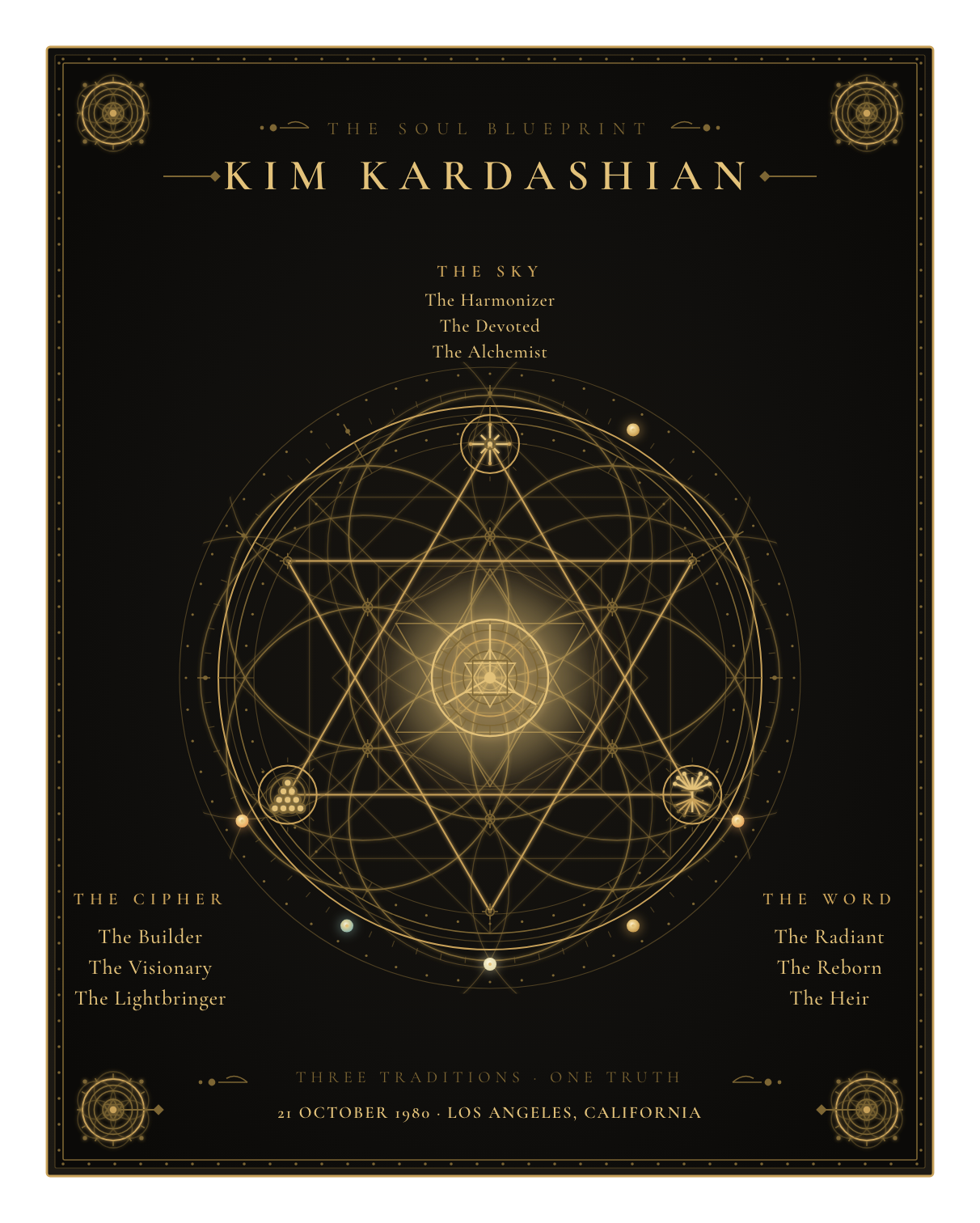
One seal, three languages. The sky she was born under at the apex, the numbers beneath her name at the lower left, the name itself at the lower right — three traditions engraved into one artifact. There is no rising sign, no houses, no angles: without a verified birth time they cannot be honestly drawn. What is true is what is shown.
At a Glance
- Full traditional name
- Kimberly Noel Kardashian
- Born
- October 21, 1980 · Los Angeles
- Sun
- Libra 28.5° — the essential fire of the life
- Rising
- Birth time unverified — the Ascendant is offered conditionally, never asserted
- Moon
- Date-dependent across the unverified birth day — not fixed without a confirmed time
- Mind · Value · Will
- Mercury Scorpio · Venus Virgo · Mars Sagittarius
- Discipline · Direction
- Saturn Libra · North Node Leo
- Life Path
- 4 — The Builder
- Title-name Destiny
- 11 — The Illuminator
- Birth-name Destiny
- 11 — The Illuminator
- Master Numbers
- 11
- Soul archetype
- The Illuminator who lives the Builder’s path
In October 2007, in a room somewhere in Los Angeles where the light came through glass and the machinery of celebrity was already turning—where a young woman sat before cameras that had begun to follow her as a stylist, as a presence, as something the culture wanted to name—the threshold opened. Not gently. A sex tape, made four years prior in another life, became public. A settlement of five million dollars. And then, almost immediately, a family decision: go into the light rather than hide from it. Appear on television. Build something from the wreckage. The fragments the world would call her—famous for being famous, a promoter of materialism, a mirror held up to the culture’s appetite for image—these are the river’s foam, the surface chatter where light breaks into foam and calls itself the current. But beneath the foam runs the source: a soul that arrived carrying a specific and penetrating architecture, born into a moment when the old rules of visibility were collapsing, carrying gifts that would only be legible once the inheritance was understood. This reading reads the source beneath the foam. It reads the blueprint—the soul’s actual blueprint—not the caricature the world assembles from headlines and hot takes. It reads what came to live through a name, through the numbers attached to that name, through the precise machinery of a birth moment in Los Angeles on a October afternoon in 1980. The soul underneath has never been what the fragments suggested. And it is time to know her.
The reading moves through the eight chapters of the Soul Blueprint architecture — The Arrival, The Soul’s Inheritance, The Living of It, The Soul’s Calling, The Soul’s Territories, The Name You Carry, The Moment, and The Invitation — and at the end, the same instrument turns gently toward you.
Her soul has a blueprint.
So do you.
The same three languages — the sky, the numbers, the name — are waiting in your own.
The Arrival
She arrived carrying a paradox that would take a lifetime to live into: the self that comes alive through relationship, yet only by meeting the other fully, taking its place as a conscious and individual part of something larger—not absorbed, not dissolved, but distinct within the greater whole. The self found by merging into situations, by showing up completely, by reconciling Leo’s urgent need to be seen with Virgo’s careful, self-critical discernment—and that reconciliation happening through a committed act of self-offering. This is not the paradox of someone famous for visibility alone. This is the paradox of someone whose identity literally activates in the presence of another: in relationship, in collaboration, in the willingness to be in partnership with forces larger than herself. She came bearing also a mind that moves beneath surfaces, penetrating into what is hidden and unspoken—a voice that will not be deflected by pretense, that names the truth others avoid, that sees through to the real motive underneath the gesture. And layered beneath all of this is the architecture of a builder—someone who arrives carrying not dreams but structures, systems, the capacity to manifest the invisible into the material world through disciplined, repetitive, unglamorous work. Three entirely different energies woven into one: the relational self, the penetrating mind, the persistent builder. She did not arrive to be famous. She arrived to build something visible through relationship, to say what others would not say, and to do it brick by brick.
The Soul’s Inheritance
She was born into a family ecosystem that was itself a teaching about visibility and the management of public persona. Her father was a lawyer who represented a figure of mythic proportions in American scandal—O.J. Simpson, her godfather, whose trial in 1994 was a national crucible when she was thirteen years old, when the machinery of celebrity-making was just beginning its tectonic shift. Her mother was not simply a presence but an architect—a businesswoman and television personality, someone who understood the grammar of how to position a family in public space. She had siblings: older, younger, the particular ordinariness of being part of a unit that would eventually be fractured and recombined through her stepparent’s own very public transformation. She was raised in Los Angeles, in a Roman Catholic all-girls school, in an Armenian-American family where the name itself carried a lineage, a diaspora, a particularity. In her teenage years she moved through proximity to Paris Hilton, to Nicole Richie—figures who were themselves navigating the early machinery of reality television fame. She worked, beginning at nineteen, in clothing stores and as a stylist, learning the grammar of beauty and presentation not as theory but as labor. By 2003 she was styling an R&B singer. By 2006 she was in the room with Paris Hilton as The Simple Life filmed. This was not a family that feared the camera. This was a family that understood, intuitively, that the boundary between private and public was already dissolving. She inherited not wealth primarily but instruction—how to turn visibility into architecture, how to manage persona as a kind of sacred work.
The Living of It
In February 2007 the wound arrived visibly, concretely, leaking onto the internet—a sex tape, private moments made public without consent, transformed into property, into scandal, into the mechanism by which a young woman could be simultaneously destroyed and launched. She was twenty-six years old. The choice that followed was not to hide or retreat but to move toward the light, to appear on television with her family, to transform the wound into the foundation of an empire. This cost something. It cost privacy permanently. It cost the ordinary right to failure, to learning in obscurity, to mistakes that do not become material for commentary. It cost the possibility of being unknown. But what became qualified through that cost was the specific authority of someone who had lived through violation and chosen visibility anyway—not as a victim, but as a builder. She began to understand, perhaps, that the self that activates in relationship could be scaled: that if she could meet the camera, she could meet the culture. If she could be present in that meeting without apology, something could be built there. She married young—at nineteen, to a music producer, the marriage dissolving quietly. She dated an NFL player, the relationship public and scrutinized. She married again, a basketball player, seventy-two days of marriage that became a cultural joke, a wound administered in real-time by commentary. She lived through relationships that were not her own choices, in the sense that they belonged to the public the moment they began. And each one taught her something about the cost of visibility, about what it meant to show up repeatedly, to be met with judgment and to continue anyway. The wound did not close. But it became a place where she learned to build.
If this is what was true for her, what might be true for you?
The Soul’s Calling
She came to demonstrate that the voice beneath surfaces—the penetrating mind that will name what others avoid—has a specific and necessary function in the culture. She was asked to speak about what the machinery of beauty had done to her body, to women’s bodies, to the standard by which a woman’s worth is calculated. She was asked to build not ornaments but structures—not fashion statements but systems that would serve the body as it actually is, the skin as it actually lives. She came to show that the builder’s work is not separate from the relational work: that you build for the other, that the act of building is an act of meeting, that saying what is true about the body—about desire, about the reshaping of form, about what it costs to be visible—is a form of service. She came to demonstrate that authority is not inherited but earned through the willingness to show up, repeatedly, in the presence of scrutiny, and to keep building anyway. She demonstrated too the specific work of the one who learns outside the conventional structure—who reads law instead of attending law school, who sits for the bar exam not because she was promised she would pass but because the work itself called to something in her. Her calling is not to be famous but to be audible—to make visible what the culture wants to keep hidden, and to do it through the patient work of building systems that serve actual bodies, actual needs, not the fantasy of what bodies should be.
The Soul’s Territories
Her most-alive territories are: first, the territory of beauty as architecture, where the body is met not as an object to be decorated but as a form to be understood, served, honored through design—where shapewear becomes not an instrument of shame but a precision tool that allows the body to move as it chooses, where skincare is not a fantasy of transformation but a rigorous system of understanding what the skin actually needs and delivering it. In this territory she is not selling fantasy but permission—permission to live in the body as it is. Second, the territory of relationship as the forge of identity—the specific work of understanding that you do not become yourself alone, that the self is activated in the presence of the other, that partnership (whether with family, with collaborators, with the culture itself) is not something that happens to you but something you do, deliberately, over time. In this territory she has learned that commitment is not the loss of self but the discovery of self-through-showing-up. And third, the territory of criminal justice reform and clemency work—the place where her capacity to see beneath surfaces, to name what others avoid, to persist in the face of indifference, becomes a force for actual liberation. She moved into this territory not as a public relations gesture but as a calling that required her to learn law, to sit with people whom the culture had abandoned, to use whatever visibility she carried to amplify voices the system had silenced. These territories are not separate. They are expressions of a single architecture: the soul that learns through relationship, that builds through penetrating honesty, that does not separate beauty from justice, visibility from service.
There are twelve domains in the kingdom of any life: The Mark, The Unfolding, The Unseen, The Long Return, The Inheritance, The Encounter, The Alchemy, The Living Tension, The Sight, The Body’s Knowing, The Crossing, The Calling.
The Name You Carry
The names she carries hold a particular resonance. Kimberly—traditionally a name meaning ‘from the royal forest’ or ‘woodcarver’s meadow’—speaks to a lineage rooted in craft, in the shaping of wood into form, in the clearing of space where one can see. There is precision in the woodcarver’s work, attention to the grain, an understanding that the form is not imposed but revealed through patient attention to what the material is already becoming. Noel—Christmas, the birth, the arrival of something meant to be seen and received—carries the vibration of the moment of appearance itself, the threshold where the invisible becomes visible. And Kardashian—an Armenian surname, rooted in a diaspora, in the specific inheritance of a culture that survives through the transmission of particularity across displacement—speaks to a family that understands that identity is not erased but carried forward through intentional continuance, through the refusal to disappear, through the insistence on being seen. The full name holds within it the pattern: the clarity of the woodcarver, the arrival-moment, the refusal to be erased. These names do not whisper. They announce. They declare that the soul bearing them came to make something visible, to craft it carefully, to arrive as an act of presence itself. The culture has used her first name alone so often that it has flattened into a brand. But the full name, carried as a lineage, speaks something else entirely: the one who carves meaning from the forest, who announces herself as an arrival, who refuses the erasure that befalls so many women in public space.
The Moment
In October 2014, a photograph appeared on the cover of Paper magazine—a single image that condensed years of presence into a moment, that made the invisible visible, that shifted something in the culture’s understanding of what visibility could do. The image was of her, photographed by Jean-Paul Goude, and the caption read: ‘Break the Internet.’ It was not arrogance. It was precision. It was the statement of someone who understood, in her body, what the mechanics of image had become in the age of shared screens—that a single photograph, distributed at the right moment, through the right channels, could rupture the surface and make people stop and look. And they looked. The image generated a cascade of response, of commentary, of fractured conversation about the body, about visibility, about what it meant to be seen at that scale. But the defining moment was not that single issue. The defining moment was the season it revealed: that she had moved from being someone about whom things happened, to someone who could make things happen through her own intentional presence. The wound of 2007 had not healed, but it had been alchemized into authority. She understood that the camera, once you have been seen through it without consent, becomes either an instrument of continued violation or an instrument of agency—that you could either hide from it or command it. She chose command. She learned how to move in front of the camera in such a way that her presence itself became the architecture—not what she wore, not what was done to her body, but the way she inhabited her own visibility that shifted how visibility itself was understood. In that moment, and in the seasons that followed, she demonstrated that the self activated in relationship could be scaled infinitely: that meeting the other—whether the other is a photographer, a culture, a system—could be done with such precision, such presence, that it became a form of power that belonged entirely to her.
The Invitation
Everything in this reading has been moving toward a single point. The doubleness named in the first chapter, the inheritance, the wound, the calling, the territory, the name, the moment. These are not seven separate truths about Kim Kardashian. They are one truth, named from seven different angles. And they all converge here.
The question asked of this soul is specific and relentless: Can you build something real from the machinery of visibility itself? Not despite the machinery, not outside it, but through it—taking the very apparatus that could have destroyed her and transforming it into infrastructure that serves actual bodies, actual needs, actual change. This is what has been asked of her since 2007, when the wound became public and the choice became visible: Will you keep building? Will you scale your presence not as narcissism but as service? Will you use the authority that violation granted you, paradoxically, to protect others from violation? And she has answered yes, repeatedly, through the patient work of building. In 2009 the fragrance launched—not revolutionary, but it was the first product bearing her name that she controlled entirely. In 2017, KKW Beauty arrived: a company that became valued at over one billion dollars, built on the premise that beauty products should be precise, that the person using them should know exactly what they were putting on their skin, that the relationship between maker and user should be transparent. In 2019, the Kimono shapewear line was rebranded to Skims after cultural appropriation backlash—and rather than defend the original name, she listened, she shifted, she demonstrated that the builder can adjust the blueprint when the blueprint is causing harm. Skims became valued at over four billion dollars by 2023, and its reach is architectural: millions of bodies moving through their days in garments designed with the specificity of someone who understands, in her own flesh, what it means to want to feel held and present in your own form. In 2022, SKKN by Kim arrived—skincare built on the premise that the skin is not a surface to be conquered but a system to be understood and served with precision. In 2019, she began studying for the bar exam by reading law instead of attending law school—not because she wanted to be a lawyer, but because the work of criminal justice reform required her to understand the system deeply enough to move through it with authority. She sat for the ‘baby bar’ exam four times before passing in December 2021. She continued the work. In 2025, she completed her law reader program. These are not the actions of someone famous for being famous. These are the actions of someone who has taken the wound, the visibility, the scrutiny, and alchemized it into structures that serve. What was being released through all of this was the fantasy of privacy, the possibility of ordinary failure, the right to be unknown. What was being called toward was the specific authority that comes only through showing up repeatedly in public, being met with judgment, being wounded by commentary, and continuing the work anyway. What became available because she said yes to the question was the capacity to scale her presence—not as a multiplication of ego, but as the multiplication of her service. She moved from being someone about whom things happened to someone through whom things are built. And what is being asked of her now, in the present continuous, is even more specific: Can you keep building even as the machinery shifts around you? Can you maintain precision as the scale grows impossible? Can you stay in relationship with the other—with the body, with the consumer, with the system—even as that relationship becomes more complex, more mediated, more fractured? She is answering yes. The work continues. The structures are being refined. The voice beneath the surface keeps speaking.
She was not late. She was exactly where the soul-clock said she should be. The mission had been inscribed at the threshold of her first breath. What was being asked of her, she has been walking. The naming has been done.
This Is Not Coincidence
The astrology speaks: a soul whose self comes alive through relationship, meeting the other fully, taking its individual place as a conscious part of something larger—and Saturn exalted in the same sign speaks to the discipline of genuine commitment, the mastery earned through showing up for relationship over time, binding oneself honorably to something beyond yourself. The numerology speaks independently: an Illuminator (the master number 11 preserved in both name and birth), whose gift is to make visible what is hidden, to serve as a mirror and a beacon, and beneath it a Builder (Life Path 4) whose sacred work is to create lasting structures that serve the actual world. The names speak: Kimberly the woodcarver’s meadow, Noel the arrival-moment, Kardashian the diaspora refusing erasure—three entirely different languages, speaking through etymology and family inheritance the same truth that the birth chart and the numerology point toward. One truth: the soul who builds visibility into service, who meets the other completely and turns that meeting into architecture, who refuses to be erased and uses that refusal as permission for others to be seen.
Three entirely different languages. One truth.
This is not coincidence. This is what three independent systems do when they are all telling the truth about the same soul.
The Numbers, Decoded
The numbers are computed, not intuited — each letter takes its Pythagorean value, each name reduces, and any Master Number is preserved rather than collapsed.
You have sat with the chart and the numbers and the name of another soul, and watched how a wound becomes a calling, how the place of least belonging becomes the place of greatest gift, how a life too precisely configured to be coincidence reveals itself when three independent languages are read together.
The reading you have just received was, in its outer form, a reading of her soul. But its inner form was a reading written for yours. You did not arrive without a Blueprint either. May this reading be the beginning of the reading you finally receive of yourself. May the light you carry — in whatever particular, irreplaceable form it has taken inside the specific life you were given.
Some lives carry a pattern this clear.
Yours does too.
You’ve read the shape of her soul. The same three languages — the sky, the numbers, the word — are waiting in your own name and birth date. Begin yours, free, below.
Or, when you’re ready, begin your own full Soul Blueprint reading →
Frequently Asked Questions
What is Kim Kardashian’s birth chart?
Kim Kardashian was born on October 21, 1980 in Los Angeles with the Sun in Libra—the self that comes alive through relationship and the meeting of the other. The birth time is unverified, which means the rising sign cannot be accurately determined. Her Mercury is in Scorpio (a penetrating, investigative mind that moves beneath surfaces), Venus is in Virgo (love expressed through devoted, discerning service), Mars is in Sagittarius (will driven by enthusiasm and the pursuit of far goals), and Saturn is in Libra (exalted—the discipline of genuine, honorable commitment made the soul’s great work).
What is Kim Kardashian’s numerology?
Kim Kardashian’s numerology carries three core frequencies: the Title Destiny is 11, the Illuminator (from ‘Kim Kardashian’), the Birth Destiny is 11, the Illuminator (from ‘Kimberly Noel Kardashian’), and the Life Path is 4, the Builder (from October 21, 1980). The 11 is a master number and is preserved rather than reduced to 2—it speaks to making visible what is hidden, to serving as a beacon and mirror for the culture. The 4 anchors this visibility in structures, in the patient, unglamorous work of building something that lasts and serves the material world.
What does the name Kim Kardashian mean?
Kimberly traditionally means ‘from the royal forest’ or ‘woodcarver’s meadow’—speaking to craft, to the precision of shaping form from raw material, to the clearing of space where one can see. Noel carries the vibration of Christmas, of arrival and manifestation, of the moment when the invisible becomes visible. Kardashian is an Armenian surname rooted in a diaspora, speaking to a family that understands that identity is carried forward through intentional continuance, through the refusal to be erased. Together, the full name speaks to someone called to make something visible through careful craft, arriving as an act of presence itself.
What is a Soul Blueprint?
A Soul Blueprint integrates three independent traditions — Western natal astrology, Pythagorean numerology, and the etymology of the full birth name — into a single document written as a personal letter to the soul. When you’re ready, you can begin your own.
This reading was prepared in the lineage and methodology of the Soul Blueprint Method — Pythagorean numerology with master numbers preserved, Western archetypal astrology, and a researched etymological reading of the full name. Kim Kardashian’s birth date (October 21, 1980) is sourced from the public record; the birth time is unverified, so the rising sign is offered conditionally and never asserted.
A Soul Blueprint reading · Astrology · Numerology · Etymology · shams-tabriz.com