
L. Ron Hubbard’s Birth Chart, Numerology, and Name Decoded
L. Ron Hubbard’s Birth Chart,
Numerology & Name Decoded
The Soul Blueprint Method — three traditions woven into one personal letter: Western natal astrology, Pythagorean numerology, and the etymology of the soul’s name. Learn the method →
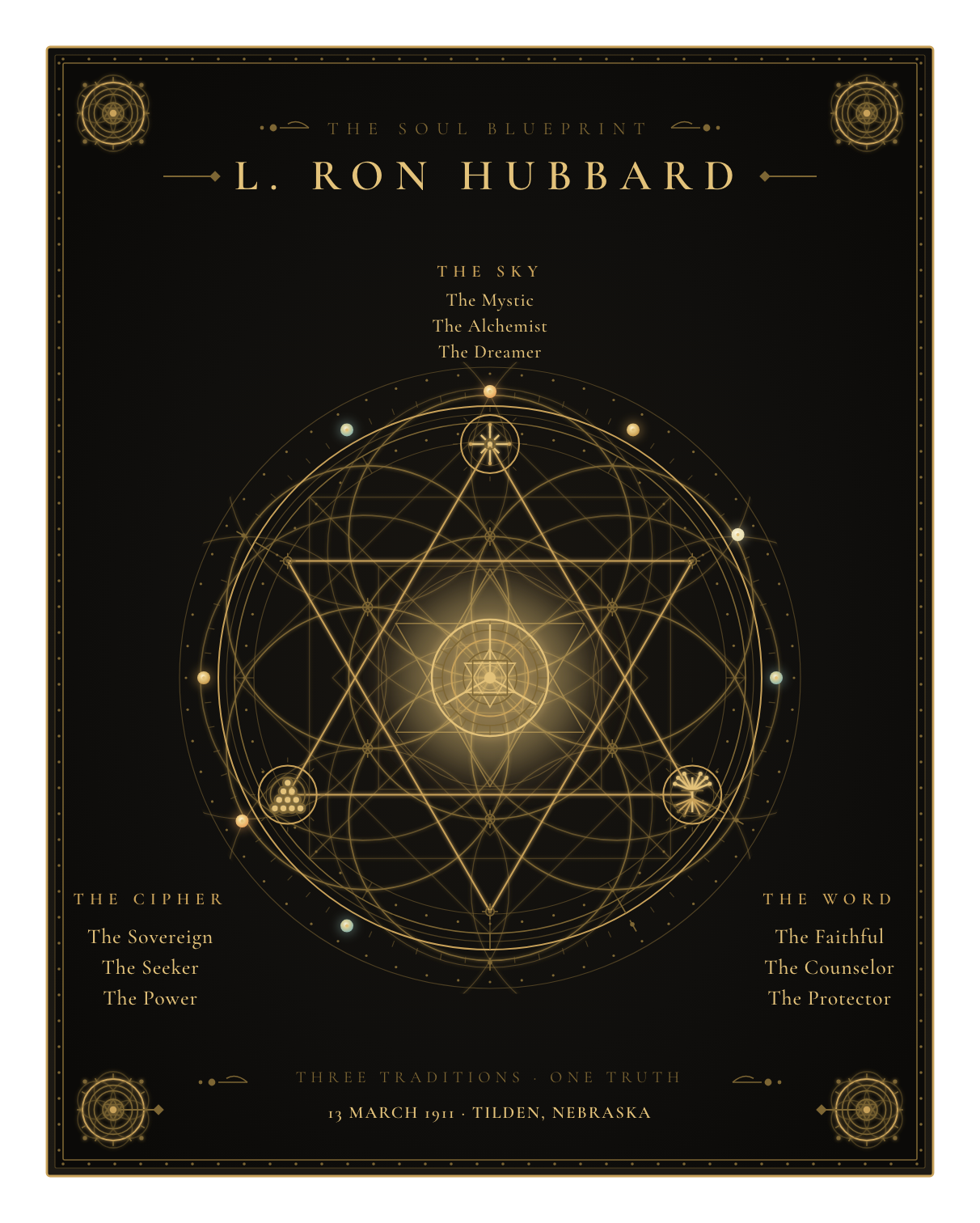
One seal, three languages. The sky he was born under at the apex, the numbers beneath his name at the lower left, the name itself at the lower right — three traditions engraved into one artifact. There is no rising sign, no houses, no angles: without a verified birth time they cannot be honestly drawn. What is true is what is shown.
At a Glance
- Full traditional name
- L. Ron Hubbard
- Born
- March 13, 1911 · Tilden
- Sun
- Pisces 22.0° — the essential fire of the life
- Rising
- Birth time unverified — the Ascendant is offered conditionally, never asserted
- Moon
- Date-dependent across the unverified birth day — not fixed without a confirmed time
- Mind · Value · Will
- Mercury Pisces · Venus Aries · Mars Capricorn
- Discipline · Direction
- Saturn Taurus · North Node Taurus
- Life Path
- 1 — The Pioneer
- Title-name Destiny
- 7 — The Seeker
- Birth-name Destiny
- 7 — The Seeker
- Master Numbers
- None preserved at the final layer
- Soul archetype
- The Seeker who lives the Pioneer’s path
It is the spring of 1959, and the man stands in the English countryside before Saint Hill Manor—an eighteenth-century house that once belonged to the Maharaja of Jaipur, now his, now the seat of something he has willed into being. The light is gray and patient. He has survived the collapse of Dianetics, the bankruptcy, the accusation, the turning-away of allies. He has moved from America to England, acquired this manor, begun to build again—not with the trembling uncertainty of a man starting over, but with the focused, methodical ambition of someone who has already learned the price of failure and now calculates exactly what it will cost to not fail again. The world will name him founder, fraud, visionary, criminal—the world names what it sees moving on the surface, the fragments of a life that leave wreckage or testimony depending on the eye. But beneath the named things, beneath the career that split into science and scripture and secret doctrine, beneath the declarations and the denials and the systematic silencing of those who questioned him, there moves a source—a coherent pattern of need and refusal, of brilliance and appetite, of the self’s oldest hunger for mastery dressed in the language of salvation. This reading descends not to the surface where the names live, but to the source underneath, to the architecture of the soul itself—the blueprint that shaped both the reaching and the ruin.
The reading moves through the eight chapters of the Soul Blueprint architecture — The Arrival, The Soul’s Inheritance, The Living of It, The Soul’s Calling, The Soul’s Territories, The Name You Carry, The Moment, and The Invitation — and at the end, the same instrument turns gently toward you.
The Arrival
A soul arrived carrying the paradox of the surrendered will—the self that comes alive only when dissolved into something larger, yoked to a purpose beyond the small self’s survival, yet arrived also burning with the strategist’s fire, the ambition to build lasting structures through disciplined, patient force. The man who would emerge carried within him the Piscean gift of boundless empathy and imaginative intuition, the capacity to perceive what others could not see, to hear what moved beneath surface speech—and the Piscean’s oldest vulnerability, the permeability that dissolves boundaries and leaves no clear line between the self’s own hunger and the hunger to serve, to merge, to make what is shapeless into form. Paired with this came the warrior’s will channeled through stone and time—the ability to endure, to strategize, to grip a goal and hold it across decades with the patience of a general, the vision of a master-builder. The paradox lived at the heart: a soul simultaneously called to surrender and called to dominate, to dissolve boundaries and to build empires, to serve something redemptive and to grasp control absolutely. That tension—between the self that would merge with the whole and the self that would master it—became the entire architecture of what he built and what he broke. The gift was real: the imagination, the reach, the hunger to heal. The refusal was equally real: the capacity to imagine that his own hunger and the Source’s demand were one and the same.
The Soul’s Inheritance
He was born into the Navy—his father a low-ranking officer, the family moving through the ordered life of military stations, the implicit lesson that loyalty and hierarchy were the substance of worth. His mother came from a line of practical people: his grandfather a veterinarian, his mother herself trained as a teacher, people who earned their standing through service and skilled work, people for whom value was not inherited but built with the hands and the mind, day by day. The era into which he arrived was the early twentieth century in America—the age of invention, of expansion westward (though his birth came late to that myth), of the rising American century when anything seemed possible to those with the appetite to seize it. He came of age in the Depression, into a world where security had been revealed as an illusion, where the solid ground his family occupied could shift without warning. His grandfather was not wealthy—the family mythology would later claim otherwise, but the record shows a veterinarian, a man who knew animals and their ailments, not a Western cattleman of legend. The correction matters: it reveals something about the soul’s earliest hunger, the way a child born without grand inheritance begins to author one, to imaginatively remake the family story into something more capacious, more heroic. He grew up in the shadow of what his parents had built and held—modest, earned, secure through competence—and something in him rejected the sufficiency of modesty. Something needed to expand beyond the careful boundaries of inherited prudence into territories larger, more absolute, more visible.
The Living of It
The life was lived as a series of incomplete claims and partial collapses, each one followed by the ingenious construction of a new mythology to explain it. He enrolled at George Washington University to study engineering, but dropped out after two years—not because the discipline was beyond him, but because something in the structured path felt like a cage, and he was already learning that the world would accept his story more readily than it would interrogate his credentials. From 1934 onward, he became prolific as a pulp fiction writer—hundreds of stories, adventure and aviation and westerns and science fiction pouring from him, the imaginative gift real and demonstrable, the income real, the recognition real. But even this was not enough to hold him, because the fiction writer was always a secondary version of what he believed himself capable of. In 1941, he entered the Navy as a lieutenant junior grade—the military life he was born into, but now as an officer, a commander. The record shows he was relieved of command twice: once because he was not temperamentally suited to independent command, and once after he mistook a magnetic deposit for an enemy submarine and engaged in imaginary combat for sixty-eight hours, firing even on Mexican territory. These were not small failures—they were humiliations in the arena where he most needed to prove his worth. The pattern was forming: the brilliant imagination that could not stay within the constraints of verifiable reality, the hunger to command that exceeded his capacity to be commanded, the story always larger than the life. After discharge, he moved into the mansion of a rocket scientist, became entangled in occult sex magic rituals, married a woman he was not yet divorced from marrying. The cost accumulated silently at first—the marriages, the children, the people who found themselves bound to him without clear boundaries between his salvation and his hunger.
Every soul arrives with a blueprint. What a life does with it is the whole of the reckoning.
The Soul’s Calling
He came to teach the soul how to be remade—to show that consciousness itself was malleable, that the self trapped in suffering and limitation could be dissolved and reconstructed into something perfected and whole. The gift was the imaginative, associative mind that moves by symbol and resonance rather than linear argument—thought that arrives as image and feeling, communication that works through the poetic and the metaphorical, Hermes as dreamer and psychic translator. The voice he developed was evocative, picture-filled, moving by tone and suggestion more than rational proof—the voice of someone who had learned that what people hunger for is not truth as fact but truth as narrative, not evidence but the shape of salvation told in language that moves the body and stirs recognition. What he came to demonstrate was both the gift and its shadow: that consciousness could be restructured through technology (the instrument he called an e-meter, measuring electrical conductivity), that past lives could be regressed and integrated, that the soul could be freed from its entanglements and made new. But the calling that arrived as liberation carried within it the seed of control—the architect of salvation must be the one to decide what freedom looks like, who is free, what the reconstructed soul should believe.
The Soul’s Territories
The first territory that came alive was the territory of the imagination—the realm where he was genuinely alive and generative, where hundreds of stories poured from him, adventure and science fiction and the strange dreamscapes of the mind. In that space, he was not constrained by the record or the verifiable; he was freed to invent, to reach beyond the known into the possible, to create worlds where the rules bent to his vision. The second was the territory of strategic ambition—the patient, methodical will to build structures that would last, to acquire property and power and the machinery of influence, to move with the focused discipline of a general who sees the board decades ahead and places each piece with calculated precision. This territory held the real gifts of patience and vision, but also the refusal to be stopped by law or ethics or the reasonable objections of others. The third was the territory of the occult and the transcendent—the hunger to access what lay beyond the material world, to contact forces and intelligences not bound by ordinary law, to participate in magic rituals that promised transformation and power. He moved between these territories as though they were separate kingdoms, but beneath them ran a single current: the hunger to remake reality itself, to show that what the world accepted as solid and unchangeable was in fact plastic, malleable, subject to the will of one who understood the hidden mechanism. This hunger toward the mystical and the strategic, the imaginative and the controlling, began to cohere into something he would name Scientology—a system that promised to do what all three territories whispered: remake the soul, remake the world, and place the one who holds the technology at the center of that remade cosmos.
There are twelve domains in the kingdom of any life: The Mark, The Unfolding, The Unseen, The Long Return, The Inheritance, The Encounter, The Alchemy, The Living Tension, The Sight, The Body’s Knowing, The Crossing, The Calling.
The Name You Carry
The name arrives with its own weight and historical resonance. Lafayette carries within it the echo of the French general who believed in the possibility of transformation, the revolutionary who imagined that the world could be remade according to a vision of freedom—a name that whispers of ambition beyond the given, of the refusal to accept the boundaries one was born into. Ronald emerges from Germanic roots suggesting counsel and rule, the advisor who becomes sovereign, the voice that shapes what others believe to be true. Together they form a calling toward influence and reinvention, toward the one who would counsel and command, who would take what was broken and remake it according to a vision. Hubbard itself—the surname—carries the sense of shelter and accumulation, the one who tends the hub around which others gather, the center around which life collects. But there is something else woven into this name that the surface does not immediately reveal: it speaks of grounding, of the earth, of what endures through time because it is built on the real. The full name held a contradiction that the life would spend itself trying to resolve: the demand to be visionary and transformed, paired with the demand to be solid and grounded, to be real. The names whispered a singular question to the soul: Can you be both the dreamer and the one who builds what the dream requires? Can you hold the boundless imagination and the strategic discipline in one hand? The answer he gave was to merge them—to tell the story that his visions were not imagination but discovery, that his authority came not from his will but from access to truths others could not see. The names would become the permission structure for that merger.
The Moment
The moment arrived on May 9, 1950, when the book called Dianetics was released into the American imagination, and the response was immediate and overwhelming—a nationwide hunger, a cult of extraordinary proportions forming almost before the ink dried. For one blazing moment, the pattern seemed to be solving itself: the imagination had found a form that the world accepted as true; the hunger to heal and to control had found a technology that made both possible; the strategic ambition and the visionary gift had merged into something the masses wanted desperately to believe. But three months later, on August 10, 1950, at the Shrine Auditorium in Los Angeles before an audience of six thousand, the moment inverted: a woman he claimed had achieved perfect recall under Dianetic therapy could not remember the color of his necktie. The failure was small in detail but catastrophic in what it revealed—that the system did not work as promised, that the claims could not be verified, that the technology was not what had been claimed. The disillusionment was swift and total; the believers withdrew; the structure collapsed almost as quickly as it had risen. In that moment, the soul faced a threshold: to admit the limitation, to revise the system, to ground it in what was actually possible rather than what had been promised. What happened instead was the refusal—the choice to build a new mythology that would explain the failure as not a failure of the system but a failure of the world to understand it, a conspiracy of enemies determined to suppress what could not be controlled. From that point forward, the energy that had been devoted to healing was increasingly devoted to explaining, defending, attacking those who questioned, creating the machinery to silence dissent. The moment was the pivot on which everything turned—the instant when the soul was offered the choice between integration and entrenchment, and chose entrenchment.
The Invitation
Everything in this reading has been moving toward a single point. The doubleness named in the first chapter, the inheritance, the wound, the calling, the territory, the name, the moment. These are not seven separate truths about L. Ron Hubbard. They are one truth, named from seven different angles. And they all converge here.
What was being asked of this soul was the integration of the paradox it arrived carrying: to learn that the gift of boundless empathy and imaginative vision could coexist with the capacity to listen, to admit error, to honor the boundaries of others and the limits of one’s own knowing. The soul was being called to demonstrate that the will to build lasting structures could be yoked to something larger than personal dominion—that the discipline and patience of the general could serve a purpose other than the expansion of the general’s own kingdom. The soul was being invited to show that the hunger to remake the world could be subordinated to the hunger to see the world as it actually is, that control could be released in service of something truer than the controller’s vision. What was being released was the need to be the Source itself—the necessity of understanding that the imagination, however brilliant, is not the same as truth; that the story one tells about oneself is not the same as what one has actually become; that the masses who wish to believe are not the same as the Source one claims to serve. What was being called toward was a different kind of mastery: not the mastery of control but the mastery of acceptance, not the architecture of domination but the architecture of genuine security built on earned ground. The Yes to this invitation would have meant the slow, patient work of building a system that could be questioned, that could admit error and change, that could honor the autonomy of those who participated in it. It would have meant measuring the distance between what was claimed and what was true, and choosing truth. It would have meant accepting that the Piscean gift of boundless empathy and imaginative resonance is most powerful not when it serves the controller’s vision but when it genuinely serves the soul of the other, without agenda. What became available because this Yes was refused was instead the full machinery of the refusal: the capacity to build an organization that could enforce belief, that could isolate members from outside contact, that could audit and confess and control the inner life of those who surrendered to it. The Fair Game policy was codified in 1967—the legal authorization to harass, to destroy, to deprive of property anyone deemed an enemy of the system. The Snow White Program was initiated in 1973, directing operatives to infiltrate government offices and steal files, a vast criminal enterprise launched to protect the organization from scrutiny. Operation Freakout was conceived to destroy a psychiatrist deemed a threat, using psychological tactics intended to drive him to suicide. The Sea Org was established in 1968, a private navy operated from international waters, a floating kingdom where the controller could maintain absolute dominion over those bound to it, beyond the reach of any law but his own. The system that promised liberation became increasingly a system of entrapment—members were isolated from families who questioned, subjected to endless auditing sessions that extracted confession and created leverage, required to sign billion-year contracts binding them to service to the organization. Children born into the system were separated from parents deemed unfit, raised in dormitories, educated minimally so that departure would seem impossible. The soul that had arrived carrying the gift of dissolving boundaries learned instead to weaponize that gift, to dissolve the boundaries between members and the organization, between the individual conscience and the doctrine, between love of the system and love of the self. The very capacity for imaginative resonance that could have healed became the instrument of a different kind of dissolution—not the mystical surrender to something larger than the self, but the psychological dissolution of the self into the will of the controller. What was written during these decades was not just the organization’s machinery but its mythology: the story of Xenu and the cosmic disaster seventy-five million years ago, the claims of past-life regressions and spiritual advancement through secret levels and the purchase of auditing sessions that promised transcendence but delivered instead the deepening of dependence. The son who could not reconcile what he was witnessing eventually left, and the father’s response was not to examine what had caused the departure but to treat it as apostasy and attack. The daughter kidnapped in 1951 in the midst of an attempted institutionalization—the desperation visible in that act, the refusal to accept that the beloved could be genuinely unwell, the choosing of the system’s narrative over the person’s actual suffering. The body itself began to show the cost: the stroke in January 1986, the dissolution, the final disappearance. To understand this is not to excuse it. Understanding is not endorsement. The architecture that produced both the reaching and the ruin is the same architecture—the will to remake, the refusal to admit limitation, the hunger to control what should not be controlled. The soul was asked to integrate the paradox. The soul chose instead to perfect the refusal.
He was not late. He was exactly where the soul-clock said he should be. The mission had been inscribed at the threshold of his first breath. What was being asked of him, he has been walking. The naming has been done.
This Is Not Coincidence
The astrology says: a self that comes alive through surrender and service, through dissolving into something redemptive and larger—yet the imagination that moves by symbol and feeling, not linear proof, paired with the will disciplined, strategic, exalted in its capacity to build through sustained force. The numerology says: a Pioneer (Life Path 1) called to blaze new territory, to initiate and lead, a Seeker (both Title and Birth Destiny 7) whose calling is to investigate the hidden, to access what others cannot see, to emerge as the one who knows the secret truth. The name says: the visionary transformed into counsel and rule, the shelter at the center where others gather, the one who would remake the world according to a vision of freedom and power. Three entirely different languages. One truth. The architecture that could have served was instead turned toward the one who built it.
Three entirely different languages. One truth.
This is not coincidence. This is what three independent systems do when they are all telling the truth about the same soul.
The Numbers, Decoded
The numbers are computed, not intuited — each letter takes its Pythagorean value, each name reduces, and any Master Number is preserved rather than collapsed.
You have sat with the chart and the numbers and the name of another soul, and watched how a wound becomes a calling, how the place of least belonging becomes the place of greatest gift, how a life too precisely configured to be coincidence reveals itself when three independent languages are read together.
The reading you have just received was, in its outer form, a reading of his soul. But its inner form was a reading written for yours. You did not arrive without a Blueprint either. May this reading be the beginning of the reading you finally receive of yourself. May the light you carry — in whatever particular, irreplaceable form it has taken inside the specific life you were given.
Some lives carry a pattern this clear.
Yours does too.
The Soul Blueprint reads any life through the same three languages — the sky, the numbers, the name.
Or, when you’re ready, begin your own full Soul Blueprint reading →
Frequently Asked Questions
What is L. Ron Hubbard’s birth chart?
L. Ron Hubbard was born with the Sun in Pisces, the sign of boundless empathy, imaginative resonance, and the self that comes alive through surrender and service to something larger. His Mercury is also in Pisces—a mind that works through image, symbol, and feeling rather than linear logic, communicating through poetry and metaphor. His Venus is in Aries, expressing affection and desire ardently and directly. His Mars is in Capricorn, exalted—a will disciplined, strategic, and built to endure, to construct lasting structures through patient force. His Saturn is in Taurus, asking the soul to build genuine security and self-earned worth. The birth time is unverified, so the rising sign cannot be fixed, though many circulated charts claim positions that are not sourced.
What is L. Ron Hubbard’s numerology?
L. Ron Hubbard’s Title Destiny (from his public name) is 7, the Seeker—the soul called to investigate hidden truths, to access what others cannot reach, to emerge as the one who knows. His Birth Destiny (from L. Ron Hubbard at birth) is also 7, reinforcing the signature. His Life Path (from the birth date, March 13, 1911) is 1, the Pioneer—the soul called to initiate, to blaze new territory, to lead and originate. The three numbers together describe a soul called both to seek what is hidden and to pioneer what is new, to be the one who discovers and the one who builds from that discovery.
What does the name L. Ron Hubbard mean?
Lafayette carries the historical echo of transformation and revolution, the refusal to accept given boundaries. Ronald emerges from Germanic roots suggesting counsel and rule, the voice that shapes belief. Together they name the one called to advise and command, to reimagine what exists. Hubbard speaks of the hub, the center around which life gathers, and of shelter and grounding—the one who tends what endures. The full name holds the tension between the visionary who transcends and the solid ground that grounds, between the dreamer and the builder. The soul received a name that asked: Can you be both transformed and transforming, boundless and grounded, the seeker and the sovereign?
What is a Soul Blueprint?
A Soul Blueprint integrates three independent traditions — Western natal astrology, Pythagorean numerology, and the etymology of the full birth name — into a single document written as a personal letter to the soul. When you’re ready, you can begin your own.
This reading was prepared in the lineage and methodology of the Soul Blueprint Method — Pythagorean numerology with master numbers preserved, Western archetypal astrology, and a researched etymological reading of the full name. L. Ron Hubbard’s birth date (March 13, 1911) is sourced from the public record; the birth time is unverified, so the rising sign is offered conditionally and never asserted.
A Soul Blueprint reading · Astrology · Numerology · Etymology · shams-tabriz.com