
Taylor Swift’s Birth Chart, Numerology, and Name Decoded
Taylor Swift’s Birth Chart,
Numerology & Name Decoded
The Soul Blueprint Method — three traditions woven into one personal letter: Western natal astrology, Pythagorean numerology, and the etymology of the soul’s name. Learn the method →
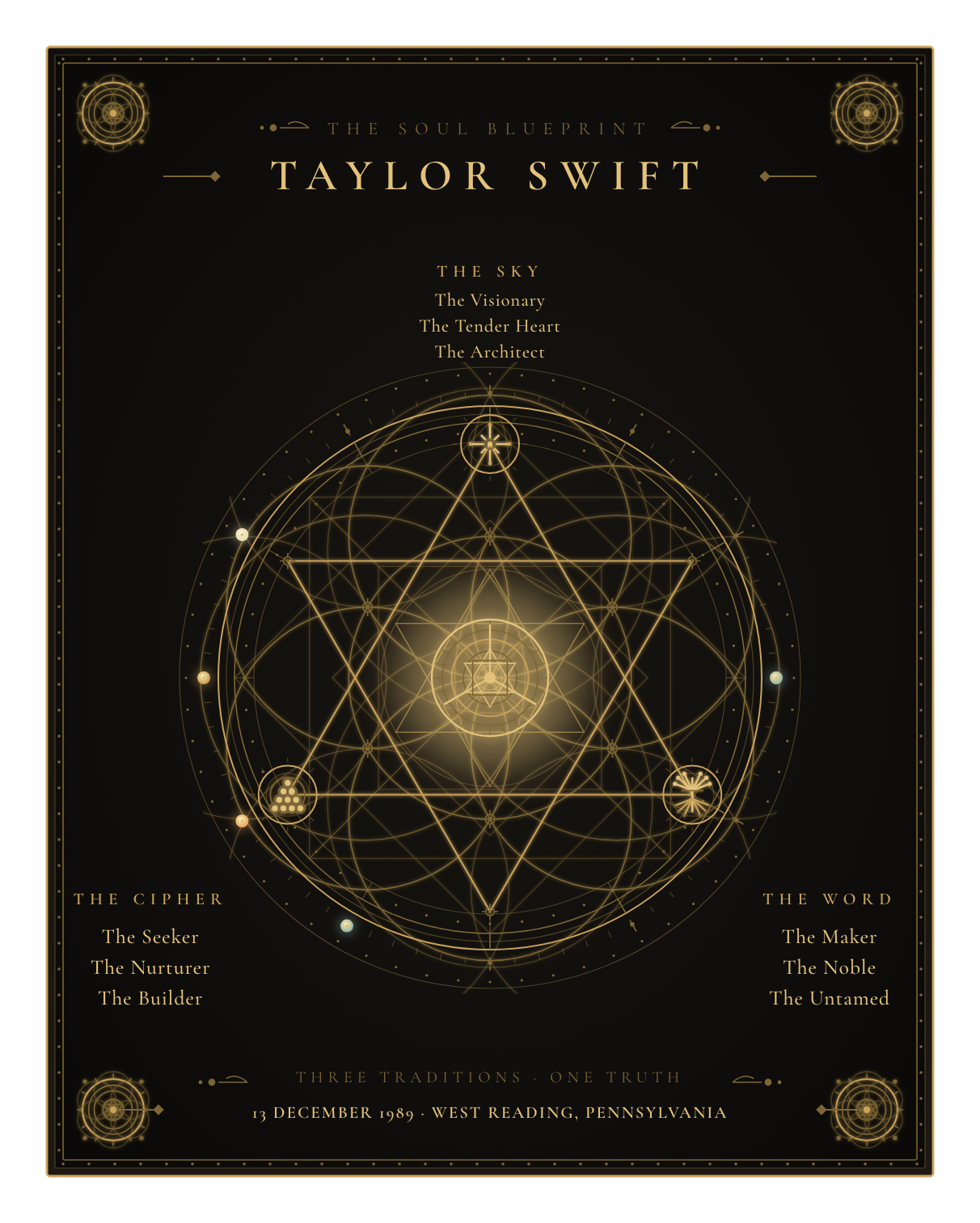
One seal, three languages. The sky she was born under at the apex, the numbers beneath her name at the lower left, the name itself at the lower right — three traditions engraved into one artifact. There is no rising sign, no houses, no angles: without a verified birth time they cannot be honestly drawn. What is true is what is shown.
At a Glance
- Full traditional name
- Taylor Alison Swift
- Born
- December 13, 1989 · West Reading, Pennsylvania, USA
- Sun
- Sagittarius 21.7° — the essential fire of the life
- Rising (unverified)
- Birth time unconfirmed; if the circulated 5:17 AM holds, the Ascendant would be Scorpio — offered conditionally, never asserted
- Moon
- Date-dependent across the unverified birth day — not fixed without a confirmed time
- Mind · Value · Will
- Mercury Capricorn · Venus Aquarius · Mars Scorpio
- Discipline · Direction
- Saturn Capricorn · North Node Aquarius
- Life Path
- 7 — The Seeker
- Title-name Destiny
- 6 — The Nurturer
- Birth-name Destiny
- 4 — The Builder
- Master Numbers
- None preserved at the final layer
- Soul archetype
- The Nurturer who lives the Seeker’s path
She was in New York City in the spring of 2014, a young woman of twenty-four years standing in the light of a threshold she had chosen to cross—the city around her glittering and indifferent, the kind of light that falls on someone who has decided to remake themselves without permission. The radio played songs she had written as a teenager, and the world knew her as a country artist, but she knew herself as something else entirely, something the country format could no longer hold. She moved through Manhattan with the clarity of someone who had already survived the public murder of innocence and emerged not smaller but more herself — the light caught her at the exact moment when the old frame was breaking and the new one not yet built.
But there is always a distance between what the world calls a person and what moves underneath that name—between the image reflected in every screen and the source from which that image continuously springs. The fragments the world knows are the songs, the albums, the scandals, the public courtesies and defiances; they are the river’s visible surface, the white water and the foam. Yet every river has a source—a spring, often hidden, from which all the motion flows. The source does not announce itself. It simply is, and everything visible originates there.
This reading reads the source. Not the river as the world sees it, but the wellspring from which a soul learned to move through the world with such deliberate velocity, such precise intention, such willingness to be transformed by the very act of choosing transformation. What arrived in this soul at birth, what she inherited before she could speak, what she was asked to become—these are the questions the source can answer.
There is a coherence underneath the apparent discontinuities of her life. The same fire that burned at twelve learning guitar burned at twenty-four moving to New York; the same will that refused to be silent at nineteen refusing to be silenced at twenty-three. This is the reading of that coherence—not the personality, but the blueprint.
The reading moves through the eight chapters of the Soul Blueprint architecture — The Arrival, The Soul’s Inheritance, The Living of It, The Soul’s Calling, The Soul’s Territories, The Name You Carry, The Moment, and The Invitation — and at the end, the same instrument turns gently toward you.
Her soul has a blueprint.
So do you.
The same three languages — the sky, the numbers, the name — are waiting in your own.
The Arrival
She arrived carrying a fire that could not sit still—the restless, forward-moving intelligence of a soul born under the Archer’s sign, the one who aims at what others cannot yet see and trusts the arc of the arrow more than the solid ground beneath her feet. But this was not the fire of someone content to be watched; it was the fire of someone who makes, who constructs, who builds what did not exist before the making. The paradox she carried from birth was this: the visionary restlessness of the Sagittarius combined with the deep structural need to build something that endures—not the temporary blaze, but the architecture that holds.
She arrived into a life that would ask her to hold both at once: the archer’s aim and the builder’s discipline, the speed of her own becoming and the slowness required to make art that lasts. The world would see her as a phenomenon, as someone moving with unusual velocity through the landscape of popular music, but the soul underneath knew itself as someone constructing—deliberately, methodically, with the precision of a master craftsperson—a body of work that would outlast the moment of its making.
This is the signature she was born carrying: the visionary who builds, the restless one who knows how to make lasting structures from the raw material of her own lived experience. Not the temporary, but the monumental. Not the quick flash, but the slow accumulation that becomes undeniable.
The Soul’s Inheritance
She was born into a lineage of people who understood two languages: the language of markets and the language of beauty, though they did not always speak both aloud. Her father was a man who moved capital for a living—a stockbroker for a major firm, someone trained in the mathematics of worth and value, the calculations that determine what things cost. Her mother was a woman who understood how to make those same calculations visible to others—a marketing executive for mutual funds, fluent in the art of persuasion, of making the invisible attractive. They were not artists themselves, but they were people who understood how systems worked, how to move within them, how to influence their operation.
Yet there was another lineage running through the family like a hidden current. Her grandmother on her mother’s side was an opera singer—not a dilettante, not a Sunday voice, but a trained artist whose voice was built to fill large spaces and make them ring. The operatic tradition carries with it a particular inheritance: discipline married to expansiveness, the voice as an instrument that requires both restraint and release, the understanding that beauty requires relentless technical foundation. This grandmother’s blood carried the memory of that dual requirement.
She was born in Pennsylvania into the 1980s, when the country music tradition was still a powerful cultural force, though her family was not from that world. When she was fourteen years old, her father transferred his work to Nashville—not because the family had country roots, but because the daughter had shown a calling that the parents recognized and chose to support structurally. This is what her inheritance truly was: parents who understood both the mathematics of ambition and the necessity of nurture, a grandmother’s voice that had learned discipline, and a historical moment when a young woman could still write her own songs and sing them into the world without first being remade by others. The blueprint was already there in the blood.
The Living of It
She was eleven years old when she first traveled to Nashville to submit demo tapes of songs she had learned from other singers—covers, the traditional way a young voice teaches itself through imitation. The record labels rejected her. Every single one. She was a child with a vision and no one to confirm it, a builder with blueprints that the world did not yet recognize as valuable. The wound here was the wound of invisibility despite clarity—knowing what you are meant to do and having the world refuse to see it.
But she did not wait for permission. By twelve she had taught herself guitar with the help of a local musician—not a famous instructor, just a person who knew how to help a determined young girl translate her inner music into the language of chords and fingerings. By fourteen she had signed a publishing contract with a major music company, becoming the youngest person in that company’s history. She was learning the lesson that the blueprint required: survival requires becoming fluent in the systems that gatekeep your own voice. She learned music publishing, contract law, the architecture of the recording industry, not as an academic exercise but as the practical necessity of her own liberation.
She made the choice to leave a development deal with a major label because the deal would not allow her to release music immediately—because waiting felt like dying, and the songs she had written as a teenager were the only authentic thing she possessed. When she signed with another label, she made the condition explicit: she would own the songwriting, she would write or co-write every song she released. This was not arrogance. This was survival. She had lived long enough to know that songs written by committee committees serve committee purposes. She needed to keep her own voice.
If this is what was true for her, what might be true for you?
The Soul’s Calling
The calling that arrived in her was not the calling to be famous—though fame would arrive inevitably—but the calling to speak into the record what was true. To take the lived experience of being a young woman in a particular time and translate it into words and melodies that other young women could recognize as their own lives. To refuse the prettification, the smoothing, the removal of difficulty that the industry typically demanded. To insist that her voice—her literal voice and her artistic voice—remain hers.
This was her Life Path, the trajectory toward which her soul was always moving: the seeking of truth, the willingness to go all the way down into the darkness of one’s own experience and bring back what was found there. The voice she carried was not a beautiful voice simply—it was a precise voice, shaped by a mind trained in Capricornian exactitude, capable of architectural rigor. She learned to write with the precision of a builder; every word was load-bearing. Every melodic choice had to earn its place in the structure.
She was called to demonstrate that a woman could control her own narrative—not accept the narrative that industry offered, not perform the femininity that was expected, but write the story from inside and insist that the world receive it as her story, not a story told about her. This became her signature contribution: the proof that artistic control and commercial success were not mutually exclusive, that a woman could be both architect and inhabitant of her own work.
The Soul’s Territories
The first territory alive in her was the territory of songwriting as testimony—the act of taking emotional experience, usually the most private and inchoate kind of experience, and building it into a song structure so precise that thousands of other people could recognize their own lives in it. Not interpretation; not performance of someone else’s emotions. Direct translation from lived experience into artistic form. Every album she released was a new topography of this same territory: she entered a different season of her own life and mapped it.
The second territory was the territory of structural resistance—the willingness to fight the systems that tried to contain her or profit from her without her consent. The re-recording of her early albums, the reclamation of her master recordings, the copyright battles and the business strategy that protected her work—these were not separate from the artistry, they were artistry. They were the application of the builder’s blueprint to the problem of her own survival as an artist. She learned to fight in the language that the industry understood: contracts, ownership, master recordings, the mathematics of value.
The third territory was the territory of transformation and renewal—the willingness to change the entire apparatus of her sound, her visual presentation, her genre classification, her location, her collaborators, every few years. Not from instability, but from the Sagittarian refusal to be trapped in any single form. Each album represented a death and rebirth; each era was a new territory mapped. She was teaching the world that artistic maturity does not mean calcification, that an artist can honor what she has built while continuously refusing to be imprisoned by it.
Beneath these territories lies something deeper: the mythology of a soul who understood early that the only way to survive the world’s hunger for you is to keep giving it only what you have chosen to give, never more. She built walls not from fear but from clarity.
There are twelve domains in the kingdom of any life: The Mark, The Unfolding, The Unseen, The Long Return, The Inheritance, The Encounter, The Alchemy, The Living Tension, The Sight, The Body’s Knowing, The Crossing, The Calling.
The Name You Carry
The name Taylor carries the inheritance of a craft—it means one who tailors, who cuts cloth precisely, who understands proportion and fit, who makes something wearable from raw material. There is no accident in this. A tailor does not make cloth; she shapes it. She understands that the same piece of material can be cut a thousand different ways, and only one way will fit the particular body standing in front of her. Taylor Swift’s entire artistic practice has been an enactment of this principle: taking the raw material of experience and shaping it so precisely that it fits the bodies of the people who need to hear it. The name carries the blueprint.
The middle name Alison derives from an old root meaning noble kind, carrying the inheritance of dignity and gentleness, the sense of someone who was meant to hold something precious. Not precious in the sense of fragile or untouchable, but precious in the sense of rare, worth protecting, bearing something that matters. She was named to be both the sharp instrument of the tailor and the noble keeper of what the cutting reveals.
The surname Swift is the name of motion, of something that moves quickly, that sweeps through space with velocity. Yet swiftness without precision is mere haste. What the three names together declare is this: a precise motion, a noble cutting, a transformation that serves. The names were the first blueprint. They were not chosen by accident. They arrived carrying the instruction for what the soul would need to become.
The Moment
It began in September of 2009, when she was nineteen years old and standing on a stage at the MTV Video Music Awards, accepting an award for Best Female Video. A man—a musician with a large platform and his own grievances—interrupted her publicly, taking the microphone from her hands and speaking over her voice, telling the audience that someone else deserved the award she had just received. The moment was brief, perhaps ninety seconds, but it was also infinite. It was the moment when the protection of youth ended and the education in public warfare began.
What happened in the immediate aftermath was crucial: the world largely condemned the interruption as rude, as inappropriate. There was a brief period when the public voice sided with her. But what followed, across years, was more complicated and more instructive. The man who interrupted her became the subject of a larger cultural narrative; the woman he interrupted learned that being right did not protect you from being diminished, that public defense could turn to public blame, that the story the world told about what happened could be rewritten many times depending on who controlled the narrative.
This moment became the hinge on which her entire artistic future turned. Everything she made afterward—the albums titled Reputation, the careful and public reclamation of her master recordings, the explicit political stances, the refusal to remain silent or small—was education purchased in that ninety seconds. She learned that silence in the face of violation is not noble; it is complicity. She learned that the only way to survive being interrupted is to make sure your voice is so strong, so necessary, so structurally undeniable, that the world cannot afford to silence it. The wound became the qualification.
The Invitation
Everything in this reading has been moving toward a single point. The doubleness named in the first chapter, the inheritance, the wound, the calling, the territory, the name, the moment. These are not seven separate truths about Taylor Swift. They are one truth, named from seven different angles. And they all converge here.
What was being asked of her from the beginning was this: Can you build something that lasts in a world that prefers the temporary? Can you insist on ownership of your own work while living in an industry built on extracting ownership from artists? Can you speak the truth of your own experience in a time when women’s experience is still treated as a commodity to be managed and reshaped by others? These were not abstract questions. They were the precise demands of her particular life.
She was asked to refuse the easy path. When the record label offered her a development deal that kept her in waiting, she chose the harder road of immediate release on her own terms. When the industry expected her to accept the invisibility and rewriting that came with standard recording contracts, she made the condition explicit: she would own her own songs or she would not record. When she was interrupted publicly and the world moved on to debate whether she deserved to be interrupted, she did not accept that debate as the final word. She spent years building a body of work so undeniable, a catalog so complete and so owned by her, that the original wound could be answered not with words but with structural proof.
What was released in saying yes to this calling was the fiction that an artist must choose between commercial success and artistic integrity, between being a businesswoman and being a true artist, between protecting her work and serving the world. She demonstrated that these were false choices. The re-recording of her early albums—a project that began in 2020 and culminated in the reclamation of her master recordings from a third party in 2025—was not a distraction from her artistry. It was her artistry. It was the living proof that ownership and creation are inseparable, that an artist’s control over her own work is not a luxury or a vanity but a necessity.
What was called toward her was the responsibility of showing other artists—particularly women and particularly young women entering industries built to exploit them—that resistance was possible. That you could say no. That you could walk away from deals that diminished you. That you could spend years rebuilding what had been taken from you and that this rebuilding would not make you smaller or less relevant but more powerful. The re-recording project was not punishment of those who had profited from her early work; it was a gift to the future. It was proof that what you create stays yours if you have the will and the clarity to reclaim it.
What became available because she said yes was the emergence of a new model—not for her alone, but for an entire category of artists who had been told that this kind of control was impossible. She proved that a woman could own her masters, control her narrative, release music on her own timeline, direct her own visual presentation, and still reach billions of people across the world. She proved that the industry’s claim that it needed to extract ownership in order to distribute work was a lie born of convenience, not necessity. She showed that structural control and artistic authenticity were not in opposition but in harmony—that the same precision that made her songs work also made her business strategy work.
She is still living in the answering of this question. The tours that followed, the albums that emerged from her ownership rather than from industry demand, the careful assembly of her own production company, the deliberate choices about what to release and when—all of this is the continuous saying of yes to the original calling. She learned early that the only sustainable power for an artist is the power to decide what happens to her own work. This is not a metaphor. This is the literal structure of her life.
She was not late. She was exactly where the soul-clock said she should be. The mission had been inscribed at the threshold of her first breath. What was being asked of her, she has been walking. The naming has been done.
This Is Not Coincidence
The Sagittarius Sun arriving with Saturn and Mercury in Capricorn speaks the truth of a visionary who builds—the archer who knows how to make her arrows from stone, the one who sees far but constructs near. The numerology independent of the stars declares the same: a Nurturer’s public number, a Builder’s birth number, and a Seeker’s life path—three entirely different languages. One truth. The soul who arrives to build the lasting structures that the world still needs to inhabit. The names themselves—Taylor the tailor who cuts precisely, Swift the one who moves with velocity, and Alison the noble keeper—echo back the same inheritance that the numbers and the planets declare. Three entirely different languages. One truth. She was named before she was born for the work she came to do.
Three entirely different languages. One truth.
This is not coincidence. This is what three independent systems do when they are all telling the truth about the same soul.
The Numbers, Decoded
The numbers are computed, not intuited — each letter takes its Pythagorean value, each name reduces, and any Master Number is preserved rather than collapsed.
You have sat with the chart and the numbers and the name of another soul, and watched how a wound becomes a calling, how the place of least belonging becomes the place of greatest gift, how a life too precisely configured to be coincidence reveals itself when three independent languages are read together.
The reading you have just received was, in its outer form, a reading of her soul. But its inner form was a reading written for yours. You did not arrive without a Blueprint either. May this reading be the beginning of the reading you finally receive of yourself. May the light you carry — in whatever particular, irreplaceable form it has taken inside the specific life you were given.
Some lives carry a pattern this clear.
Yours does too.
You’ve read the shape of her soul. The same three languages — the sky, the numbers, the word — are waiting in your own name and birth date. Begin yours, free, below.
Or, when you’re ready, begin your own full Soul Blueprint reading →
Frequently Asked Questions
What is Taylor Swift’s birth chart?
Taylor Swift’s birth chart shows a Sagittarius Sun—the essential fire of her public life and vision. Her Mercury is in Capricorn, giving her mind and voice an architectural, enduring quality; her Saturn is also in Capricorn, strengthening this structural discipline. Her Venus is in Aquarius, indicating how she approaches love and value with innovation and independence. Her Mars is in Scorpio, a will that goes all the way down into complexity and does not settle for surfaces. Because her birth time is unverified, her Ascendant (rising sign) cannot be determined with certainty, and only speculation exists about her Moon sign—what is certain is the Sun and the personal planets that shape how she thinks, loves, desires, and acts.
What is Taylor Swift’s numerology?
Taylor Swift’s numerology shows three distinct archetypal numbers: her Title Destiny is 6, the Nurturer—reflecting the public role she has taken as someone who builds and cares for the integrity of her work; her Birth Destiny is 4, the Builder—the deepest structural impulse of her soul, present from birth; and her Life Path is 7, the Seeker—the trajectory toward which her life has always moved, the relentless search for truth beneath the surface. Together, these three numbers describe a soul who builds lasting structures in service of seeking and speaking what is true.
What does the name Taylor Swift mean?
Taylor Swift’s names carry the inheritance of craft and velocity. Taylor means one who tailors cloth—who cuts precisely and shapes material to fit what is needed. Swift means moving quickly, sweeping through space with urgency. Together, they declare a soul built for rapid, precise creation. The middle name Alison carries the root meaning of noble kind, adding the dimension of dignity and the keeping of what is precious. The three names together form a blueprint: a precise motion in service of something worth protecting.
What is a Soul Blueprint?
A Soul Blueprint integrates three independent traditions — Western natal astrology, Pythagorean numerology, and the etymology of the full birth name — into a single document written as a personal letter to the soul. When you’re ready, you can begin your own.
This reading was prepared in the lineage and methodology of the Soul Blueprint Method — Pythagorean numerology with master numbers preserved, Western archetypal astrology, and a researched etymological reading of the full name. Taylor Swift’s birth date (December 13, 1989) is sourced from the public record; the birth time is unverified, so the rising sign is offered conditionally and never asserted.
A Soul Blueprint reading · Astrology · Numerology · Etymology · shams-tabriz.com