
Keke Palmer’s Birth Chart, Numerology, and Name Decoded
Keke Palmer’s Birth Chart,
Numerology & Name Decoded
The Soul Blueprint Method — three traditions woven into one personal letter: Western natal astrology, Pythagorean numerology, and the etymology of the soul’s name. Learn the method →
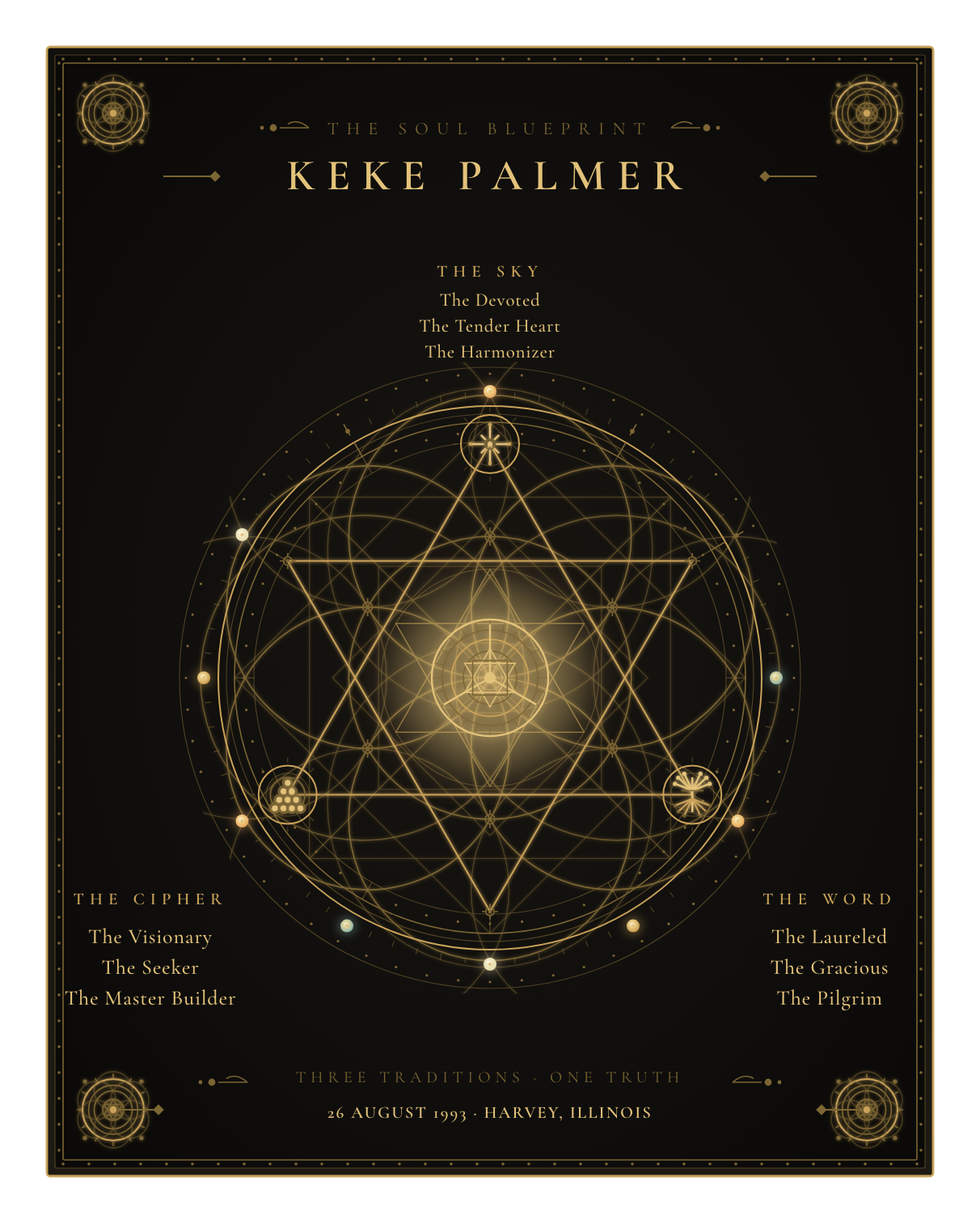
One seal, three languages. The sky she was born under at the apex, the numbers beneath her name at the lower left, the name itself at the lower right — three traditions engraved into one artifact. There is no rising sign, no houses, no angles: without a verified birth time they cannot be honestly drawn. What is true is what is shown.
At a Glance
- Full traditional name
- Lauren Keyana Palmer
- Born
- August 26, 1993 · Harvey
- Sun
- Virgo 3.5° — the essential fire of the life
- Rising
- Birth time unverified — the Ascendant is offered conditionally, never asserted
- Moon
- Date-dependent across the unverified birth day — not fixed without a confirmed time
- Mind · Value · Will
- Mercury Virgo · Venus Cancer · Mars Libra
- Discipline · Direction
- Saturn Aquarius · North Node Sagittarius
- Life Path
- 11 — The Illuminator
- Title-name Destiny
- 7 — The Seeker
- Birth-name Destiny
- 22 — The Master Builder
- Master Numbers
- 11, 22
- Soul archetype
- The Seeker who lives the Illuminator’s path
There is a girl on a stage in New York, September 2014, wearing a ballgown that catches the light like water—and she is singing Cinderella into being. The audience does not know yet that this is a threshold moment, a fracture in the architecture of possibility itself. She is twenty-one years old, and the role she carries has never been given to a Black woman on this stage before, not once in the long expensive history of Broadway. The light finds her face and the voice comes clear—refined, precise, each note placed exactly where it must go. This is not accident. This is the signature of a soul who came to master what she touches.
But walk backward through the fragments the world calls her—Keke Palmer the child star, Keke Palmer the television host, Keke Palmer the actress in a hundred different skins—and you will find yourself holding pieces of a river that does not flow in one direction. The world names what it sees: the roles, the awards, the industry momentum, the public narrative stitched together from glimpses and announcements and the careful architecture of a career. Yet beneath all of this runs a deeper current, older than the first audition, older than Harvey, Illinois—a source from which the soul has always been drinking. This reading does not trace the fragments. This reading traces the source. It names what the fragments are for.
The reading moves through the eight chapters of the Soul Blueprint architecture — The Arrival, The Soul’s Inheritance, The Living of It, The Soul’s Calling, The Soul’s Territories, The Name You Carry, The Moment, and The Invitation — and at the end, the same instrument turns gently toward you.
Her soul has a blueprint.
So do you.
The same three languages — the sky, the numbers, the name — are waiting in your own.
The Arrival
She arrived carrying a paradox at her center: the soul whose identity is realized through refinement—the devotion to technique, to precision, to the work done truly well—colliding perpetually with an interior landscape of scattered feeling, of sensitivity laid bare, of wounds that would not obey the mastery of analysis. The Virgo sun does not arrive gentle. It arrives as a burning demand: become pure, become clear, become the vessel through which power can flow without contamination or error. This is the self that comes alive by doing the work right—not perfectionism as punishment, but perfectionism as prayer, each small correction a act of devotion to illumination itself.
Yet within this same soul runs a precise and discriminating mind that sees exactly what is and what is not so, a voice that cuts through noise and speaks the truth cleanly—and alongside it, a heart that loves by nurturing, by making home, by the tender devotion to belonging. These are not at war in her. They are woven together into a single thread: the one who refines in order to serve, who masters the craft in order to care for. She came to demonstrate that technique is not cold—that the path of self-purification is the path of love itself, that becoming the clear vessel is how one becomes available to others. This is her essential signature: the alchemist of self, the one who burns away what does not serve so that the light can reach those who are waiting.
The Soul’s Inheritance
She was born into a family that understood the work of transformation intimately—both her parents had trained as actors, had stood on stages themselves before choosing different paths, before settling into the work of teaching and service. Her father worked in the precision and discipline of industry, serving as a deacon, a man who had answered a call to spiritual practice. Her mother taught children whose minds worked differently, whose learning required not just instruction but a deep attentiveness, a willingness to see each child freshly, to refine the approach until it fit. This was her inheritance: people who had chosen mastery, who had chosen to put their gifts in service of something larger than applause.
She grew up in a Roman Catholic household, in a community in Illinois, singing first in the church—the earliest stage was sacred space. The nickname that would follow her through the world, Keke, came not from her given name but from an imaginary friend her older sister had carried before she was even born, a name waiting for someone to inhabit it. This is the lineage she inherited: a family that knew how to translate inner vision into outer form, that understood both the discipline of technique and the devotion to something beyond the self. She was the younger, and she arrived into a world already shaped by her parents’ choices, their values, their willingness to work hard and serve—and she would spend her life both honoring and interrogating that inheritance.
The Living of It
The life was lived as a series of precise choices within an industry that demands constant performance, constant adaptation, constant refinement of the self into market-ready form—and she met those demands with the focused clarity of someone who understands that mastery requires attention to detail. From her first film at nine years old to the television roles that made her a household name while she was still a child, she moved through the work with the deliberation of a craftsperson, choosing roles that required her to stretch, to learn, to become something she had not yet been. Each role was a form of self-purification: the girl in Akeelah and the Bee, the executive in True Jackson, VP, the vocalist in Cinderella on Broadway—each demanded that she refine some new capacity, that she master some new language of the body, the voice, the emotional truth.
But the cost was written into the fabric of her becoming. She carried injuries that required mastery—the physical challenge of her vision, the hormonal imbalances that shadowed her body, the anxiety and depression that arrived without announcement. She survived what the world did not see: childhood abuse that she would not understand as harm until she was old enough to read about it in a book, until language finally gave her the shape of what had happened. And through all of this, she continued to refine, to master, to show up at the work—because this is what souls like this do. They transmute the wound into qualification. They do not look away from what has broken them; they use the breaking as the source of clarity. By the time she was recognized as one of the world’s most influential rising stars, she had already become a master of the craft of survival itself.
If this is what was true for her, what might be true for you?
The Soul’s Calling
The calling arrived as an irresistible compulsion toward clarity—toward saying what is true, toward cutting through the noise and speaking the precise thing that needs to be said. This is the gift of Mercury dignified: a voice that does not scatter, that does not perform without intention, that knows the power of the right word in the right place at the right moment. She was called to host, to lead conversations, to interview—to be the one who asks the questions that matter, who creates the space where truth can be spoken. She became a talk show host while still young enough that the industry had no template for what she was doing, no category ready-made. She built the role by building herself into it—by refusing to perform someone else’s version of what a host should be.
But deeper still, the calling is toward narrative itself—toward the reclamation of her own story, the refusal to let the fragments the world had assembled stand unchallenged. She wrote books. She launched a network. She hosted a podcast. She spoke directly about her own life—the abuse, the depression, the complexity of her sexuality, the abortion, the restraining order, the intimacies and injuries that had been kept private. The soul’s calling is not to be interviewed; it is to interview herself in public, to model what it looks like to refuse the narrative that other people have written, to take back the pen. This is her lineage and her work: the voice that clarifies, the voice that names, the voice that will not accept the fragments as the whole truth.
The Soul’s Territories
The first territory alive in her is film and television—the particular domain where she learned to translate the inner self into visible form, where she discovered that the craft of acting is not deception but radical honesty, the stripping away of everything false until only the exact emotional truth remains. In Akeelah and the Bee, in Nope, in Scream Queens—each role required her to enter a different consciousness, to master the particular language of that being, and in mastering it to understand something deeper about the human capacity for transformation. She does not act at audiences; she acts toward them, offers them the gift of her presence, asks them to recognize themselves in the character she has become.
The second territory is voice and performance—the direct transmission of her own truth through song, through hosting, through the presence that requires no script. When she hosted the MTV Video Music Awards, when she stood before millions and spoke about the George Floyd protests, when she sang in her own voice on her own stage—this was not celebrity deployment. This was the soul offering its particular frequency, its particular frequency to the collective. She learned early that she could sing, could move an audience, could command attention not through decoration but through clarity.
The third territory is narrative and self-authorship—the books she has written, the podcast she hosts, the content platform she launched, the direct conversation she continues to have with her audience about the actual texture of her life. She came to understand that the greatest role she could ever play was her own, lived honestly, told without mediation. These three territories—the crafted performance, the direct transmission, the narrative reclamation—weave together into a single intention: the soul that masters the form in order to serve the truth, that uses technique not as mask but as clarity, that stands in public as an act of service to all those who are learning to stand in their own truth.
There are twelve domains in the kingdom of any life: The Mark, The Unfolding, The Unseen, The Long Return, The Inheritance, The Encounter, The Alchemy, The Living Tension, The Sight, The Body’s Knowing, The Crossing, The Calling.
The Name You Carry
The name Lauren—the name she asks the world to call her by, the name that belongs to her in the deepest sense—carries a frequency of royalty and laurel, of the victor crowned, of the one who has earned what she carries through discipline and through grace. In a 2022 interview, she stated plainly that she prefers to go by this name, to be called by it ‘more than anything’—and this itself is an act of reclamation, of insisting that the world know her not by the nickname that was born before she arrived, but by the name her parents chose to mark her actual becoming. Lauren is the name of the woman she has become through the work, through the mastery, through the refusal to accept the fragments as the whole.
Keyana—the middle name that carries the K forward, that speaks to something particular and African and rooted in a specific lineage—flows beneath Lauren like an underground river. It is the name that anchors her to a history, to a specificity, to a blood inheritance she did not choose but that chose her. And Keke, the nickname born from her sister’s imaginary friend—this is the name the world knows, the name that travels with her through the industry, the name that has become synonymous with a particular kind of presence on screen, a particular frequency of joy and clarity and mischief. Three names, three versions of the self: the formal and chosen, the ancestral and particular, the playful and public.
Together they form the architecture of a soul who has had to hold multiple versions of herself in tension—who has had to learn that she is not one self but a constellation of selves, all of them true, all of them deserving of recognition and space. The work she has done is learning to let all three names live, to honor what each one carries, to refuse the demand that she collapse into a single, manageable version of who she is.
The Moment
The moment arrived in December 2022, on the stage of Saturday Night Live, when she announced her pregnancy to millions of viewers in real time—and in that announcement, something shifted in the architecture of her public life. She was not performing someone else’s narrative. She was not allowing the fragments—the career, the roles, the industry momentum—to dictate the terms of her becoming. She was claiming the right to her own story, to announce the most intimate development of her life on her own terms, in front of the whole world, without apology or mediation.
But the moment extended beyond that announcement. What followed was a season of public reckoning: the separation that came months later, the restraining order filed and then withdrawn, the intimate details of her relationship made visible to millions, the refusal to disappear or perform a false narrative of resolution. This was not the polished moment. This was the soul insisting on being known in her complexity, in her actual humanity, in the places where the mastery had not prevented the breaking. And it revealed something essential: that the work was never about perfection. The work was about honesty. The work was about standing in the light even when—especially when—the light illuminates the wounds, the mistakes, the places where the technique had failed her.
By 2024, when she released her second book and spoke on Instagram about her own asexuality, about her fluidity with identity and desire, the moment had become a season—a sustained act of narrative reclamation that continues to unfold. She was not waiting for the industry to give her permission to be herself. She was not performing according to anyone else’s script. She had become the author of her own becoming.
The Invitation
Everything in this reading has been moving toward a single point. The doubleness named in the first chapter, the inheritance, the wound, the calling, the territory, the name, the moment. These are not seven separate truths about Keke Palmer. They are one truth, named from seven different angles. And they all converge here.
The soul that arrived with the paradox of mastery and vulnerability has spent her entire life learning what it means to hold both truths at once—what it means to refuse the choice between perfection and authenticity, between the role and the self, between the technique and the raw human feeling underneath. She was being asked, from the very beginning, to master her craft while refusing to disappear into it—to become technically excellent while remaining radically honest about what excellence costs, what it requires, what it does not protect you from. The invitation was not to become a perfect vessel; it was to become a true one.
What was being released—what had to die, what had to be burned away—was the possibility of invisibility. A soul carrying her particular signature cannot simply perform and disappear. She carries the Sun of refinement, the Mercury of clarity, the Venus that loves by nurturing—and these forces demand that she show up not just as an actress, not just as a host, but as a whole human being willing to be seen in her actual complexity. The industry wanted her to be the polished version, the version without contradictions, the version that fit neatly into the role. She had to refuse that version repeatedly, had to insist on her own right to be messy, to be wrong, to be still becoming.
What was being called toward—what the soul had come to serve—was the reclamation of narrative itself. Not just for herself, but for everyone watching, everyone listening, everyone who had been told their own stories were not worth telling. She was being called to model what it looks like to take back the pen, to refuse the fragments that the world assembles and insist on the truth of the whole. The books, the podcast, the network, the direct address to her audience—these are not side projects. They are the central work. They are the soul’s way of saying: I will not let someone else tell my story. I will not accept the narrative that was written about me before I was born. I will master the craft of self-authorship. This is not ego. This is survival. This is the highest form of service.
What became available because she said yes to that calling—because she continued to show up even when showing up meant exposure, meant vulnerability, meant the shattering of the false narrative—was a kind of permission that ripples outward. She gave permission to everyone watching to do the same. She gave permission to the truth-tellers, the vulnerable ones, the people whose stories did not fit the template. She gave permission to the messy, the broken, the still-becoming. By refusing to disappear into the role, by insisting on being known in her whole complexity—the survivor, the host, the artist, the mother, the woman learning about her own body and desire and identity in real time—she created a space where other people could also refuse to disappear. This is what it means when a soul with her particular signature lives out its calling: it does not just transform the self. It transforms the field around it, makes it safer for others to be real, to be whole, to be themselves.
She was not late. She was exactly where the soul-clock said she should be. The mission had been inscribed at the threshold of her first breath. What was being asked of her, she has been walking. The naming has been done.
This Is Not Coincidence
The astrology speaks with precision: the Sun in Virgo insists on refinement as the path to illumination; Mercury in Virgo provides the clear, discriminating voice; Venus in Cancer names the love that nurtures and makes home; Mars in Libra carries the will to fight for fairness and balance; Saturn in Aquarius calls toward the discipline of building lasting systems rooted in genuine principle, and the North Node in Sagittarius pulls the soul away from endless collection of facts toward the commitment to a coherent vision that is lived, not just known. These five positions describe a soul built to master the craft of self-truth and speak it clearly, built to nurture others while refusing to disappear into that nurture, built to transform the collective narrative by transforming her own. The numerology independently confirms it: the Title Destiny of 7 (The Seeker) names the soul who must examine, interrogate, refine—who cannot rest until the truth has been found and integrated; the Birth Destiny of 22 (The Master Builder) reveals the one who came to construct something lasting, something that serves the whole; the Life Path of 11 (The Illuminator) describes the soul that bridges the conscious and unconscious, that brings light into darkness, that illuminates what has been hidden. Three numbers, three different languages, one governing blueprint: the soul that seeks truth in order to master her own becoming in order to illuminate the path for others. Three entirely different languages. One truth. She came to refuse the fragments and speak the whole.
Three entirely different languages. One truth.
This is not coincidence. This is what three independent systems do when they are all telling the truth about the same soul.
The Numbers, Decoded
The numbers are computed, not intuited — each letter takes its Pythagorean value, each name reduces, and any Master Number is preserved rather than collapsed.
You have sat with the chart and the numbers and the name of another soul, and watched how a wound becomes a calling, how the place of least belonging becomes the place of greatest gift, how a life too precisely configured to be coincidence reveals itself when three independent languages are read together.
The reading you have just received was, in its outer form, a reading of her soul. But its inner form was a reading written for yours. You did not arrive without a Blueprint either. May this reading be the beginning of the reading you finally receive of yourself. May the light you carry — in whatever particular, irreplaceable form it has taken inside the specific life you were given.
Some lives carry a pattern this clear.
Yours does too.
You’ve read the shape of her soul. The same three languages — the sky, the numbers, the word — are waiting in your own name and birth date. Begin yours, free, below.
Or, when you’re ready, begin your own full Soul Blueprint reading →
Frequently Asked Questions
What is Keke Palmer’s birth chart?
Keke Palmer was born with the Sun in Virgo, the sign of technical mastery, self-refinement, and the pursuit of illumination through precision and correct action. Her Mercury is also in Virgo—giving her a clear, discriminating, exact mind that sees precisely what is and what is not so. Her Venus is in Cancer, expressing love through nurture, care, and the making of emotional home; her Mars is in Libra, giving her the will to fight for fairness and balance through diplomacy and strategy; her Saturn is in Aquarius, asking her to build something lasting rooted in authentic principle and earned belonging. Because her exact birth time is unverified, her rising sign cannot be reliably determined, and so we speak only from the planetary positions and the day-chart itself.
What is Keke Palmer’s numerology?
Keke Palmer’s numerology reveals three governing numbers: her Title Destiny is 7—The Seeker, the soul who must examine and interrogate until truth is found; her Birth Destiny is 22—The Master Builder, naming the one born to construct something lasting that serves the collective; her Life Path is 11—The Illuminator, describing the soul who bridges worlds and brings light into what has been dark or hidden. These three numbers are preserved as Master Numbers (11 and 22 are not reduced), revealing a soul whose essential work is seeking truth in order to build something real and illuminating, and whose natural tendency is to bring clarity to complexity.
What does the name Keke Palmer mean?
The name Lauren—her given name, the one she has asked the world to call her by—carries the frequency of the laurel, the victor crowned, the one who has earned through discipline what she carries. Keyana, her middle name, anchors her to a specific ancestral and African lineage. Keke, the nickname born from an imaginary friend her sister carried before she was born, has become the public name known across film and television. Together, the three names represent the constellation of selves she inhabits: the formally chosen, the ancestrally rooted, and the publicly recognized—and her work has been learning to honor all three rather than collapsing into one.
What is a Soul Blueprint?
A Soul Blueprint integrates three independent traditions — Western natal astrology, Pythagorean numerology, and the etymology of the full birth name — into a single document written as a personal letter to the soul. When you’re ready, you can begin your own.
This reading was prepared in the lineage and methodology of the Soul Blueprint Method — Pythagorean numerology with master numbers preserved, Western archetypal astrology, and a researched etymological reading of the full name. Keke Palmer’s birth date (August 26, 1993) is sourced from the public record; the birth time is unverified, so the rising sign is offered conditionally and never asserted.
A Soul Blueprint reading · Astrology · Numerology · Etymology · shams-tabriz.com