
Travis Scott’s Birth Chart, Numerology, and Name Decoded
Travis Scott’s Birth Chart,
Numerology & Name Decoded
The Soul Blueprint Method — three traditions woven into one personal letter: Western natal astrology, Pythagorean numerology, and the etymology of the soul’s name. Learn the method →
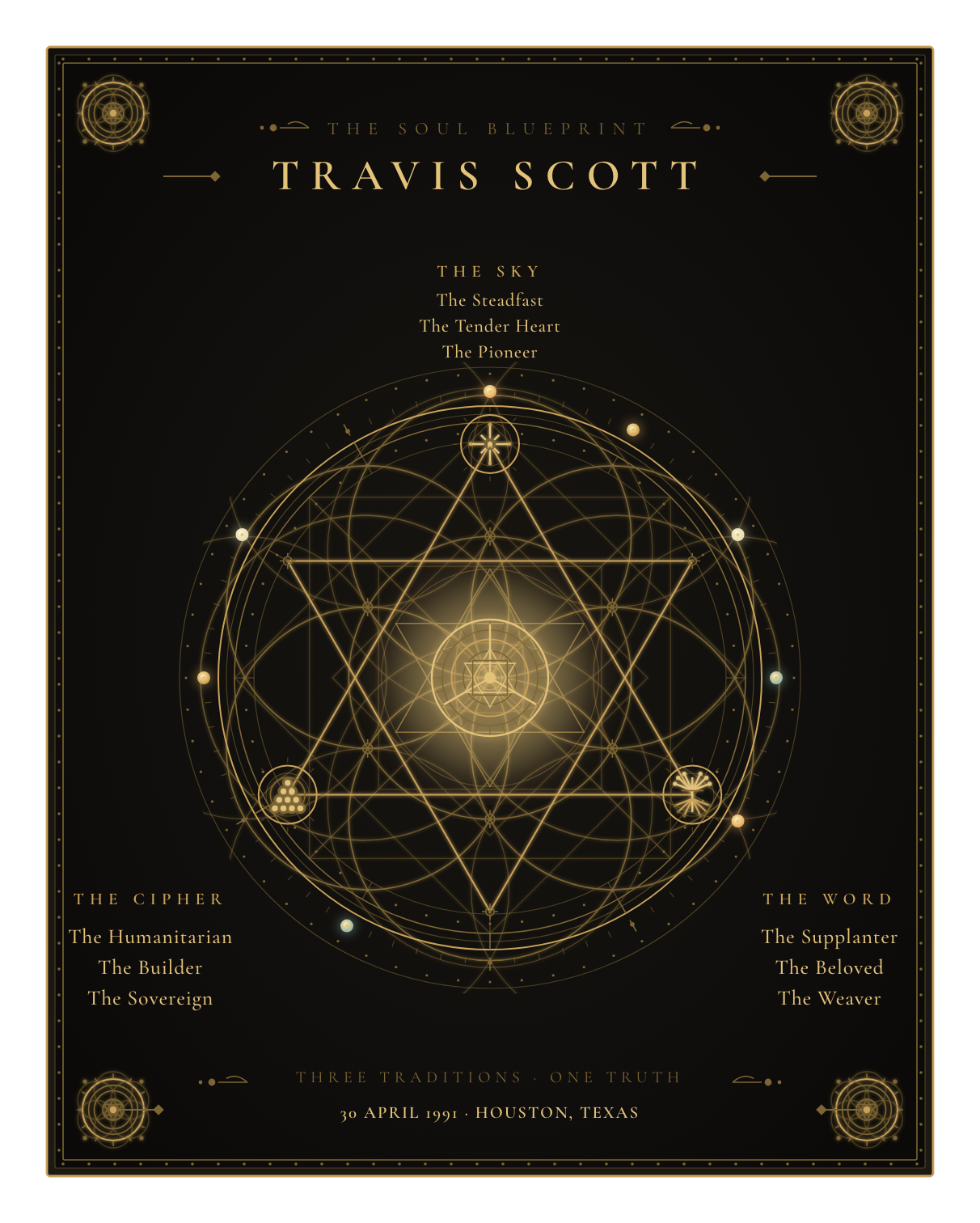
One seal, three languages. The sky he was born under at the apex, the numbers beneath his name at the lower left, the name itself at the lower right — three traditions engraved into one artifact. There is no rising sign, no houses, no angles: without a verified birth time they cannot be honestly drawn. What is true is what is shown.
At a Glance
- Full traditional name
- Jacques Bermon Webster II
- Born
- April 30, 1991 · Houston
- Sun
- Taurus 9.9° — the essential fire of the life
- Rising
- Birth time unverified — the Ascendant is offered conditionally, never asserted
- Moon
- Date-dependent across the unverified birth day — not fixed without a confirmed time
- Mind · Value · Will
- Mercury Aries · Venus Gemini · Mars Cancer
- Discipline · Direction
- Saturn Aquarius · North Node Capricorn
- Life Path
- 9 — The Humanitarian
- Title-name Destiny
- 4 — The Builder
- Birth-name Destiny
- 1 — The Pioneer
- Master Numbers
- None preserved at the final layer
- Soul archetype
- The Builder who lives the Humanitarian’s path
It is 2013 in Los Angeles, and the light arrives like a question mark—dusty, insistent, cutting through apartment windows where a young man sleeps on borrowed couches, the city indifferent to his hunger. His name is not yet Travis Scott, though the world will come to know him by that alias. He has left Houston behind—the neighborhood where his grandmother raised him from ages one to six, where poverty and crime were the first language he learned to read. He has dropped out of university. His parents have cut him off. He is twenty-two years old and the world says he is nobody, that his dream has arrived too early, that he should have waited, that the machinery of success does not turn for the dispossessed. And yet there is something in him that refuses to fold—a steadiness beneath the grinding, a knowledge that something is being built even as the world sees only a failure sleeping on a friend’s couch.
But the fragments the world calls him by—the stage name, the credentials he does not yet possess, the success waiting five, ten, fifteen years in the future—these are not the figure itself. They are the surface of a river, the visible current. Underneath, there flows a source: a blueprint that arrived complete, a soul’s inheritance written in the body’s own language, in the chart, in the number, in the name itself. The world measures a life by its outcomes. But the source measures a life by what it came already knowing—what it was born to embody, to build, to protect, to demonstrate through its very being.
This reading turns beneath the surface of the visible. It does not ask who Travis Scott has become, but who he was born to be—and how the life, in all its struggle and accomplishment and failure and grief, has been an unfolding of that original truth. The source does not lie. The source only waits to be read.
The reading moves through the eight chapters of the Soul Blueprint architecture — The Arrival, The Soul’s Inheritance, The Living of It, The Soul’s Calling, The Soul’s Territories, The Name You Carry, The Moment, and The Invitation — and at the end, the same instrument turns gently toward you.
His soul has a blueprint.
So do you.
The same three languages — the sky, the numbers, the name — are waiting in your own.
The Arrival
He arrived carrying a paradox that the world would spend two decades trying to reconcile: the self that comes alive through embodiment and sustaining—through building something real that others can touch, measure, rely upon—and yet a mind that cuts quick and decisive, a voice that initiates before others have finished thinking, a will that protects through feeling rather than armor. There is a steadiness in his foundation, the kind that comes from knowing one’s value does not depend on permission. The identity rests on an inner source, not on external validation or the applause of strangers.
He is the soul who must build—who cannot not build—who experiences the act of creating something enduring as the primary language of being alive. But he also carries a restless, initiating consciousness that moves at the speed of the spark, that sees what is broken and says it plainly, that refuses the comfort of silence. There is no peace in him without creation, but there is also no peace in creation that does not move forward, that does not push against what was there before.
This is the signature he carried into the world: not a contradiction to be resolved, but a creative tension to be embodied. He did not arrive to be comfortable. He arrived to build something that would change the architecture of his own life, and through that, the shape of a generation’s listening.
The Soul’s Inheritance
He was born into Houston in 1991, into a family with music in its bones—a father who was an entrepreneur and a soul musician, a mother who worked in the infrastructure of corporate America at AT&T, and a lineage that touched jazz, creativity, and the work of sustaining a household. The family itself was the first territory, the first school. But more defining than the names of his parents was the neighborhood where he was raised from ages one to six, living with his grandmother in South Park—a place marked by poverty and crime, where the ground itself taught lessons about scarcity, about what it takes to survive, about whose lives were counted and whose were not.
That neighborhood was his first inheritance: not money or privilege, but an education in witness. He learned early that the world’s systems were not designed for everyone equally, that protection required fierceness, that home was something you had to defend. He learned the language of hunger—not just for food, but for a way out, for a future that existed beyond what the geography seemed to promise. His parents later cut him off financially, kicked him out during his early struggles in Los Angeles, a severing that deepened the original wound and made the call to self-sufficiency absolute.
He was born in the era of hip-hop’s second adolescence, into a Texas tradition that had already proven its own genius, into a family that understood that art and enterprise were not separate things. All of this—the neighborhood, the music in the bloodline, the later abandonment, the refusal of his parents to fund his dream—became the material from which he would build.
The Living of It
The living of it began with dropping out of university in his second year—a choice that looked like failure to everyone watching, including the people who had made him. He formed musical groups with schoolmates, released projects on Myspace, crashed in New York City briefly, moved to Los Angeles with nothing but the certainty that something had to be built and that he was the one who had to build it. The world in those years did not cooperate. He was broke. He slept on couches. The music industry ignored him. The path that should have led somewhere led nowhere for long enough that most people would have quit, would have called their parents for rescue, would have found another dream.
But something in him refused the comfort of surrender. His Mercury—the mind that initiates—met the test of absolute necessity, and instead of breaking, it sharpened. His will, which protects through feeling rather than force, learned to provide for himself the care his parents had withdrawn. He moved to Los Angeles in 2012, signed his first major-label recording contract with Epic Records and a publishing deal with Kanye West’s GOOD Music, entered a joint venture with T.I.’s Grand Hustle Records. The mixtapes came—Owl Pharaoh in 2013, Days Before Rodeo in 2014. The studio albums followed: Rodeo in 2015 at number three, Birds in the Trap Sing McKnight in 2016 at number one.
But this is not the story of a smooth ascent. The cost was visible: arrests for inciting crowds, lawsuits from balcony collapses, repeated incidents of security failures and crowd injuries. The soul paid for its ambition in liability, in accountability, in the knowledge that his art had consequences he could not always control.
If this is what was true for him, what might be true for you?
The Soul’s Calling
The soul came to demonstrate what is possible when the mind and the will and the creative force are all in service of something that must be built. His Mercury speaks in quick, direct, initiating sentences—the mind that cuts to the point and refuses to soften the necessary truth. His Life Path carries the humanitarian archetype, which means his calling is not solely personal; it is to demonstrate something that others can learn from, that can shift how a generation thinks, that can open a door that was previously closed. He came to show that the dispossessed have genius, that the neighborhood produces visionaries, that the voice of someone who came from nothing carries a truth that the privileged cannot manufacture.
But the calling is also more intimate: his Venus speaks in playful curiosity and verbal wit, drawing others through conversation and mental companionship rather than dominance. He is a builder of collaborations, a voice that brings other voices forward—signing Don Toliver to Cactus Jack Records, working with Kanye West and Kid Cudi and Quavo, creating spaces where others could be discovered. He came to demonstrate that power is not hoarding, but generosity; that the strongest position is the one that makes room for others. His Mars, which protects through feeling, meant his calling included protecting the young, the vulnerable, the ones coming up behind him—hence the Cactus Jack Foundation, Project HEAL, the resources he has funneled back into Houston youth.
The Soul’s Territories
The first living territory is Music Creation—the album as organism, the sound design as architecture, the studio as the place where the future is being constructed. In Rodeo, Birds in the Trap Sing McKnight, Astroworld, Utopia, the listener hears not a collection of songs but a blueprint being unfolded—a world with its own weather, its own language, its own moral gravity. The albums are conceived as total entities, as places to inhabit. The soul comes alive in this territory because it is embodied, it is sustainable, it is something others can touch and move through.
The second territory is Ecosystem Building—Cactus Jack Records as imprint, the label deals, the discovery and elevation of other artists, the creation of infrastructure that serves not only the self but the community of makers around him. This is the builder’s true work: not the solo monument, but the living system that continues to produce beyond the individual. He learns here that power held alone is power wasted; power distributed is power multiplied.
The third territory is Public Ceremony—the Astroworld Festival, the Fortnite concerts drawing millions of viewers, the theatrical release of Circus Maximus, the stage itself as sacred ground. In this territory, the soul addresses the many at once, creates a shared experience of transcendence, holds a moment where thousands feel the same frequency. This is where the humanitarian medicine lives: the capacity to gather and to speak a language that moves through bodies, not just ears. These three territories—the album, the label, the ceremony—are the places where the deepest myths of his soul are being lived out, where the blueprint continues its unfolding into the world.
There are twelve domains in the kingdom of any life: The Mark, The Unfolding, The Unseen, The Long Return, The Inheritance, The Encounter, The Alchemy, The Living Tension, The Sight, The Body’s Knowing, The Crossing, The Calling.
The Name You Carry
The name he was born with—Jacques Bermon Webster II—carries in its structure the inheritance of occupational knowledge and family lineage: Webster speaks to the one who weaves, who creates order from threads, whose hands know how to interlace separate strands into something unified and strong. This is his birth inheritance encoded in language, the mastery of binding things together. Bermon and Jacques move through the family as continuation, as the second bearing the names of what came before, but also as the one who must author something new with those inherited letters.
But the name the world knows him by—Travis Scott—arrives from a different source entirely: Travis from an uncle he loved, Scott from Kid Cudi, whom he calls one of his biggest inspirations. In choosing this name, he performed an act of sovereignty and declaration: I will author my own lineage. I will name myself after the people who showed me what was possible, not after the family who cut me off. This is the birth numerology at work—the Pioneer archetype living itself out through the act of naming, the assertion that this life begins here, not in the past. Travis Scott is the name of becoming, the name of the threshold crossed, the moment when he claimed the right to be his own origin.
The two names together hold the whole arc: Jacques Bermon Webster II is the inheritance, the weaver’s knowledge, the family structure. Travis Scott is the initiation, the choice to begin again, the alliance forged with the mentors and the mirrors who saw him first. Together, they are the story of a soul learning to weave its own life from the threads it has been given, and then learning to choose which threads to keep.
The Moment
It is November 5, 2021. The Astroworld Festival is unfolding at the former site of Six Flags AstroWorld in Houston—the soul has come home in a way that mirrors the paradox he carries: he is returning to the geography that made him, the place that was both his origin and his wound, to create a ceremony of celebration and transcendence. The festival is his declaration to Houston: I came from here, and I made something, and now I am building a gathering place for all of us.
But somewhere in the ceremony, the architecture fails. The protection collapses. Ten people die in a crowd crush. Hundreds are injured. The young man who built Cactus Jack Records to protect emerging artists, who founded the Cactus Jack Foundation to serve Houston youth, who returned to his birthplace to create a homecoming—that man is now the accidental architect of tragedy. The moment fractures reality. In an instant, he becomes not the builder but the one whose structure failed, not the protector but the one whose ceremony turned into harm.
A Texas grand jury declines to indict him on June 29, 2023—a legal exoneration that reaches only the surface. The deeper reckoning cannot be exonerated by law. The moment revealed what every builder must eventually face: that creation carries consequences beyond intention, that protection is more fragile than it appears, that the desire to gather a community does not automatically create the safety required for gathering. The soul learned, in fire, what it means to hold accountability not as punishment but as the price of power, the cost of building in a world where the structures are always more fragile than they appear.
The Invitation
Everything in this reading has been moving toward a single point. The doubleness named in the first chapter, the inheritance, the wound, the calling, the territory, the name, the moment. These are not seven separate truths about Travis Scott. They are one truth, named from seven different angles. And they all converge here.
Travis Scott is living in the aftermath of recognition—a fame that has proven total and exhausting, an accomplishment that has turned into a kind of weight. He has achieved what the dispossessed boy sleeping on couches in 2013 was supposed to achieve: the number-one albums, the Grammy nominations, the global platform, the resources to build and protect. Six consecutive number-one albums. Five number-one singles. Collaborations with Nike, with Dior, with McDonald’s, with PlayStation. The Utopia – Circus Maximus Tour grossing $209 million. The machinery of success has vindicated him entirely.
And yet the question that is being asked of him now is not the question of becoming famous. It is a question of what to do with fame once it has arrived, what to build when the first building—the personal vindication, the proof that he was right to choose music over university—is already complete. The question is: what becomes available only after the Yes is said to the first calling? What does the soul serve when it has already served its own hunger?
He is being asked to release the fantasy that his will, his protection, his creation can ever be total—that he can ever fully control the consequences of gathering, of speaking, of building in the public square. The 2021 Astroworld tragedy did not negate his genius or his intention; it revealed that intention and consequence are not the same thing, that the soul’s work includes accepting the limits of protection, that some harms occur despite everything, not because of carelessness but because the structures of gathering in crowds of thousands are inherently fragile. This is the medicine of his Mars-in-Cancer soul: fierceness toward protection, but also humility before the forces larger than individual will.
He is being called toward a different kind of building now—not the building of monuments to personal triumph, but the building of systems, of principles, of structures that distribute power and accountability rather than concentrating it. The Cactus Jack Foundation and Project HEAL are not ego projects; they are the work of the soul that has learned that protection is collective or it is not protection at all. His Saturn-in-Aquarius is maturing now: the old fear of not belonging, of being an outsider, is transforming into the strength of principled contribution—the authority that comes not from domination but from serving something larger than the self.
What became available because the Yes was said to the first calling—the Yes to music, the Yes to Los Angeles, the Yes to building despite homelessness and abandonment—is the capacity to ask the second question: not ‘Can I build?’ but ‘What should be built?’ Not ‘Can I gather?’ but ‘How do we gather safely?’ Not ‘Can I lead?’ but ‘What does it mean to lead in service of something I do not control?’
He is in the middle of this unfolding. The sixth number-one album arrived in 2025. The collaborations continue—Spotify, Barcelona, WWE, Oakley. The builder is still building, but the building now includes a reckoning with failure, a conversation with consequence, a humility before the forces in the crowd that no individual will can entirely bend. This is what the soul is learning: that the greatest buildings often require the builder to become smaller, to share the space, to make room for what he cannot control. The invitation now is not to stop building. It is to build differently.
He was not late. He was exactly where the soul-clock said he should be. The mission had been inscribed at the threshold of his first breath. What was being asked of him, he has been walking. The naming has been done.
This Is Not Coincidence
The astrology speaks: a Taurus Sun rooted in self-sufficiency and embodied value, paired with Mars in Cancer’s fierce protectiveness and Saturn in Aquarius’s demand for earned belonging and systemic contribution. The numerology independently arrives at the same house: a Title Destiny of 4 (the Builder), a Birth Destiny of 1 (the Pioneer), and a Life Path of 9 (the Humanitarian) — three archetypes that together compose a soul called to construct lasting shelter, to initiate from principle, and to serve the collective through what endures. The name itself — Travis, drawn from a beloved uncle and woven with Scott, borrowed from an artistic mentor — speaks a lineage of inheritance and initiation: the one who carries forward and begins anew. Three entirely different languages. One truth: a builder who serves. The second witness: Mercury in Aries ignites the mind with decisive, forthright thought — the voice that cuts to the point and does not hesitate. Venus in Gemini draws him toward connection through wit, curiosity, and the play of ideas — love expressed as conversation, attraction rooted in mental spark. The Life Path 9 whispers the same medicine: the humanitarian arc, the soul who learns wisdom by giving it, who completes one cycle only to begin the next at a higher turn. The names — Jacques Bermon Webster, the birth-soul — carry the weight of family, the uncertain lineage, and the etymology of the weaver, the one who interlaces threads. Three entirely different languages. One truth: the connector who builds bridges between worlds.
Three entirely different languages. One truth.
This is not coincidence. This is what three independent systems do when they are all telling the truth about the same soul.
The Numbers, Decoded
The numbers are computed, not intuited — each letter takes its Pythagorean value, each name reduces, and any Master Number is preserved rather than collapsed.
You have sat with the chart and the numbers and the name of another soul, and watched how a wound becomes a calling, how the place of least belonging becomes the place of greatest gift, how a life too precisely configured to be coincidence reveals itself when three independent languages are read together.
The reading you have just received was, in its outer form, a reading of his soul. But its inner form was a reading written for yours. You did not arrive without a Blueprint either. May this reading be the beginning of the reading you finally receive of yourself. May the light you carry — in whatever particular, irreplaceable form it has taken inside the specific life you were given.
Some lives carry a pattern this clear.
Yours does too.
You’ve read the shape of his soul. The same three languages — the sky, the numbers, the word — are waiting in your own name and birth date. Begin yours, free, below.
Or, when you’re ready, begin your own full Soul Blueprint reading →
Frequently Asked Questions
What is Travis Scott’s birth chart?
Travis Scott was born with the Sun in Taurus on April 30, 1991, in Houston, Texas — a foundation rooted in self-sufficiency, embodied value, and the steady flow of life-force through presence and endurance. His Mercury is in Aries, giving him a quick, decisive, initiating mind; his Venus is in Gemini, drawing affection through wit and shared discovery; his Mars is in Cancer, expressing will through protection and provision for the vulnerable; and his Saturn is in Aquarius, the traditional seat of disciplined service and earned belonging to the collective. Because his birth time remains unverified, the rising sign cannot be fixed in the chart — the ascendant is not circulated with certainty.
What is Travis Scott’s numerology?
Travis Scott’s numerology reads across three dimensions: his Title Destiny (from the name Travis Scott) is 4, the Builder — the archetype of foundation, structure, and the work that lasts; his Birth Destiny (from Jacques Bermon Webster II) is 1, the Pioneer — the soul who initiates, who stands alone, who refuses the already-mapped path; and his Life Path (from April 30, 1991) is 9, the Humanitarian — the wisdom-giver, the one who completes cycles and serves the evolution of the whole. Together, these three numbers compose a single soul-signature: the initiator who builds systems of enduring shelter and serves the collective through what he creates.
What does the name Travis Scott mean?
The name Travis Scott carries a dual inheritance: Travis comes from his favorite uncle and speaks a lineage of family love and embodied presence, while Scott is borrowed from Kid Cudi (Scott Mescudi), one of his greatest artistic inspirations — a name that bridges family and artistic initiation. His birth name, Jacques Bermon Webster II, carries the weight of family legacy and a surname with roots in the Old English word for weaver — the one who interlaces threads, who brings disparate materials into woven wholeness. Together, the names speak a soul called both to honor lineage and to weave new patterns.
What is a Soul Blueprint?
A Soul Blueprint integrates three independent traditions — Western natal astrology, Pythagorean numerology, and the etymology of the full birth name — into a single document written as a personal letter to the soul. When you’re ready, you can begin your own.
This reading was prepared in the lineage and methodology of the Soul Blueprint Method — Pythagorean numerology with master numbers preserved, Western archetypal astrology, and a researched etymological reading of the full name. Travis Scott’s birth date (April 30, 1991) is sourced from the public record; the birth time is unverified, so the rising sign is offered conditionally and never asserted.
A Soul Blueprint reading · Astrology · Numerology · Etymology · shams-tabriz.com