
Janet Jackson’s Birth Chart, Numerology, and Name Decoded
Janet Jackson’s Birth Chart,
Numerology & Name Decoded
The Soul Blueprint Method — three traditions woven into one personal letter: Western natal astrology, Pythagorean numerology, and the etymology of the soul’s name. Learn the method →
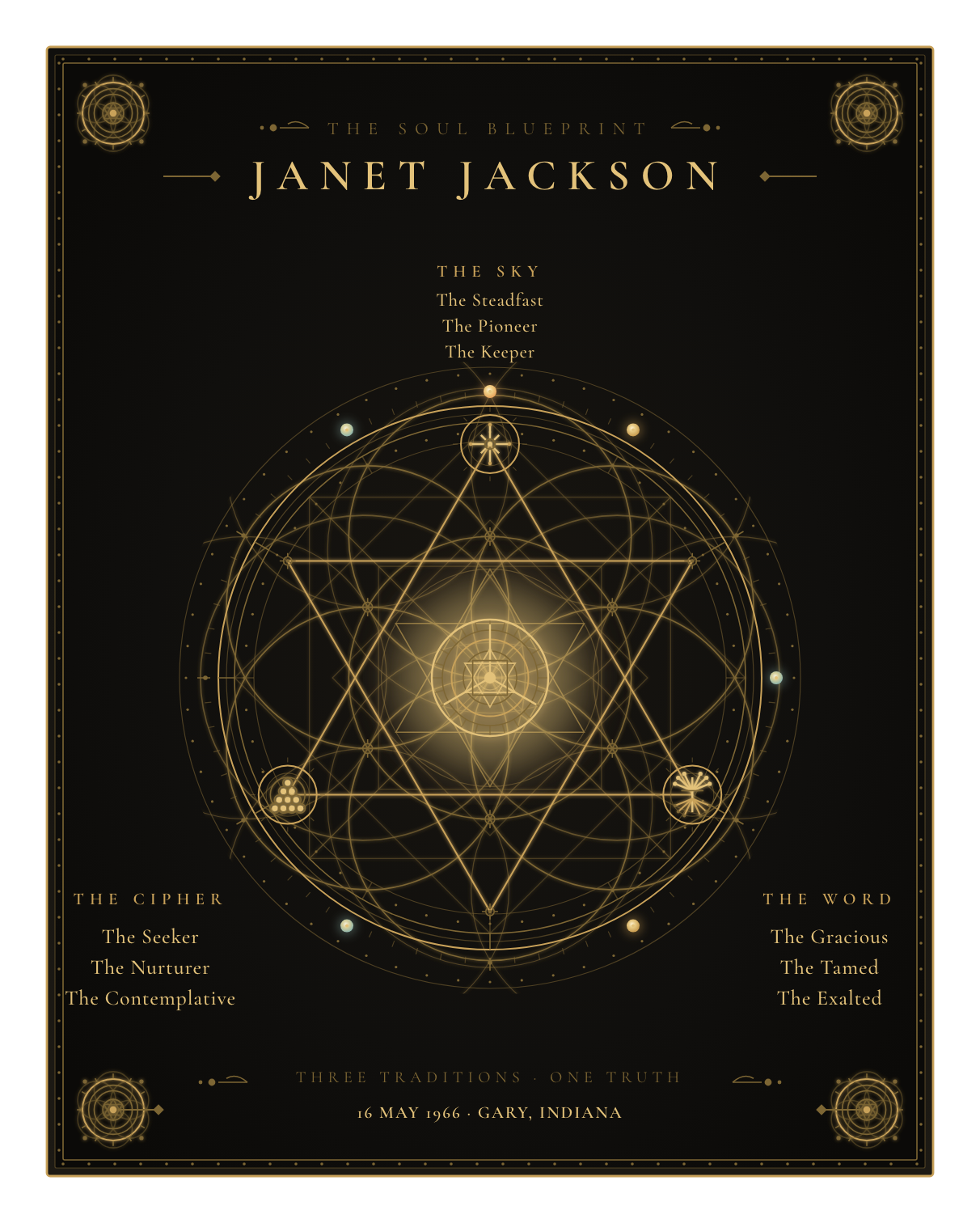
One seal, three languages. The sky she was born under at the apex, the numbers beneath her name at the lower left, the name itself at the lower right — three traditions engraved into one artifact. There is no rising sign, no houses, no angles: without a verified birth time they cannot be honestly drawn. What is true is what is shown.
At a Glance
- Full traditional name
- Janet Damita Jo Jackson
- Born
- May 16, 1966 · Gary
- Sun
- Taurus 25.4° — the essential fire of the life
- Rising
- Birth time unverified — the Ascendant is offered conditionally, never asserted
- Moon
- Aries 12.0° — the inner life
- Mind · Value · Will
- Mercury Taurus · Venus Aries · Mars Taurus
- Discipline · Direction
- Saturn Pisces · North Node Taurus
- Life Path
- 7 — The Seeker
- Title-name Destiny
- 6 — The Nurturer
- Birth-name Destiny
- 7 — The Seeker
- Master Numbers
- None preserved at the final layer
- Soul archetype
- The Nurturer who lives the Seeker’s path
Las Vegas, 1969: a child of seven years stands in the wings of the MGM Casino, feeling the heat of stage lights on her skin and the tremor of music moving through the floorboards—her brothers already shining on the stage, the Jackson name already a cipher for ambition and collective will. The world would come to know her as the youngest of a musical dynasty, the one who arrived into an inheritance already made, already demanded. But beneath the biography the world assembles—the facts, the dates, the breakthrough albums and the scandal that reshaped her place—there runs a quieter current: the soul beneath the name, the source beneath the fragments. This reading turns away from the chronicle of achievement and controversy that defines her public image and instead traces the deeper river from which her actual self emerged: not the Jackson 5 appendage, not the pop icon who broke free, not the voice silenced by industry machinery, but the soul carrying a paradox so precise it can barely be named. She arrived embodied, self-sufficient, grounded—a river that flows steadily and does not require the banks to teach it how to move. Yet the heart she was born with burns with a need for direct action and immediate response, a courage that cannot wait. These two forces—the steady self-sufficiency of root and stone, and the fierce need to act, to dare, to answer in the moment—would define not only her music but the entire architecture of her becoming. This reading reads the source.
The reading moves through the eight chapters of the Soul Blueprint architecture — The Arrival, The Soul’s Inheritance, The Living of It, The Soul’s Calling, The Soul’s Territories, The Name You Carry, The Moment, and The Invitation — and at the end, the same instrument turns gently toward you.
Her soul has a blueprint.
So do you.
The same three languages — the sky, the numbers, the name — are waiting in your own.
The Arrival
She arrived carrying a paradox so central it became the secret architecture of everything she would do: the soul that sustains itself from within, that does not require external permission to know its own value, housed in a body and heart that burn with the need to act directly, to move, to respond in the moment without hesitation. The Taurus inheritance is self-sufficiency—the steady, embodied presence that knows its own ground—but it lives not in passivity but in the courage to hold that ground while the world moves around it. She was born with the capacity to endure long after others have exhausted themselves, to build something real and durable by refusing to be shaken. Yet the emotional nature she carries is restless, brave, and demanding of freedom: a reigning need to respond immediately, to act on what the heart knows, to pursue what ignites her rather than wait for permission. The paradox is this: she is both the river that flows steadily in its own channel and the warrior that charges forward unafraid. The soul arrived knowing it must prove its sufficiency by doing—not by being witnessed, but by moving, by making, by refusing to surrender her own authority over her own life. This is the signature she would spend decades learning to honor: that her steadiness was not restraint, and her courage was not recklessness, but a single impulse moving in two directions at once.
The Soul’s Inheritance
She was born into a family already in motion—a father who had carried music through his own body as a rhythm-and-blues musician, a mother whose hands knew the language of instruments and who had once harbored the dream of performing herself before life channeled her differently. The inheritance was both material and spiritual: music lived not as abstraction but as presence, as the way the household itself breathed. Gary, Indiana in 1966 was a working place, an industrial city where her father worked the steel mills by day—the body learning patience and persistence in hard labor—while music lived as the counterweight, the thing that kept the spirit alive. She was the youngest among many siblings, each one already moving into the family enterprise, the Jackson name already being assembled into a brand. To be born into this was to inherit not only a musical gift but an expectation: that she would add her voice to the collective, that her talent would serve the family’s ambition. This was not cruelty but structure—the way families pass on not only blood but vocation, burden, and the assumption that the individual exists partly to sustain the whole. Yet this inheritance carried a hidden cost: the confusion between her own worth and her usefulness to others, between self-sufficiency and the servitude of being claimed before she could claim herself. She would grow up inside a machinery of achievement that never asked her permission and rarely asked what she wanted. The family gave her music and platform but also the long lesson that she would have to fight to know what belonged to her alone.
The Living of It
The living of it began early—at seven, she was already onstage, her small body enlisted into the family’s choreography, her voice absorbed into the collective sound. To live as the youngest in a dynasty is to live with a peculiar wound: the erosion of the boundary between self and instrument, between the person and what she can be made to produce. She watched her brothers move through fame, watched the machinery of the industry close around the Jackson name, and learned a dangerous lesson: that her value was portable, transferable, dependent on what she could deliver rather than who she was. By her teens, she had already recorded, already performed, already been shaped by forces outside her own will. The wound deepened when she signed with her father’s arrangements, when she released albums that were not hers, when she understood that even her earliest music-making was not her own authority but his. This cost everything—years of her twenties spent trying to reclaim territory that had been taken. The qualification that emerged from this wound was radical: she learned that self-sufficiency was not a luxury but a survival necessity, that she could not rely on the family machinery to know her own worth, that she would have to demolish the old arrangements and rebuild herself from scratch. At twenty, she did it—terminated the business affairs that bound her, refusing to remain under his control. The cost was estrangement, the loss of the collective, the terrifying freedom of standing alone. What emerged was not bitterness but clarity: she understood that her steadiness, her capacity to endure and to build, could only be trusted if it was entirely her own.
If this is what was true for her, what might be true for you?
The Soul’s Calling
Her calling arrived not as inspiration but as necessity: to demonstrate that a human being could reclaim her own authority, could strip away the machinery that had claimed her, could build value from her own ground rather than accept it from external hands. The voice she was born with—deliberate, grounded, measured, speaking only when sure—learned to speak truths that the industry had not scripted. She came to show that steadiness is not passivity, that self-sufficiency is not isolation, that a woman could hold her own ground while the world demanded she surrender it. The calling was to make music that belonged entirely to her: not the family sound, not what producers imposed, but what emerged when she stood alone in the studio and allowed her own authority to move through her. She came to demonstrate the capacity to persist—to make album after album, to rebuild after devastation, to refuse the narrative that a single moment could erase her. The calling is the slow revolution: she came to teach that the steady river, once it begins to move in its own channel, becomes unstoppable. The voice she learned to use was not the instrument of others but the instrument of her own knowing, and that knowing had to be earned through standing in her own truth, again and again, until the world had no choice but to recognize what she had always been.
The Soul’s Territories
Her most alive territories: Music as Self-Recovery—where she learned that the act of making, of recording, of moving through the creative process without asking permission became the primary tool of reclamation. Each album was not promotion but resurrection: Control was the burning of the old contracts; Rhythm Nation 1814 was the proof that her steadiness could move others; The Velvet Rope was the courage to speak about depression and anxiety, to make vulnerability into art. The territory taught her that music was not what was done to her but what she could do with her own hands, her own voice, her own authority. Performance as Truth-Telling—the stage where her body became the statement, where the choreography and the presence and the uncompromising control of every movement said what the voice sometimes could not. The warehouse in the Rhythm Nation video, the Super Bowl stage, the touring: these were territories where she demonstrated that steadiness was not fragility, that a woman’s body could be both vulnerable and unyielding. The performance taught her that presence itself is a form of power. Solitude as Consolidation—the difficult territory of standing apart, of refusing the family machinery, of bearing the cost of independence so that her own ground could become solid. This territory was painful and necessary: without it, she could not have known what was truly hers. Each territory has led deeper into a personal mythology that is still unfolding: the myth of the river that finds its own course, the myth of the woman who refuses diminishment, the myth of the soul that knew its worth long before the world was ready to see it.
There are twelve domains in the kingdom of any life: The Mark, The Unfolding, The Unseen, The Long Return, The Inheritance, The Encounter, The Alchemy, The Living Tension, The Sight, The Body’s Knowing, The Crossing, The Calling.
The Name You Carry
The name she carries holds the resonance of a specific invitation: Janet speaks to the grace of arrival, the feminine presence that enters and changes the atmosphere of a room—not through loudness but through an undeniable steadiness. It is a name that arrives complete in itself, that does not require ornamentation or extension. The full name—Janet Damita Jo Jackson—holds layers that the world has largely not examined: Damita, the middle name she would later choose as the title of an album, speaks to something both personal and formal, a nod to the family’s own complexity. Jo carries the simplicity and directness she inherited from her mother’s lineage, a diminutive that suggests both approachability and an inner life that cannot be fully known. Jackson is the family name, the surname that became a brand, a apparatus, the thing she had to separate from in order to discover what was hers alone. When she claimed Damita Jo as the title of an album, she was reclaiming the dimensions of her name that the public had never really seen—not Janet the pop star, not Jackson the dynasty member, but Janet Damita Jo: the person underneath, the name that held her own mothers and grandmothers, the designation that was intimate and particular. The names together hold a truth: that she is the one who arrives, who steadies, who can be known only if you are willing to slow down and listen, who carries the inheritance of the family while also carrying the fierce need to be distinguished from it. The resonance is of a woman who had to earn the right to her own names, letter by letter.
The Moment
February 2004, the Super Bowl stage: she stood in the machinery of the largest televised event in the United States, having arrived at the absolute apex of visibility, and in a moment that lasted less than a second, everything fractured. The halftime show itself was not scandal—it was a demonstration of her complete command, the choreography precise, the presence undeniable. But the moment at the end, when the costume separated from her body, transformed everything: suddenly the conversation was not about her artistry or her power but about her vulnerability, about the exposure that a machine had decided to perform. The world divided into factions: those who saw conspiracy, those who saw accident, those who decided that her body had committed a crime by being seen. What followed was systematic erasure. The radio silence came not from accident but from deliberate choice—a CEO’s directive that her music would not be played, that her presence would be reduced, that the industry would collectively decide that she had transgressed beyond redemption. She was silenced not because she had failed musically but because she was a woman whose body had been exposed without her narrative controlling how that exposure would be read. The moment revealed the fragility of even the most complete achievement: that visibility itself could become a weapon, that steadiness could be dismantled by the collective decision to no longer see her. Yet the moment also revealed something else—that her own ground was deeper than the industry’s approval, that she could endure the erasure and return, that the river does not stop flowing because the world has decided to look away. The defining moment was not a triumph but a teaching: she learned that her worth could not be granted by the machinery; it could only be inhabited by her, again and again, regardless of who was watching.
The Invitation
Everything in this reading has been moving toward a single point. The doubleness named in the first chapter, the inheritance, the wound, the calling, the territory, the name, the moment. These are not seven separate truths about Janet Jackson. They are one truth, named from seven different angles. And they all converge here.
What is being asked of her—what has been asked of her for decades—is to stand in her own authority in a world that would prefer she remain a function, a voice in a collective, a body to be used rather than a person to be reckoned with. The soul arrived carrying steadiness as its primary inheritance, the capacity to endure, to build, to hold ground when others abandon the effort. But the world she was born into—the family machinery, the industry apparatus, the relentless demand that she prove her worth by producing—never created space for that steadiness to simply exist. Instead, it demanded that the steadiness serve, that the self-sufficiency become instrumental, that her independence become marketable. The asking has been: Can you remain yourself while everyone else profits from your refusal to remain yourself? Can you hold steady while the ground beneath you is being claimed by others? Can you persist when persistence itself is consumed and commodified? She has been asked to do the hardest thing: to distinguish between her own authority and the authority that has been assigned to her, to know the difference between standing her ground and being used as a ground for others to stand on.
What was being released, slowly and painfully, was the false inheritance—the idea that her worth was dependent on her usefulness, that her value could be calculated by her productivity, that she belonged to the family enterprise rather than to herself. The albums Control and Rhythm Nation 1814 were not just artistic statements but acts of severance: releasing the fiction that the Jackson name could contain her, that the family machinery understood what she was capable of, that permission from the external world was necessary for her to make something real. She released the idea that steadiness meant submission, that endurance meant accepting diminishment, that her capacity to build meant she existed to build for others.
What was being called toward—what she has been answering for forty years—is the possibility of a woman who knows her own worth from within, who does not require the world’s validation to move forward, who can be both vulnerable and unshakeable, both publicly visible and personally private. The calling is toward the demonstration that steadiness is not passivity, that a woman can be the author of her own narrative even when the machinery tries to script it for her, that an individual can remain whole inside a collective without surrendering the whole to the collective. The call is to show that a river, once it finds its own channel, moves with an authority that no external force can interrupt.
What became available because she said yes to this asking, again and again, was something the industry did not anticipate: she became uncontrollable not through rebellion but through self-knowledge. The records that followed—each one made on her own terms, with her own producers, in her own time—carried an authority that no algorithm, no scandal, no collective silencing could diminish. She became the woman who could disappear from the radio and return unchanged. She became the artist whose control over her own sound was absolute. She became the person who understood that vindication was not external—it was the daily practice of knowing herself, of making what she wanted to make, of moving through the world with a steadiness that did not depend on being seen. She is still answering this call, still demonstrating what is possible when a woman refuses the script that has been written for her, still teaching that the river that flows from its own source cannot be dammed by the world’s indifference or hostility. She is still standing in her own ground, and the ground is holding.
She was not late. She was exactly where the soul-clock said she should be. The mission had been inscribed at the threshold of her first breath. What was being asked of her, she has been walking. The naming has been done.
This Is Not Coincidence
The astrology speaks a single paradox: the self that sustains itself from within (Taurus Sun, the steady river), and the heart that burns with a reigning need to act directly and immediately (Aries Moon), the mind that speaks slowly but carries weight (Taurus Mercury), the will that persists long after others quit (Taurus Mars), the love that pursues boldly what it wants (Aries Venus)—these are not in conflict but in chorus, a soul called to demonstrate steadiness through courageous action. The numerology speaks independence and seeking: the Title Destiny of the Nurturer (6) meets the Birth Destiny of the Seeker (7) and the Life Path of the Seeker (7)—a soul who came to learn that true nurture means allowing others (and herself) the freedom to seek their own ground, that the caretaker becomes whole only by refusing to carry what is not hers to carry. The names themselves—Janet (arrival, the presence that steadies), Damita (the particular, the intimate self beneath the public), Jo (the simplicity, the direct heart)—speak a woman who had to reclaim her own names from a collective that had claimed them first. Three entirely different languages. One truth: She came to teach that the person who stands in their own ground becomes the teacher others have been waiting for.
Three entirely different languages. One truth.
This is not coincidence. This is what three independent systems do when they are all telling the truth about the same soul.
The Numbers, Decoded
The numbers are computed, not intuited — each letter takes its Pythagorean value, each name reduces, and any Master Number is preserved rather than collapsed.
You have sat with the chart and the numbers and the name of another soul, and watched how a wound becomes a calling, how the place of least belonging becomes the place of greatest gift, how a life too precisely configured to be coincidence reveals itself when three independent languages are read together.
The reading you have just received was, in its outer form, a reading of her soul. But its inner form was a reading written for yours. You did not arrive without a Blueprint either. May this reading be the beginning of the reading you finally receive of yourself. May the light you carry — in whatever particular, irreplaceable form it has taken inside the specific life you were given.
Some lives carry a pattern this clear.
Yours does too.
You’ve read the shape of her soul. The same three languages — the sky, the numbers, the word — are waiting in your own name and birth date. Begin yours, free, below.
Or, when you’re ready, begin your own full Soul Blueprint reading →
Frequently Asked Questions
What is Janet Jackson’s birth chart?
Janet Jackson was born on May 16, 1966, with her Sun in Taurus, the sign of the self that sustains itself from within—grounded, embodied, self-sufficient. Her Moon is in Aries, speaking to an emotional nature that burns with the need to act and respond directly. Her Mercury is also in Taurus, giving her a deliberate, measured mind that speaks only when sure; her Venus is in Aries, speaking to love that is ardent and pursuing; and her Mars is in Taurus, meaning her will is patient, persistent, and immovable. Saturn in Pisces speaks to the discipline of giving form to the boundless. The birth time is unverified, so the rising sign cannot be fixed with certainty.
What is Janet Jackson’s numerology?
Janet Jackson’s Title Destiny—calculated from the name by which the world knows her—is 6, the Nurturer, speaking to her gift for holding others and fostering healing. Her Birth Destiny, calculated from her full birth name Janet Damita Jo Jackson, is 7, the Seeker, speaking to a soul oriented toward truth and inner knowing. Her Life Path, calculated from her birth date (May 16, 1966), is also 7, reinforcing the Seeker archetype: a soul called to seek, to question, to find her own ground rather than accept what has been handed to her.
What does the name Janet Jackson mean?
Janet carries the resonance of arrival, the feminine presence that enters and changes an atmosphere through undeniable steadiness. Damita, her middle name, holds a more particular and intimate dimension—the self beneath the public designation. Jo speaks to simplicity and directness, a diminutive suggesting both approachability and an inner life that cannot be fully known. Jackson is the family surname that became a brand; when she titled an album Damita Jo, she was reclaiming the layers of her name that the public had never really seen, asserting that she is not only the product of the family enterprise but a person in her own right.
What is a Soul Blueprint?
A Soul Blueprint integrates three independent traditions — Western natal astrology, Pythagorean numerology, and the etymology of the full birth name — into a single document written as a personal letter to the soul. When you’re ready, you can begin your own.
This reading was prepared in the lineage and methodology of the Soul Blueprint Method — Pythagorean numerology with master numbers preserved, Western archetypal astrology, and a researched etymological reading of the full name. Janet Jackson’s birth date (May 16, 1966) is sourced from the public record; the birth time is unverified, so the rising sign is offered conditionally and never asserted.
A Soul Blueprint reading · Astrology · Numerology · Etymology · shams-tabriz.com