
Stephen King’s Birth Chart, Numerology, and Name Decoded
Stephen King’s Birth Chart,
Numerology & Name Decoded
The Soul Blueprint Method — three traditions woven into one personal letter: Western natal astrology, Pythagorean numerology, and the etymology of the soul’s name. Learn the method →
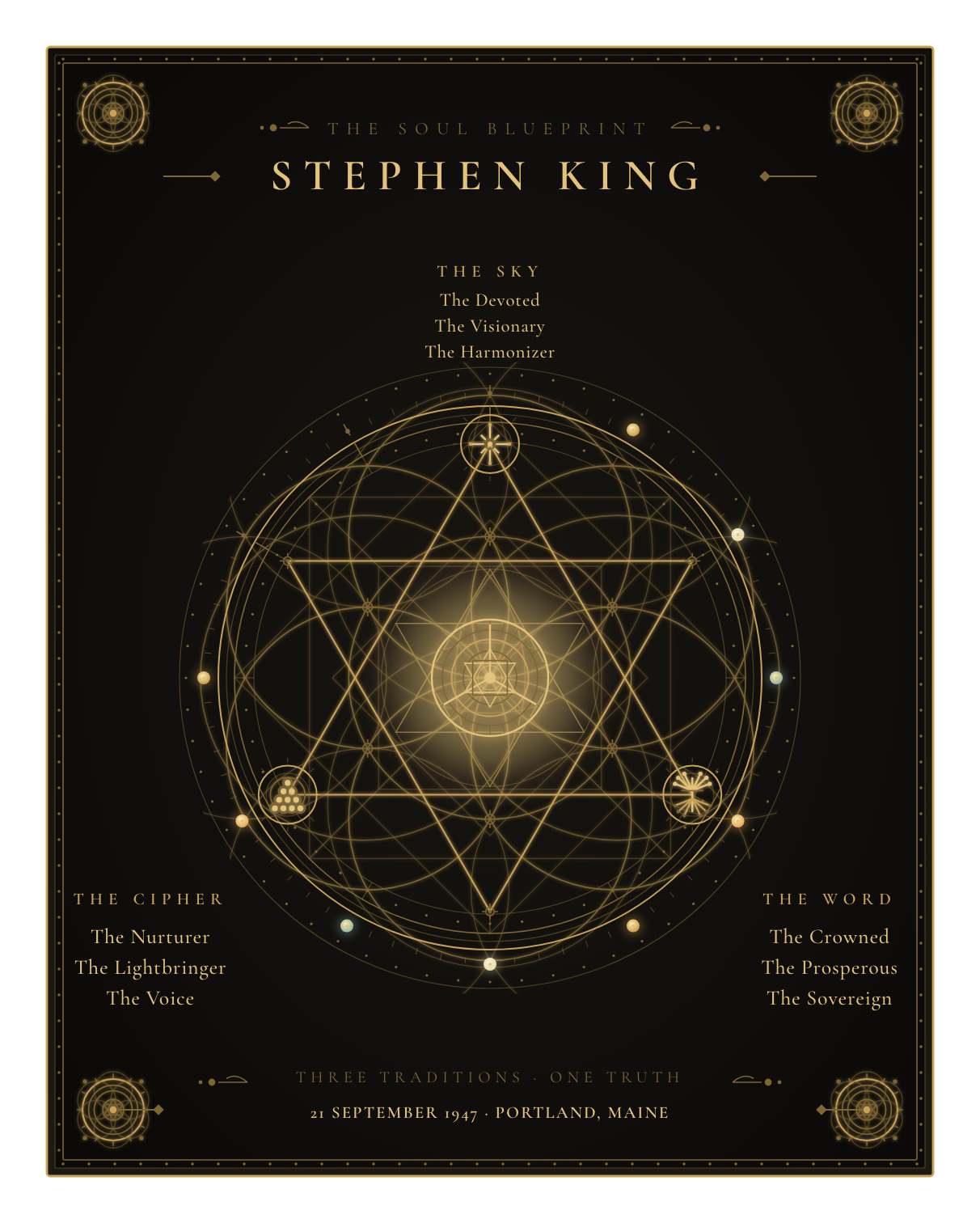
One seal, three languages. The sky he was born under at the apex, the numbers beneath his name at the lower left, the name itself at the lower right — three traditions engraved into one artifact. There is no rising sign, no houses, no angles: without a verified birth time they cannot be honestly drawn. What is true is what is shown.
At a Glance
- Full traditional name
- Stephen Edwin King
- Born
- September 21, 1947 · Portland
- Sun
- Virgo 27.8° — the essential fire of the life
- Rising
- Birth time unverified — the Ascendant is offered conditionally, never asserted
- Moon
- Sagittarius 21.5° — the inner life
- Mind · Value · Will
- Mercury Libra · Venus Libra · Mars Cancer
- Discipline · Direction
- Saturn Leo · North Node Taurus
- Life Path
- 6 — The Nurturer
- Title-name Destiny
- 11 — The Illuminator
- Birth-name Destiny
- 3 — The Communicator
- Master Numbers
- 11
- Soul archetype
- The Illuminator who lives the Nurturer’s path
It is 1974, and a young man sits in a classroom at Hampden Academy in Maine, teaching the mechanics of grammar and sentence structure to students who will never know that the manuscript he carried home in his jacket pocket—a story called Carrie, written in the laundry room of a double-wide trailer—would arrive at a publisher’s desk and change the trajectory of American letters. The light through those classroom windows is ordinary. His hands are ordinary. The words he spoke that day to his students about precision and care were the same words that had been hammered into his own craft through years of small magazines and typewriter keys and rejection.
But here is what the world sees: a genre writer, a “King of Horror,” a figure whose name became synonymous with terror and the visceral dark. And here is what moves beneath that surface—a river with a different source entirely. Not darkness for darkness’s sake, but a soul that arrived carrying the mandate to refine, to purify, to make the work true; a communicator built to carry meaning and steadiness into the places where meaning had been lost; a nurturer whose fierce protectiveness expressed itself not through comfort alone but through the unflinching transmission of what it costs to be human. The fragments the world calls him—”bestselling author,” “prolific,” “controversial”—are the foam and spray. This reading descends to the source, to the spring itself, where the water begins as something clean and necessary, before it takes the shape the world demands of it.
The reading moves through the eight chapters of the Soul Blueprint architecture — The Arrival, The Soul’s Inheritance, The Living of It, The Soul’s Calling, The Soul’s Territories, The Name You Carry, The Moment, and The Invitation — and at the end, the same instrument turns gently toward you.
His soul has a blueprint.
So do you.
The same three languages — the sky, the numbers, the name — are waiting in your own.
The Arrival
Stephen King arrived carrying a paradox that would animate every decade of his living: the soul of a perfectionist born into a framework that demanded production, not polish; a technician of language wired to refine toward mastery, yet called to write at the speed of feeling and vision. His self-knowledge was built on a need to purify, to cleanse his own work through relentless revision and self-correction—the quiet discipline of someone for whom the craft itself is the practice of illumination. Yet he was also a vessel for stories that erupted from the depths, that poured out at the velocity of dream and fever, that could not wait for perfect conditions. The signature of his arrival, therefore, was not the gentle accumulation of a careful artist working toward one masterpiece in solitude. It was a doubled intensity: the need to make the work true, married to an absolute mandate to make the work flow. He came in carrying both the critic and the conduit, the editor and the oracle. This tension—between the Virgoan hunger for technical purity and the deeper call to be a channel for what the culture needed to hear—would shape not only what he wrote but how he learned to write it, and at what cost.
The Soul’s Inheritance
He was born into the inheritance of a family fractured at its root. His father, a man who had traveled the country selling vacuums—a hustle, a restlessness, a hunger for motion and commerce—abandoned the household when Stephen was two years old, leaving a mother to carry two boys forward into a world that had already taught her something about survival and steadiness. His mother, Nellie Ruth, worked as a caregiver in a residential facility for the mentally challenged, a woman who spent her days in intimate contact with the vulnerable and the forgotten, who understood what it meant to hold space for those the world had deemed difficult or broken. This was the soil he was planted in: the inheritance of absence balanced against an example of relentless care; a father’s name that had been chosen by his own father after the war—a name that was not original but claimed, reforged from something else. He inherited, therefore, the dual nature of his lineage: the ghost of masculine restlessness and the lived reality of maternal nurturance. He was born in 1947, into an America still settling itself after war, in Maine, a landscape of winter and isolation and small towns where secrets accumulated behind closed doors. The era gave him its particular dread—the atomic age, the Cold War, the sense that catastrophe was always humming beneath the surface. And he arrived into a family that understood, in their bones, what it meant to protect the vulnerable from forces larger than themselves.
The Living of It
The living of it began early: at six or seven years old, he began copying the panels from comic books, not merely reproducing them but making them his own—inventing new stories, new possibilities for the images already drawn. His mother did not praise him for the copying. She challenged him: I bet you could do better. Write one of your own. And this single sentence became his mandate. By his teenage years, he was publishing in fanzines, had written and lost and rewritten, had begun to understand that the work demanded everything. He graduated from the University of Maine with a degree in English and took a teaching position, holding down a life that was supposed to be stable even as the stories poured through him at night, even as he began to sell his work to magazines, brick by brick.
But the cost accumulated. He struggled with addiction throughout the 1980s and into the 1990s—cocaine, alcohol, substances that promised to quiet the intensity of his own mind, that promised relief from the relentless demand to produce and refine simultaneously. He wrote novels barely remembering the writing of them, moved through years in a fog, watched his own mastery become compromised by the very thing he thought might help him bear it. His wife, Tabitha, intervened after The Tommyknockers. She staged an intervention. She told him what he already knew but could not name: that he was drowning. And he agreed to seek treatment, to climb out of the depths, to choose life and clarity over the seduction of numbness. The cost was the years of memory lost, the physical toll on his body, the damage done to relationships and to his own sense of integrity. The qualification it became was the hard-won knowledge that sobriety was not the end of the work—it was the beginning.
If this is what was true for him, what might be true for you?
The Soul’s Calling
He came to demonstrate that the voice of the storyteller is not a luxury—it is a technology of survival. His calling was to speak into the darkness in a language that the culture could understand, to name the terrors that live in ordinary houses and small towns, to show that the most profound human experiences—love, loyalty, the capacity to protect the vulnerable, the cost of choosing life over numbness—were not separate from the visceral and the frightening. They were woven through each other. He was built to communicate, to hold and weigh both sides of a question, to speak with grace and fairness even when naming what was unfair about the world. His gift was not to comfort but to translate—to take the inchoate terrors of the human condition and render them in language so precise, so technically exact, that readers could recognize themselves and find, in that recognition, some form of belonging. He was called to be a nurturer not through softness but through unflinching witness. He came to show that the masculine principle, when aligned with protection and provision for the vulnerable, becomes a form of sacred service. And he was called to demonstrate, through the very ordinariness of his life—as a teacher, a husband, a father, a man in recovery—that the work of becoming oneself is never finished, that refinement is a lifelong practice, that the soul’s deepening is inseparable from the work that feeds it.
The Soul’s Territories
The Territory of the Ordinary Made Luminous: He inhabited a landscape where the everyday—a kitchen sink, a car breaking down on an empty road, a small-town main street, children riding bicycles—became the container for what matters most. In this territory, he did not need exotic settings or extraordinary circumstances. The ordinary was already dense with meaning, already haunted by the presence of what lives beneath surface calm. He held this territory with the precision of a craftsman, knowing that the smaller the gesture, the more exact it must be. The Territory of Lineage and Inheritance: He explored, again and again, what it means to be shaped by the people who came before—parents, mentors, the culture that formed you. His work held the question of what we are born into and what we must consciously choose to become. In this territory, he was asking: How do we honor the wounded places we inherit? How do we transform them? How do we become worthy of the love given to us? The Territory of the Threshold Between Worlds: He moved continuously between the rational and the inexplicable, between what can be measured and what can only be felt. In this space—the borderland between the seen and the unseen, between the world that explains itself and the world that demands faith—he found the greatest power. He was describing the moment when a person stands at the edge of their own understanding and must choose to step forward into mystery. These three territories converge into a deeper mythology: the story of a soul that came to show that the sacred is not separate from the material, that horror and love are not opposites but siblings, that the work of becoming human is the work of learning to see truly and then to speak what you have seen.
There are twelve domains in the kingdom of any life: The Mark, The Unfolding, The Unseen, The Long Return, The Inheritance, The Encounter, The Alchemy, The Living Tension, The Sight, The Body’s Knowing, The Crossing, The Calling.
The Name You Carry
The names he carries hold a particular resonance that flows beneath the numerology into something quieter and more intimate. Stephen—a name that means ‘crown,’ the symbol of authority claimed and earned—speaks to a soul born to bring something to its crowning. Not authority granted by external decree, but the quiet authority that comes from having done the work, from having refined the craft until mastery becomes visible. It is the name of a witness, a holder, someone who stands and sees and carries what he has seen. Edwin, his middle name, carries within it the sense of ‘wealthy friend’—a reminder of partnership, of the bonds that sustain us, of the provision that flows through relationship. And King, the surname that his father chose after returning from war, is not a birthright but a claim. It is a name that says: I am not defined by what was given to me; I am defined by what I have made myself into. Together, these three names speak to a soul called to earn its own light, to find wealth not in isolation but in the bonds of loyalty and creative partnership, and to understand that the name we carry—whether given or claimed—is an invitation to become worthy of it. The names are not arbitrary. They are a blueprint whispering what the soul came here to demonstrate.
The Moment
On June 19, 1999, Stephen King was struck by a van on a road in Maine. The impact shattered the illusion of invulnerability. He suffered a collapsed lung, multiple fractures, a broken hip. The body that had carried him through decades of relentless work was suddenly broken, dependent, unable to move through the world as it always had. He was hospitalized. The pain was substantial. The recovery would be long.
But something shifted in those weeks of immobility. By July 1999, still hospitalized, still injured, he returned to the manuscript of On Writing: A Memoir of the Craft, a book he had begun before the accident. And he wrote through the pain, writing about the craft itself, about the work that had sustained him, about what it means to be a writer and to be called to write. The accident did not stop him. It changed him. It revealed something he had perhaps been moving toward all along: that the work was not separate from the living; that pain and creation were not opposites but could be held in the same moment; that the practice of refining toward mastery was not diminished by suffering but was, in fact, deepened by it.
The defining moment was not the impact itself but what he chose to do in the aftermath. He chose to continue. Not to push through numbly, not to override the body’s wisdom, but to sit with the pain and write anyway. To show, through his own example, that recovery and creativity are not sequential—they happen together. The broken body became a teacher. The manuscript became a transmission of what he had learned: that the soul’s work does not pause for the body’s healing; it is part of the healing.
The Invitation
Everything in this reading has been moving toward a single point. The doubleness named in the first chapter, the inheritance, the wound, the calling, the territory, the name, the moment. These are not seven separate truths about Stephen King. They are one truth, named from seven different angles. And they all converge here.
What was being asked of Stephen King, across the arc of his living, was nothing less than this: to become a translator of the dark—not to exploit it, not to sensationalize it, but to transmit it with such precision and such care that readers could see themselves and their own hidden terrors rendered in language, and in that rendering, find belonging. The soul arrived carrying a mandate to refine, to purify, to make the work true through relentless self-correction and technical mastery. But it was also asked to do this at speed, at the velocity of dream and necessity, to be a channel as well as a craftsman. The asking required him to hold both positions simultaneously, and for much of his living, this paradox created a pressure that nearly broke him.
What was being released was the illusion that perfection and productivity could not coexist; that precision and passion were at odds; that the work of self-purification meant isolation and control. The addiction years—the cocaine, the alcohol, the fog—were an attempt to resolve this paradox through numbness, to quiet one side of the doubled mandate so that the other could proceed unopposed. When his wife intervened, when he agreed to seek treatment, what was actually being released was the fantasy that he could medicate away the intensity of his own nature. He had to learn to live with the paradox, not escape it. The sobriety that followed was not the end of struggle; it was the beginning of a different kind of mastery—the mastery of holding tension without requiring relief, of being both the refined craftsman and the open conduit, of trusting that both were necessary.
What was being called toward was a deeper alignment with his own inheritance. His mother had shown him what it meant to care for the vulnerable with dignity and presence. His father’s absence had taught him what it meant to choose to stay, to provide, to protect. The teaching work, the relationship with Tabitha, the children who became writers themselves—these were not distractions from the “real work” of writing novels. They were the real work. They were the soul demonstrating, through the actual living of a life, what he was trying to say in the stories. The calling was toward integration: the recognition that the nurturer, the communicator, the technician of language, and the man in recovery were not separate selves but one soul, expressed through multiple territories.
What became available because the Yes was said—because he agreed to the asking, because he allowed himself to be broken and remade—was a different kind of authority. The post-recovery work carries a clarity that the earlier work, brilliant as it was, could not quite achieve. Needful Things, written after sobriety, has a quality of earned wisdom. The Green Mile speaks from a place of genuine compassion. 11/22/63 asks profound questions about time and consequence and the weight of choice. These are not better novels than the earlier ones; they are novels written by someone who had looked into the abyss of his own dissolution and chosen to return. They carry the authority of someone who knows, in his bones, what it means to nearly be lost and to find one’s way back to the work, to the people, to the actual living of a life. And in that return, the work itself was transformed. It became not merely a vehicle for terror or fascination, but a genuine offering—a transmission of what one human being had learned about survival, about loyalty, about the cost and the necessity of staying present to one’s own becoming.
He was not late. He was exactly where the soul-clock said he should be. The mission had been inscribed at the threshold of his first breath. What was being asked of him, he has been walking. The naming has been done.
This Is Not Coincidence
Passage One: The astrology speaks a soul wired to refine toward mastery, a technician of language whose self-identity is realized through analysis and self-purification, technique in service of illumination—a Virgo Sun moving always toward greater clarity, greater precision, the continual correction of one’s own work in service of something larger. The numerology independently arrives at the same destination from a different angle: an 11 in the public name (The Illuminator), a 3 in the birth name (The Communicator), a 6 in the life path (The Nurturer)—three numbers that, woven together, speak a soul called to illuminate what others need to hear, to communicate it with grace and care, to nurture the vulnerable through the act of telling the truth. The names—Stephen, Edwin, King—echo the same thread: a crown to be earned, friendship and partnership as the ground of wealth, a surname claimed rather than given, all pointing toward a soul who must choose to become what he has been called to be. Three entirely different languages. One truth. A soul arrives as the bridge between the dark and the light, wielding language itself as the instrument of transformation. Passage Two: The chart shows a heart steadied by faith and the far horizon, a Moon in Sagittarius that needs meaning, that cannot rest in cynicism or shallow explanation but must always reach toward the larger view and the deeper significance. The numerology confirms this trajectory: the calling is toward illumination, toward the transmission of what matters, toward being a voice that does not shy away from the difficult truths but speaks them with grace and fairness. The name King—claimed, not inherited—stands as a declaration that this soul will not be defined by what was given but by what it has earned and chosen. Together they speak the same insistence from three separate angles: This soul came to show that meaning is not separate from terror, that love and fear are woven through each other, and that the work of becoming human requires both technical precision and the willingness to be broken open. Three entirely different languages. One truth. In the ordinary world, in ordinary pain, the sacred is waiting to be named.
Three entirely different languages. One truth.
This is not coincidence. This is what three independent systems do when they are all telling the truth about the same soul.
The Numbers, Decoded
The numbers are computed, not intuited — each letter takes its Pythagorean value, each name reduces, and any Master Number is preserved rather than collapsed.
You have sat with the chart and the numbers and the name of another soul, and watched how a wound becomes a calling, how the place of least belonging becomes the place of greatest gift, how a life too precisely configured to be coincidence reveals itself when three independent languages are read together.
The reading you have just received was, in its outer form, a reading of his soul. But its inner form was a reading written for yours. You did not arrive without a Blueprint either. May this reading be the beginning of the reading you finally receive of yourself. May the light you carry — in whatever particular, irreplaceable form it has taken inside the specific life you were given.
Some lives carry a pattern this clear.
Yours does too.
You’ve read the shape of his soul. The same three languages — the sky, the numbers, the word — are waiting in your own name and birth date. Begin yours, free, below.
Or, when you’re ready, begin your own full Soul Blueprint reading →
Frequently Asked Questions
What is Stephen King’s birth chart?
Stephen King was born on September 21, 1947, in Portland, Maine, with the Sun in Virgo—a signature of identity realized through refinement and technical mastery, the pursuit of illumination through self-purification and precision. The birth time is unverified, so the rising sign cannot be fixed with certainty. His Moon in Sagittarius speaks to an emotional nature that requires meaning and faith, a heart steadied by the larger view and the conviction that life contains significance. Mercury in Libra gives him a balanced, relational intelligence—a capacity to weigh both sides fairly and to speak with grace and diplomatic skill. Venus in Libra amplifies this gift for relationship and harmony, expressing affection through partnership and the art of making things beautiful and fair. Mars in Cancer manifests as a will that protects and provides, a fierce tenacity in defense of the vulnerable. Saturn in Leo speaks to the discipline required to earn one’s own creative authority and to bear being seen and valued for one’s authentic expression.
What is Stephen King’s numerology?
Stephen King carries three numerological signatures that define his soul’s mission. His Title Destiny is 11—The Illuminator—derived from his public name, speaking to a soul called to bring light and clarity to what is hidden or feared. His Birth Destiny is 3—The Communicator—derived from his birth name Stephen Edwin King, indicating a fundamental calling to transmit meaning and truth through language and creative expression. His Life Path is 6—The Nurturer—derived from his birth date, September 21, 1947, a signature of a soul called to care for others through presence, honesty, and the willingness to hold difficult truths. Together, these three numbers weave a unified mission: to illuminate the human condition, to communicate its depths and its struggles with grace, and to nurture the vulnerable through the act of bearing witness.
What does the name Stephen King mean?
The name Stephen means ‘crown’—a symbol of authority earned and claimed rather than inherited, speaking to a soul called to prove its worth through the quality of its work. Edwin, the middle name, carries the sense of ‘wealthy friend,’ an echo of the principle that genuine wealth flows through loyalty and partnership rather than isolation. King, the surname, was chosen by his father after returning from World War II—not a birthright but a claim, a deliberate assertion of identity. Together, the three names form a statement: I am called to earn the light I carry, to find my riches in the bonds I build with others, and to become, through choice and effort, worthy of the name I bear. The names are not random; they are a blueprint whispering the soul’s own mandate.
What is a Soul Blueprint?
A Soul Blueprint integrates three independent traditions — Western natal astrology, Pythagorean numerology, and the etymology of the full birth name — into a single document written as a personal letter to the soul. When you’re ready, you can begin your own.
This reading was prepared in the lineage and methodology of the Soul Blueprint Method — Pythagorean numerology with master numbers preserved, Western archetypal astrology, and a researched etymological reading of the full name. Stephen King’s birth date (September 21, 1947) is sourced from the public record; the birth time is unverified, so the rising sign is offered conditionally and never asserted.
A Soul Blueprint reading · Astrology · Numerology · Etymology · shams-tabriz.com