
Jake Gyllenhaal’s Birth Chart, Numerology, and Name Decoded
Jake Gyllenhaal’s Birth Chart,
Numerology & Name Decoded
The Soul Blueprint Method — three traditions woven into one personal letter: Western natal astrology, Pythagorean numerology, and the etymology of the soul’s name. Learn the method →
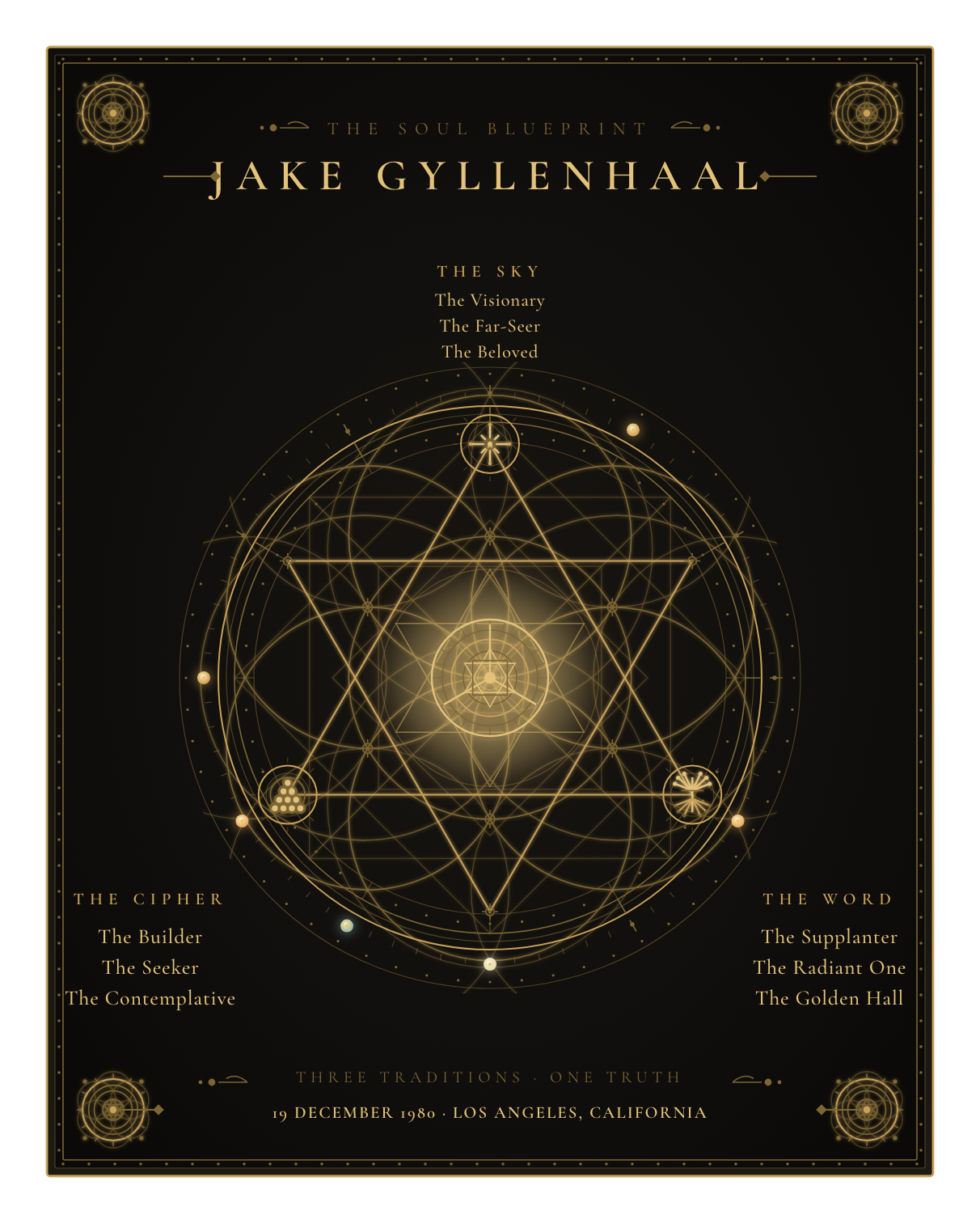
One seal, three languages. The sky he was born under at the apex, the numbers beneath his name at the lower left, the name itself at the lower right — three traditions engraved into one artifact. There is no rising sign, no houses, no angles: without a verified birth time they cannot be honestly drawn. What is true is what is shown.
At a Glance
- Full traditional name
- Jacob Benjamin Gyllenhaal
- Born
- December 19, 1980 · Los Angeles
- Sun
- Sagittarius 28.1° — the essential fire of the life
- Rising
- Birth time unverified — the Ascendant is offered conditionally, never asserted
- Moon
- Date-dependent across the unverified birth day — not fixed without a confirmed time
- Mind · Value · Will
- Mercury Sagittarius · Venus Sagittarius · Mars Capricorn
- Discipline · Direction
- Saturn Libra · North Node Leo
- Life Path
- 4 — The Builder
- Title-name Destiny
- 7 — The Seeker
- Birth-name Destiny
- 7 — The Seeker
- Master Numbers
- None preserved at the final layer
- Soul archetype
- The Seeker who lives the Builder’s path
It is October 2001, and the light in a small American town is amber and thick with autumn—the kind of light that falls through school corridors and across the faces of teenagers who have just begun to understand that their lives might mean something beyond the ordinary. A young man sits in the glow of that light, inhabiting a character caught between worlds: Donnie Darko, troubled and visionary, speaking to invisible presences, asking the questions no one else dares ask. The role fit him like a skin he had been waiting to wear. Few saw it at first; the film arrived quietly, a modest box-office murmur. But something in the performance held—a luminous strangeness, a willingness to descend into the fractured places of the mind and emerge asking about meaning itself.
The world sees fragments: the face on magazine covers, the roles on screen, the awards and nominations, the relationships parsed in headlines. The actor who plays troubled boys. The one who said yes to difficult things. The soul underneath those fragments is another matter entirely—a source, a river running beneath the visible life, fed by currents the spectator cannot see. That river has a direction, a logic, a fidelity to something larger than a single life or career arc. It moves according to laws that predate the biography.
This reading descends to that source. Not to the performances or the fame—those are the ripples on the surface—but to the essential blueprint from which the whole life has been patterned. The soul that arrived in Los Angeles on a December day in 1980 came carrying a paradox, a map, a calling. The work of fifty years (and continuing) has been the patient, methodical unveiling of that truth.
What follows is an architecture of that unveiling—the geometry of his soul as it has been living itself into form.
The reading moves through the eight chapters of the Soul Blueprint architecture — The Arrival, The Soul’s Inheritance, The Living of It, The Soul’s Calling, The Soul’s Territories, The Name You Carry, The Moment, and The Invitation — and at the end, the same instrument turns gently toward you.
His soul has a blueprint.
So do you.
The same three languages — the sky, the numbers, the name — are waiting in your own.
The Arrival
He arrived as a seeker in a seeker’s body—born under the sign of the pilgrim, the one whose self comes alive by pushing toward the far horizon in search of meaning that transcends the merely personal. This is not the arrival of a soul content with surfaces; it is the arrival of someone for whom the question Why? arrives as naturally as breath. The mind that woke in him was already expansive, already reaching past the visible world toward principles and eternal values—toward religion, philosophy, the vast uncharted realms where significance lives.
But there is a paradox woven into this arrival: the seeker’s gift is paired with a will of extraordinary discipline and patience. He did not come to drift or philosophize in abstractions. He came with the capacity to build—to take the visionary impulse and make it manifest through sustained, strategic effort, through the mastery of a craft, through the kind of ambition that knows how to wait, to structure, to control its own force and direct it with maximum efficiency toward what matters. The warrior in him is not hot-blooded; he is the general, the architect, the one who wins through endurance.
And yet there is a third current running beneath this signature: the soul’s true medicine lies in the direction it has been called to grow—away from hiding, away from the cool detachment of standing safely apart, and toward the individual heart. The soul came to seek, and the soul came to build, but the soul came to be seen. Not merely to find meaning or construct monuments, but to let his own warmth, his own creative impulse, his own capacity to matter personally become visible. This is the tension he has been resolving his whole life: the cold clarity of the builder-philosopher learning to burn.
The Soul’s Inheritance
He was born into a lineage of makers—people who understood that art was not decoration but a way of investigating the world. His father, a director, and his mother, a screenwriter, had made their lives in the grammar of film and story. They had created the conditions in which a child could understand that questions about meaning, about truth, about how people actually live were not indulgences but vocations. The house he grew up in was saturated with that understanding.
But there was also a lineage of witness and conscience woven into the inheritance. His mother was born into an Ashkenazi Jewish family, carriers of a tradition that had taught its children to ask difficult moral questions, to remember what it means to survive, to hold justice as a living practice rather than an abstraction. His father had been raised in the Swedenborgian tradition, a spiritual lineage that emphasized inner illumination and the correspondence between the visible and invisible worlds. He was born into a family that took the interior life seriously, that understood conscience as something that could be cultivated and deepened.
And there was something else: he was born into privilege that had been deliberately complicated by his parents. They had not allowed that privilege to become a kind of narcissism. They insisted on summer work—he was a lifeguard, a busboy, sent into the ordinary world to understand what labor was, what service meant. They had also given him godparents of considerable spiritual stature: Paul Newman, the actor and philosopher of craft; Jamie Lee Curtis, a keeper of her own difficult truth. The inheritance was: You have been given much; therefore you must become someone worth the gift. The gift is not security; it is responsibility.
The Living of It
The life was lived in the grammar of no—not refusal, but a particular kind of scrupulous choosing. His parents, guardians of something they sensed in him, regularly forbade him from taking roles he had already been cast in. The message arrived early and indelibly: not every opportunity is a true calling; not every yes serves the soul. He learned young that the life of integrity means knowing what to refuse.
There was also the small, relentless fact of the lazy eye—a physical asymmetry that required correction from age six onward, a reminder written into his own flesh that vision does not come without work, that seeing truly is not automatic. For a soul called to be seen, to have matured watching the world through the apparatus of correction, carried its own education.
The work itself became the signature practice. He studied Eastern religions and philosophy at Columbia before leaving to pursue his calling more directly—the decision itself a kind of saying yes to what felt true over what looked prestigious. He worked in theater, which strips away all the machinery and leaves only the actor and the audience and the text. He moved between mediums—film, theater, the craft of narrative itself—as a way of understanding not what roles fit him but what work deepened him.
The cost was lived in the territories of intimacy. The soul called toward growth in the direction of personal warmth, of being seen and mattering individually, has had to navigate the fear that comes with that vulnerability. The relationships he has lived through have been the crucible in which he learned what it means to show up, to commit, to let oneself be known. The life has been lived, consistently, in the direction of yes to difficulty—yes to the roles that fractured him, yes to the work that required him to descend into darkness and emerge asking about meaning.
If this is what was true for him, what might be true for you?
The Soul’s Calling
The calling that has organized his work is the calling of the interpreter—the one whose voice and mind are built to make visible what is usually hidden. His Mercury, expansive and philosophical, gives him the architecture of a teacher and a synthesizer: the mind that grasps the principle underneath the surface, the pattern that connects, the meaning that transcends the particular moment. But it is not an abstract intelligence; it is the voice of someone who understands that philosophy becomes alive only when it is lived, when it is embodied in a human being struggling with actual dilemmas.
So the work has been: take the fractured teenager, the desperate man, the one consumed by obsession, the villain wearing a mask—take the character who is asking the unspoken question—and let that question become audible, visible, true. He has moved through roles in the grammar of the seeker asking why, whether that seeker was hunting for a serial killer’s logic, or watching love between two people the world had labeled impossible, or sitting in a newspaper office piecing together fragments into meaning, or descending into the psychology of obsession itself. The calling has been to demonstrate, again and again, that the interior life—the dark, strange, often beautiful interior life—is worth exploring, is the place where the real questions live.
The voice that emerges from him in interviews, in the way he speaks about his work, carries that same quality: enthusiastic, frank, visionary. He does not hide behind the machinery of celebrity. He speaks as someone trying to understand, trying to articulate what the work revealed. The calling has been to be a translator between the interior world and the visible world, to make meaning legible.
The Soul’s Territories
The first territory is the territory of the fractured witness—the films where he inhabits a consciousness coming apart at the seams, seeing too much, asking too many questions. In Donnie Darko, in Enemy, in Nightcrawler most mercilessly, he has descended into minds that do not fit the world as it is given. Each role required him to inhabit the perspective of someone whose vision was too acute, too strange, too uncompromising. What these territories hold is the truth that breakdown can be breakthrough; that the mind that fractures is often the mind that has seen something others have not. To live in these roles meant learning to speak from inside the dissolution and discover the intelligence on the other side of it.
The second territory is the territory of commitment against the current—the roles where he has been asked to embody love and connection in circumstances the world tells you are impossible. Brokeback Mountain stands at the center of this terrain, but it extends through Prisoners, through Rendition, through the Broadway work in Constellations. These are the roles that required him to say yes to showing up, to being vulnerable, to letting himself want something that the world was telling him he should not want. This territory has taught him that the deepest work of a human being is the willingness to love, to bind oneself, to commit, despite the cost.
The third territory is the territory of the meticulous detective—the roles where precision, strategy, obsessive attention become the vehicle for meaning-making. Zodiac most precisely holds this energy: the methodical investigation, the accumulation of small truths into larger architecture, the refusal to stop asking questions until the pattern emerges. This is where his disciplined Mars, his capacity for sustained effort and control, finds its voice. What this territory holds is the understanding that mastery requires patience, that significance arrives through the accumulation of small, faithful choices over time. These three territories—fracture, commitment, and methodical investigation—are the places where his soul has come most alive, each one revealing a different facet of what it means to seek meaning in a world that often resists that search.
There are twelve domains in the kingdom of any life: The Mark, The Unfolding, The Unseen, The Long Return, The Inheritance, The Encounter, The Alchemy, The Living Tension, The Sight, The Body’s Knowing, The Crossing, The Calling.
The Name You Carry
The name he carries—Jacob, Benjamin, Gyllenhaal—is a name woven from multiple traditions, each one holding its own resonance. Jacob holds within it the ancient meaning of supplanter, the one who comes from behind, the younger who must find his own way, the one who wrestles with what he loves in order to receive the blessing. It is a name that carries the pattern of struggle, of needing to prove oneself, of the journey toward wholeness that is not given but earned. The numerological signature of this name speaks to the seeker, the investigator, the one who dives deep into questions that others pass by.
Benjamin, son of the right hand, carries a different resonance: the beloved, the one held in particular regard, the youngest who is cherished. There is grace in this name, a kind of being chosen. But Benjamin also carries the weight of that choosing—the responsibility of being held dear means the obligation to become worthy of that regard. The combination of Jacob and Benjamin creates a paradox: the wrestler and the beloved, the one who must earn his place and the one who has been graced with particular care.
And then Gyllenhaal—the Swedish lineage, the weight of a name that carries ancestry, that marks him as heir to something older than himself. His family roots reach back to Sweden, to a spiritual tradition that emphasized inner illumination and the correspondence between worlds. The name itself is a kind of inheritance, a claim that he is part of something larger, something with depth and duration.
Taken together, these three names form a coherence: the seeker-builder who has been chosen and must prove himself worthy of the choosing, who carries within him the weight of multiple traditions and must learn to integrate them, who is called both to investigate deeply and to be seen warmly. The names prophesy the life that would unfold.
The Moment
The fire came in December, years into his becoming—not the first fire he would know, but the one that burned closest, the one that asked him to choose between the person the world expected and the person his soul was learning to be.
It was 2005 when the door opened onto a landscape he had not rehearsed. The role of Jack Twist arrived not as a safe choice but as an invitation into the country of his own heart, a place he had been taught to approach with caution, with the discipline of a builder laying stone upon stone, never rushing, never breaking the line. This was different. This required him to stand in the personal light—not hidden in the collective safety of ensemble or clever disguise, but seen. Warm. Vulnerable in a way that the cool, observant part of him had learned to fear.
The recognition that followed was not gentle. It came as an Academy Award nomination, as a BAFTA in his hands, as the world’s sudden, piercing attention. The soul’s medicine arrived as a demand to be loved for who he actually was, not for the roles he could perform. This was the threshold where the builder had to become the creator—where structure had to give way to self-expression, where the controlled ambition that had carried him this far had to learn to want something for itself, not just for the craft.
But the fire that burned closest came in the aftermath, in the friendship forged with his co-star, in the godparenting that followed—in the way that vulnerability, once chosen, becomes its own kind of power. The soul had traveled from the hiding-place of the detached observer into the territory of the heart that dares to matter, that dares to be seen not as a function but as a person.
What the moment revealed was this: the greatest transformation is not visible on screen, but in the willingness to stop protecting the self and start expressing it. The fire had burned away the permission to stay small, and he had walked through it.
The Invitation
Everything in this reading has been moving toward a single point. The doubleness named in the first chapter, the inheritance, the wound, the calling, the territory, the name, the moment. These are not seven separate truths about Jake Gyllenhaal. They are one truth, named from seven different angles. And they all converge here.
What was being asked of this soul, in the deepest sense, was a kind of integration that only a lifetime could accomplish. He arrived carrying the gift of the seeker—the mind that reaches toward eternal values, toward meaning, toward the vast uncharted realms of philosophy and spirit. He arrived carrying the gift of the builder—the disciplined will, the strategic ambition, the capacity to structure chaos and move mountains through sustained, methodical effort. But the soul’s true instruction was written in the direction he has been called to grow: away from the safe distance of the observer, away from the cool clarity that stands apart, and toward the individual heart—toward creative self-expression, toward warmth, toward the willingness to be seen as a particular, irreplaceable human being.
For decades, his work has been the grammar in which this integration has been lived. The roles he chose were not accidents. They were invitations to the territory where the seeker, the builder, and the one learning to be seen could meet. In playing Jack Twist, he was asked to release the armor of detachment that had protected him. In inhabiting obsessed men on the edge of dissolution, he was asked to release the fantasy that clarity and control could protect him from the fundamental strangeness of being alive. In the work of sustained commitment—showing up night after night on stage, line after line, present to another actor, present to the audience—he has been learning what his Saturn knows at its deepest: that the only mastery that matters is the mastery of genuine, honored, vulnerable commitment.
What was being released was the possibility that he could remain the cool observer, the brilliant analyst, the one who understood everything from a distance. The industry itself wanted him to be that figure—the beautiful young man, the one who could embody fractured consciousness without being fractured himself. But the soul’s calling has been more exacting. It has asked him to descend, again and again, into the places where the mind breaks and the heart opens. It has asked him to let his own wanting become visible, to stop hiding in the collective coolness and stand as an individual, particular human being with something at stake.
What was being called toward was the courage to matter. Not to be significant as a concept, not to be brilliant as an intellect, but to be personally significant—to let his own creative impulse, his own capacity for tenderness, his own willingness to be changed by love become the substance of his work. The production company that bears his name, Nine Stories, is itself a kind of answer to this calling: not to hide behind the machinery of the industry, but to create the conditions in which stories that matter can be told, in which the work itself becomes a kind of integrity. He is learning, through the years, to trust that his own warmth is not a weakness that threatens the architecture of meaning he came to seek, but the very medium through which meaning becomes alive.
What became available because the yes was said—because he kept saying yes to roles that demanded vulnerability, yes to descent into darkness, yes to letting himself be transformed by the work—was a kind of authority that only lived experience could grant. He speaks now not as someone theorizing about the human condition but as someone who has inhabited it, who has let it change him, who has learned through his own flesh what it means to love, to break, to rebuild, to trust. The seeker has not abandoned his seeking, but the seeking has become concrete, embodied, alive in the particular chambers of a human heart. The builder has not abandoned his discipline, but the discipline has become the discipline of showing up for what matters most—presence, commitment, the willingness to be seen. The soul that came to learn how to burn has spent fifty years learning what it means to stop hiding the light.
He was not late. He was exactly where the soul-clock said he should be. The mission had been inscribed at the threshold of his first breath. What was being asked of him, he has been walking. The naming has been done.
This Is Not Coincidence
The astrology speaks: born under Sagittarius, the self that wakes by seeking meaning, the mind expanded to the far horizon in quest of eternal values, paired with Mars in Capricorn—the will exalted in discipline and enduring ambition—and Saturn in Libra demanding the mastery of genuine, committed partnership. The numerology speaks independently: the Title Destiny is 7, the Seeker; the Birth Destiny is 7, the Seeker; the Life Path is 4, the Builder—three numbers weaving the seeker’s call with the builder’s patience, then asking the soul to construct something lasting from what it has sought. The names speak: Jacob the wrestler who must earn his blessing, Benjamin the beloved who must prove himself worthy, Gyllenhaal the Swedish heir to spiritual inheritance—three entirely different languages. One truth: the soul arrived as a pilgrim carrying a blueprint, and the blueprint has been asking him to transform seeking into building, and building into love made visible. The seeker-builder learning to burn.
Three entirely different languages. One truth.
This is not coincidence. This is what three independent systems do when they are all telling the truth about the same soul.
The Numbers, Decoded
The numbers are computed, not intuited — each letter takes its Pythagorean value, each name reduces, and any Master Number is preserved rather than collapsed.
You have sat with the chart and the numbers and the name of another soul, and watched how a wound becomes a calling, how the place of least belonging becomes the place of greatest gift, how a life too precisely configured to be coincidence reveals itself when three independent languages are read together.
The reading you have just received was, in its outer form, a reading of his soul. But its inner form was a reading written for yours. You did not arrive without a Blueprint either. May this reading be the beginning of the reading you finally receive of yourself. May the light you carry — in whatever particular, irreplaceable form it has taken inside the specific life you were given.
Some lives carry a pattern this clear.
Yours does too.
You’ve read the shape of his soul. The same three languages — the sky, the numbers, the word — are waiting in your own name and birth date. Begin yours, free, below.
Or, when you’re ready, begin your own full Soul Blueprint reading →
Frequently Asked Questions
What is Jake Gyllenhaal’s birth chart?
Jake Gyllenhaal was born on December 19, 1980 in Los Angeles with the Sun in Sagittarius—the sign of the seeker, the philosopher, the one whose self comes alive by reaching toward meaning and eternal values. His Mercury is also in Sagittarius, giving him an expansive, big-picture mind that grasps principles and speaks with visionary enthusiasm. His Venus is in Sagittarius, orienting his affections toward adventure, freedom, and shared exploration. His Mars is in Capricorn, exalting his will into disciplined, strategic ambition—the warrior as general and master-builder. His Saturn is in Libra, speaking to the soul’s deep work in commitment and true justice. Because his birth time is unverified, the rising sign cannot be determined with certainty.
What is Jake Gyllenhaal’s numerology?
Jake Gyllenhaal’s Title Destiny (calculated from his public name) is 7, the Seeker—the investigator, the one who dives deep into questions. His Birth Destiny (from his full birth name, Jacob Benjamin Gyllenhaal) is also 7, the Seeker, reinforcing this signature. His Life Path (from the birth date December 19, 1980) is 4, the Builder—the architect, the one who structures and creates lasting form. Together, these three numbers weave a coherent pattern: the seeker’s call paired with the builder’s patience, creating a soul whose work has been to transform seeking into something built, something lasting.
What does the name Jake Gyllenhaal mean?
The full birth name Jacob Benjamin Gyllenhaal carries multiple traditions and meanings. Jacob holds the ancient resonance of the wrestler, the one who must earn his blessing through struggle. Benjamin means ‘son of the right hand’—the beloved, the chosen one. Gyllenhaal is a Swedish surname, marking him as heir to a lineage with roots in Sweden and a spiritual tradition emphasizing inner illumination. Together, the names prophesy a soul who must integrate the wrestling of the seeker with the grace of being chosen, and carry forward an inheritance of both discipline and spiritual depth.
What is a Soul Blueprint?
A Soul Blueprint integrates three independent traditions — Western natal astrology, Pythagorean numerology, and the etymology of the full birth name — into a single document written as a personal letter to the soul. When you’re ready, you can begin your own.
This reading was prepared in the lineage and methodology of the Soul Blueprint Method — Pythagorean numerology with master numbers preserved, Western archetypal astrology, and a researched etymological reading of the full name. Jake Gyllenhaal’s birth date (December 19, 1980) is sourced from the public record; the birth time is unverified, so the rising sign is offered conditionally and never asserted.
A Soul Blueprint reading · Astrology · Numerology · Etymology · shams-tabriz.com