
Austin Butler’s Birth Chart, Numerology, and Name Decoded
Austin Butler’s Birth Chart,
Numerology & Name Decoded
The Soul Blueprint Method — three traditions woven into one personal letter: Western natal astrology, Pythagorean numerology, and the etymology of the soul’s name. Learn the method →
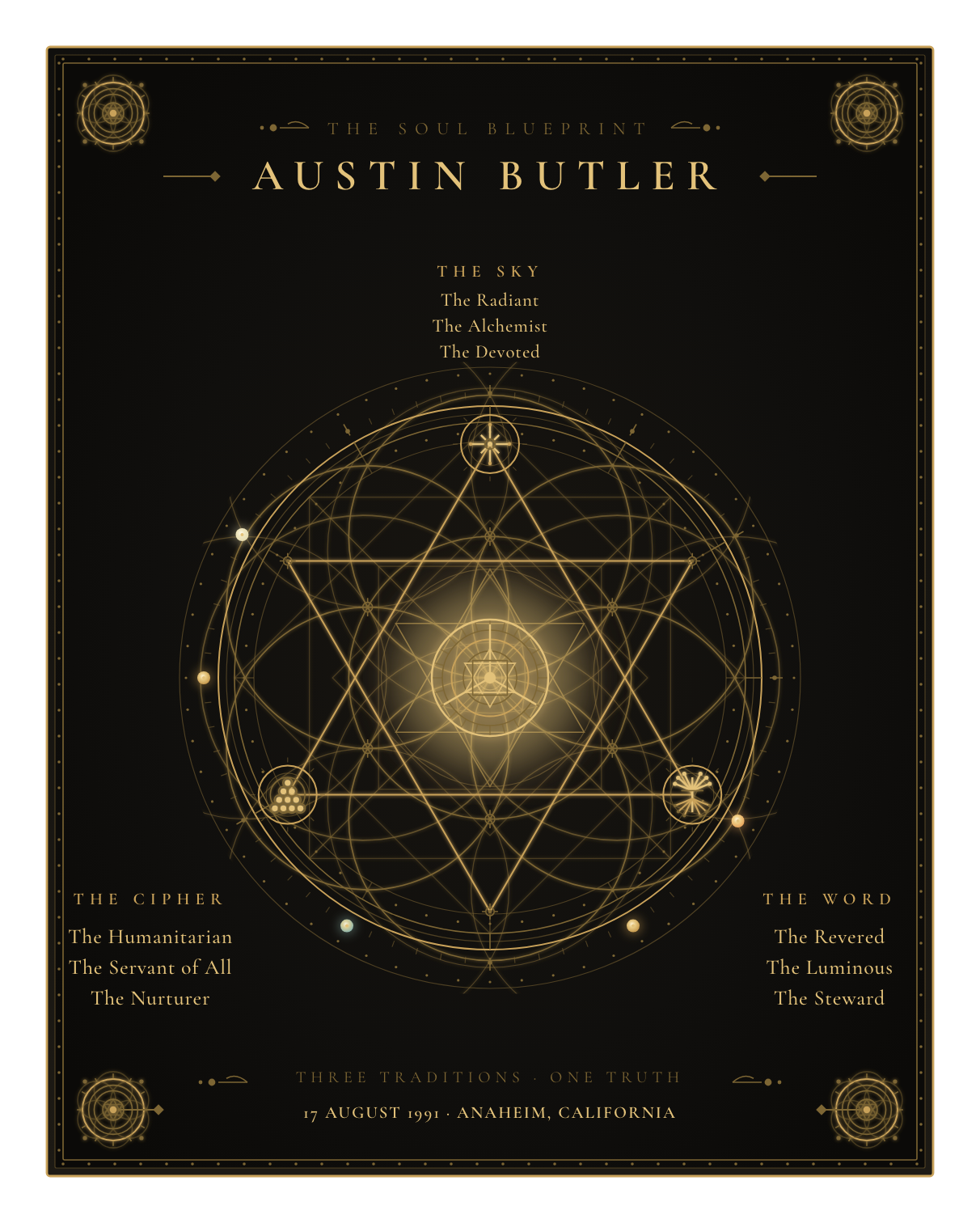
One seal, three languages. The sky he was born under at the apex, the numbers beneath his name at the lower left, the name itself at the lower right — three traditions engraved into one artifact. There is no rising sign, no houses, no angles: without a verified birth time they cannot be honestly drawn. What is true is what is shown.
At a Glance
- Full traditional name
- Austin Robert Butler
- Born
- August 17, 1991 · Anaheim
- Sun
- Leo 24.4° — the essential fire of the life
- Rising
- Birth time unverified — the Ascendant is offered conditionally, never asserted
- Moon
- Date-dependent across the unverified birth day — not fixed without a confirmed time
- Mind · Value · Will
- Mercury Virgo · Venus Virgo · Mars Virgo
- Discipline · Direction
- Saturn Aquarius · North Node Capricorn
- Life Path
- 9 — The Humanitarian
- Title-name Destiny
- 9 — The Humanitarian
- Birth-name Destiny
- 6 — The Nurturer
- Master Numbers
- None preserved at the final layer
- Soul archetype
- The Humanitarian who lives the Humanitarian’s path
It is 2022, and the light in Los Angeles is the color of burnished copper—the kind that turns the skin golden and makes even the ordinary street look like a film set. Austin Butler sits in a room somewhere in that city, or perhaps in a rehearsal space, or perhaps alone in a house with a guitar, and there is a quality of exhaustion in the air around him that is almost visible. ‘I honestly didn’t sleep for about two years,’ he will say of what came before this moment, speaking of the Elvis role as though it were a fever he had to ride until the body broke through to the other side. The world sees fragments: the boy who began at the Orange County Fair, plucked from anonymity by a talent scout at thirteen; the steady climber through Nickelodeon and Disney, then the leap to Broadway, then the sudden, shattering arrival of a role so total it demanded the sacrifice of sleep itself. The world calls him an actor, a transformer, a technical virtuoso who could inhabit Tex Watson’s violent numbness or Elvis Presley’s mythic loneliness with equal precision. But underneath the fragments the world assembles—the résumé, the awards, the narrative of arrival—there flows a different source: a soul whose signature is the marriage of radiant creative expression with exacting, almost surgical precision; a being who came into form to demonstrate how a life can be poured entirely into the work, how the self can be remade through discipline and devotion, how recognition arrives not as an accident but as the fruit of having lived the calling completely. This reading descends into that source.
The reading moves through the eight chapters of the Soul Blueprint architecture — The Arrival, The Soul’s Inheritance, The Living of It, The Soul’s Calling, The Soul’s Territories, The Name You Carry, The Moment, and The Invitation — and at the end, the same instrument turns gently toward you.
His soul has a blueprint.
So do you.
The same three languages — the sky, the numbers, the name — are waiting in your own.
The Arrival
Austin Butler arrived carrying a paradox that would shape every threshold he crossed: the drive to create, to build form and beauty and meaning and to offer it outward for recognition, lived simultaneously with an almost monastic capacity for precision, for getting every detail exactly right, for the kind of mastery that demands the dissolution of the self into the work itself. The Sun’s light in him is the dramatic exteriorization of personality—the self that lives by bringing something alive, by radiating outward, by being seen—and yet this radiance is not the spray of light uncontained; it is the focused beam of a consciousness that has been trained by Mercury and Venus and Mars all standing in Virgo, the sign of the craftsman, the healer, the one who sees precisely what is and is not so. He came to show how the creative fire and the disciplined hand are not opposites but lovers, each making the other possible. The Leo Sun is the voice saying ‘I am alive, I am real, I can make something that lives’; the Virgo planets are the voice saying ‘and it will be done correctly, attended to, perfected, consecrated through care.’ This is not the arrival of a natural entertainer coasting on charm; this is the arrival of a servant-artist, a soul whose gift is to pour the self into form until the boundary between the creator and the created dissolves, until the work becomes the prayer.
The Soul’s Inheritance
He was born into a lineage of immigrants and makers—Finnish great-great-grandparents who crossed the ocean to Wisconsin, Irish descent on his father’s side, and a mother who worked with her hands as an aesthetician, someone whose gift was to tend to the surface of things, to see the face and know how to make it beautiful. The marriage that held him did not hold; by age seven, the family split, and the boy carried forward the inheritance of resilience that comes when the primary shelter fractures and one must learn early to make oneself useful, to be the one who does not break others further, to understand that one’s own need must sometimes be secondary to the stability of the whole. He grew up in Orange County, California, in the 1990s, in the era of television as the great dream-factory, and something in him responded to that frequency—not passively, but with a hunger to understand how transformation worked, how the human body and voice could become a vessel for another’s story. At thirteen, he was seen at the Orange County Fair, approached by a representative from a background acting company, and from that moment forward, his childhood became a negotiation between school and set, between the ordinary requirement to grow and the extraordinary pull of the work. He taught himself guitar at thirteen and piano at sixteen, the instruments of someone who speaks internally first, who needs to translate the interior life into sound before it can be offered outward. His great inheritance was not wealth or institutional belonging; it was the capacity to be remade, to apprentice himself to precision, to understand early that the self is not a fixed thing but a work always in progress.
The Living of It
The cost of becoming began early and never ceased. To be a working child actor in Los Angeles is to live in a double time—the time of childhood and the time of professional scrutiny, the time of ordinary growth and the time of being watched, assessed, judged for one’s utility and marketability. He was homeschooled to accommodate the shooting schedules, removing himself from the ordinary classroom where a boy learns the anonymous safety of belonging to a group; instead, he was always the one being looked at, always available, always ready to serve the vision of a director. The roles accumulated—Zippy Brewster on Nickelodeon, then Sebastian Kydd on The CW, guest spots on Hannah Montana and iCarly, a film role in Aliens in the Attic—and with each one came the incremental wearing of the self against the demands of the work. But the real wound came not from the work itself; it came from grief. In 2014, his mother died of duodenal cancer, and the boy who had learned to be useful, who had learned to serve the work, faced a threshold where the work could not save him. He considered retiring entirely, stepping away from the vocation that had consumed his adolescence and young adulthood. Yet he did not stop; instead, he deepened. The wound became the qualification—the knowledge of loss, the understanding of how a life can be taken, the empathy for characters who carry darkness or numbness or the weight of having survived when others did not. By the time he arrived at Broadway in 2018, standing opposite Denzel Washington in The Iceman Cometh, he had lived enough sorrow to speak it truthfully. The critic Hilton Als wrote: ‘there is only one actor, and his name is Austin Butler’—not because he was naturally gifted, but because he had paid the price.
If this is what was true for him, what might be true for you?
The Soul’s Calling
There is a voice in him that came alive early—not the voice of performance or mimicry, but the voice of precision itself. The throat-work of his craft was built on discrimination: the ability to see what is exactly so and what is not, to hear the difference between true and false in a line of dialogue, in a gesture, in the texture of a character’s breath. This is not the gift of the actor who inhabits; this is the gift of the craftsman who refines. His mind arrived shaped for the meticulous—for getting it right, for correcting what is crooked, for making language and movement serve the truth of what is being portrayed. The soul’s calling wrote itself in the demand for exactness.
But exactness alone does not make a voice that matters. The life arc that shaped him—from the child working as an extra at thirteen, signing with management through a chance friendship, building his craft across television and stage—moved him steadily toward a different kind of utterance: the humanitarian voice, the voice that speaks not for itself but for the collective wound, the historical moment, the human story that needs telling. When he took on the role of Elvis, when he inhabited Tex Watson, when he embodied a soldier in wartime, he was not performing variation on a theme. He was translating the interior life of others into a language the world could witness and remember.
He was called to serve the narrative that lives in ordinary souls—to make the exact and disciplined work of his craft into an instrument for the stories that bind us. The precision was never the destination; it was always the price paid to reach toward something larger: the obligation to speak truly for those whose truths are otherwise unheard. His gift is the marriage of meticulous labor and humanitarian reach—the craftsman in service of remembrance.
The Soul’s Territories
The territories most alive in this soul are, first, the territory of transformation itself—the willingness to remake the body, the voice, the posture, the internal rhythm of a being until one can inhabit another’s skin completely. When he prepared to play Elvis Presley, he did not simply memorize movements; he became a different physical organism, down to the particular way the spine held itself, the particular frequency of the voice, the particular quality of attention in the eyes. This territory holds the knowledge that the self is not fixed, that the body is not a prison but a instrument capable of infinite modulation. Second is the territory of discipline as a form of prayer—the understanding that mastery is not achieved through talent alone but through the willingness to be broken and remade by the work itself. ‘I honestly didn’t sleep for about two years’ is the language of someone who has entered into a covenant with the role, who understands that the work demands everything and that everything is exactly what one must offer. Third is the territory of characters who are broken, who carry damage or darkness or the weight of histories they did not choose—Tex Watson, Feyd-Rautha, Gale Cleven—men whose interiority is obscured by trauma or malevolence, and whom he approaches with the compassion of someone who understands that even the most damaged consciousness is a human consciousness, worthy of being rendered truthfully. These territories converge toward the deeper mythology that is taking shape: a soul whose medicine is to show how the price of authenticity is paid in the body, in sleep sacrificed, in the self poured out completely, and how that pouring creates the possibility of transformation in others.
There are twelve domains in the kingdom of any life: The Mark, The Unfolding, The Unseen, The Long Return, The Inheritance, The Encounter, The Alchemy, The Living Tension, The Sight, The Body’s Knowing, The Crossing, The Calling.
The Name You Carry
The names he carries hold a resonance that speaks to his essential work. Austin, in its very sound, has the quality of something arriving, something stepping into a space—and the world first encountered him stepping into that fair at thirteen, stepping into the notice of a talent representative, stepping across thresholds that would remake his life. Robert, the name buried in his full designation, carries the old Germanic sense of ‘fame’ and ‘brightness,’ the radiance that glows from within, that arrives of its own accord when a soul has done its work truly. And Butler—a name that speaks to service, to one who attends to the needs of a household, who manages, who keeps things running, who is the one behind the scenes making it possible for the visible work to occur. These three names together compose a particular truth: the one who arrives, who brings brightness, who serves. They speak to a soul whose genius is not rebellion or the assertion of a singular ego but the perfect subordination of the self to the demands of the work, the quiet mastery of the one who knows that real power is invisible, that the best service is the service one does not call attention to. He is the name of the craftsman who steps into the light not for the light itself but because the work requires him to, who glows not from vanity but from having poured everything into the form he has been asked to hold.
The Moment
The year was 2019, but the threshold had been building for years—the slow accumulation of small roles, the learning of the craft in the margins, the death of his mother in 2014 that had cracked him open to depths he did not know he carried. Then, in the late summer of 2019, Quentin Tarantino’s Once Upon a Time in Hollywood arrived, and in that film, playing Tex Watson, a fictional member of the Manson Family, Austin Butler inhabited a consciousness of such flat, unsettling numbness that something shifted in the world’s perception of him. It was not a large role—limited, intense, brief—but it was the role that said: this actor can do something dangerous, something that does not require charisma or likeability to be riveting. Then came the audition for Elvis, and then came the role itself, premiering at Cannes in 2022. And then came the understanding, finally, that all the years of small work, of apprenticeship, of learning to serve had been leading here. The critical recognition that arrived—the BAFTA, the Golden Globe, the Oscar nomination, the invitation to join the Academy, the appearance on Time’s list of the most influential people—was not the arrival of someone newly talented; it was the recognition of someone who had always been paying the price, who had always been showing up, who had simply waited until he was asked to pour everything he had learned into a single vessel. The moment revealed something about how arrival works: it is not a stroke of lightning but the culmination of a life of small disciplines, small yes-answers, small acts of service that gradually remake a human being into an instrument transparent enough to channel something larger than itself.
The Invitation
Everything in this reading has been moving toward a single point. The doubleness named in the first chapter, the inheritance, the wound, the calling, the territory, the name, the moment. These are not seven separate truths about Austin Butler. They are one truth, named from seven different angles. And they all converge here.
The invitation arrived not as a whisper but as a door opening in the flesh — a representative appearing at the Orange County Fair when Austin was thirteen, the age when the voice begins to change and the body becomes a stranger to itself, a threshold where childhood’s safety dissolves into the terrifying possibility of becoming. What was being asked of him then, and what continues to be asked, is the precise and irreducible thing: to make a craft from the instrument of his own being, to turn the body and the voice and the face into a vehicle for the transmission of truth about other souls, other lives, other griefs that are not his own. This is not the romantic invitation of the stage — it is the invitation of service through exact embodiment, the call to become a master technician of presence, to learn what it means to dissolve the boundary between his own interiority and the character who lives behind his eyes.
What was being released — what had to die for this Yes to mean anything — was the ordinary safety of childhood, the familiar nest of school and neighborhood and the unremarkable progression toward adulthood that his peers were walking. At seven, his parents’ separation had already written into his nervous system the knowledge that what appears stable can fracture; now, stepping into professional work before adolescence could complete itself, he was choosing a second rupture, trading the unobserved life for a life lived in fragments, in rewrites, in the scrutiny of others’ judgment. The homeschooling that followed was not a gentleness but a restructuring — the removal of ordinary time so that extraordinary time could be claimed. To work as a background actor, then as a supporting player on children’s television, required the surrender of the teenage years that other boys inhabited. This is what the invitation always demands: the release of the path not taken, the ordinary life as exchange for the extraordinary one.
What was being called toward — and what remains the direction this soul is traveling — is nothing less than the full maturation of his gift into public contribution and earned responsibility. The early work in television was apprenticeship, the necessary grinding of the craft: learning to hit marks, to take direction, to understand the mechanical precision required to make something work on screen. But the real invitation began to crystallize in the breach — in the moment when the work stopped being about becoming famous and started being about becoming true. The Broadway stage in 2018, playing opposite Denzel Washington in a role that demanded he carry the weight of a man’s spiritual collapse, was the threshold where the precision of his instrument met the depth of human suffering. When the critic’s pen wrote that there was ‘only one actor, and his name is Austin Butler,’ something shifted — not his ego, but his responsibility. He was no longer permitted to be small.
And then came the call that would transform everything: to become Elvis Presley, to inhabit not a character in a story but a historical presence, a grief-laden American icon whose body and voice and loneliness had to be reconstructed from the inside out. What became available because Austin said Yes to this — because he chose the extremity of it, the ‘two years without sleep,’ the physical transformation, the psychological descent into another man’s despair — was the opportunity to discover what his instrument was actually capable of. He could not perform Elvis; he could only become the conditions under which Elvis could be seen and felt. The awards and the acclaim that followed were not the point; they were the evidence that he had succeeded in the alchemy of transformation, that he had taken the radiant creative fire he was born with and refined it into something so exact, so useful, so penetratingly honest that it moved not just viewers but the gatekeepers of culture itself.
Now the invitations continue to arrive — not in hesitation but in demand. The villainous Feyd-Rautha in the science fiction epic; the war story of Masters of the Air; the forthcoming biography of the athlete. Each one asks the same question with greater intensity: How far will you go to tell the truth of another soul? This is where the invitation dwells now, in the precision and the rigor of that question, in the knowledge that his gift is not for himself but for the collective hunger to understand what it means to be human, to suffer, to transcend, to fall. The invitation is to keep saying Yes — not to fame, but to the work itself, to the mastery of the craft that allows a soul to become a vessel for the world’s stories.
He was not late. He was exactly where the soul-clock said he should be. The mission had been inscribed at the threshold of his first breath. What was being asked of him, he has been walking. The naming has been done.
This Is Not Coincidence
The astrology shows a soul designed for dramatic creative expression—the Sun in Leo, the sign of creative self-actualization and the radiant outpouring of the self into form—but this radiance is immediately tempered and refined by Mercury, Venus, and Mars all stationed in Virgo, the sign of precision, service, and the mastery of exacting detail; the soul came to demonstrate that creativity and craft are not opposites but lovers, and that the highest form of expression requires the most rigorous discipline. The numerology independently reveals a Humanitarian whose work is to serve something larger than himself, a Birth Destiny as the Nurturer who tends to what needs tending, and a Life Path that demands he contribute to the collective through service and transformation; the numbers speak of a consciousness designed to pour itself out, to give, to render others’ stories visible, to heal through the act of witnessing. The names speak of one who arrives carrying brightness, whose gift is service itself, whose work is to remain the invisible craftsman behind the visible work. Three entirely different languages. One truth: a soul whose medicine is radical transparency, the willingness to become completely empty so that something larger can fill the space and flow through.
Three entirely different languages. One truth.
This is not coincidence. This is what three independent systems do when they are all telling the truth about the same soul.
The Numbers, Decoded
The numbers are computed, not intuited — each letter takes its Pythagorean value, each name reduces, and any Master Number is preserved rather than collapsed.
You have sat with the chart and the numbers and the name of another soul, and watched how a wound becomes a calling, how the place of least belonging becomes the place of greatest gift, how a life too precisely configured to be coincidence reveals itself when three independent languages are read together.
The reading you have just received was, in its outer form, a reading of his soul. But its inner form was a reading written for yours. You did not arrive without a Blueprint either. May this reading be the beginning of the reading you finally receive of yourself. May the light you carry — in whatever particular, irreplaceable form it has taken inside the specific life you were given.
Some lives carry a pattern this clear.
Yours does too.
You’ve read the shape of his soul. The same three languages — the sky, the numbers, the word — are waiting in your own name and birth date. Begin yours, free, below.
Or, when you’re ready, begin your own full Soul Blueprint reading →
Frequently Asked Questions
What is Austin Butler’s birth chart?
Austin Butler’s birth chart is anchored by a Leo Sun—the sign of creative self-actualization and dramatic creative expression—but this Sun is immediately complicated and deepened by three planets in Virgo: Mercury (the analytical, precise voice), Venus (love expressed as devoted care and service), and Mars (will expressed as exact, skillful action). Saturn in Aquarius adds the dimension of discipline, principles, and a soul called toward lasting contribution to the collective. Because his birth time is unverified, the rising sign cannot be reliably determined; what we know with certainty is the Sun and the inner planetary signature that speaks to how he thinks, loves, and acts.
What is Austin Butler’s numerology?
Austin Butler’s numerology reveals three interconnected numbers: the Title Destiny (from ‘Austin Butler’) is 9, the Humanitarian, indicating a soul whose work is to serve something larger than itself and to contribute to collective evolution. The Birth Destiny (from ‘Austin Robert Butler’) is 6, the Nurturer, speaking to his capacity to tend, to care, to hold others’ stories with compassion. The Life Path (from his birth date, August 17, 1991) is also 9, reinforcing the call to humanitarian service and the dissolution of the individual ego in service to something transcendent. Together, these numbers speak to a soul designed to give, to witness, to serve.
What does the name Austin Butler mean?
The name Austin carries a quality of arrival, of stepping into visibility and presence. Robert speaks to radiance and brightness—the light that shines from within when a being has devoted itself to its true work. Butler is the name of service itself, the one who attends, who remains steady behind the scenes, who makes it possible for others to do their work. Together, these three names compose the essence of his particular calling: to arrive in service, to bring brightness through the act of attending to others’ stories with complete devotion.
What is a Soul Blueprint?
A Soul Blueprint integrates three independent traditions — Western natal astrology, Pythagorean numerology, and the etymology of the full birth name — into a single document written as a personal letter to the soul. When you’re ready, you can begin your own.
This reading was prepared in the lineage and methodology of the Soul Blueprint Method — Pythagorean numerology with master numbers preserved, Western archetypal astrology, and a researched etymological reading of the full name. Austin Butler’s birth date (August 17, 1991) is sourced from the public record; the birth time is unverified, so the rising sign is offered conditionally and never asserted.
A Soul Blueprint reading · Astrology · Numerology · Etymology · shams-tabriz.com