
Amanda Seyfried’s Birth Chart, Numerology, and Name Decoded
Amanda Seyfried’s Birth Chart,
Numerology & Name Decoded
The Soul Blueprint Method — three traditions woven into one personal letter: Western natal astrology, Pythagorean numerology, and the etymology of the soul’s name. Learn the method →
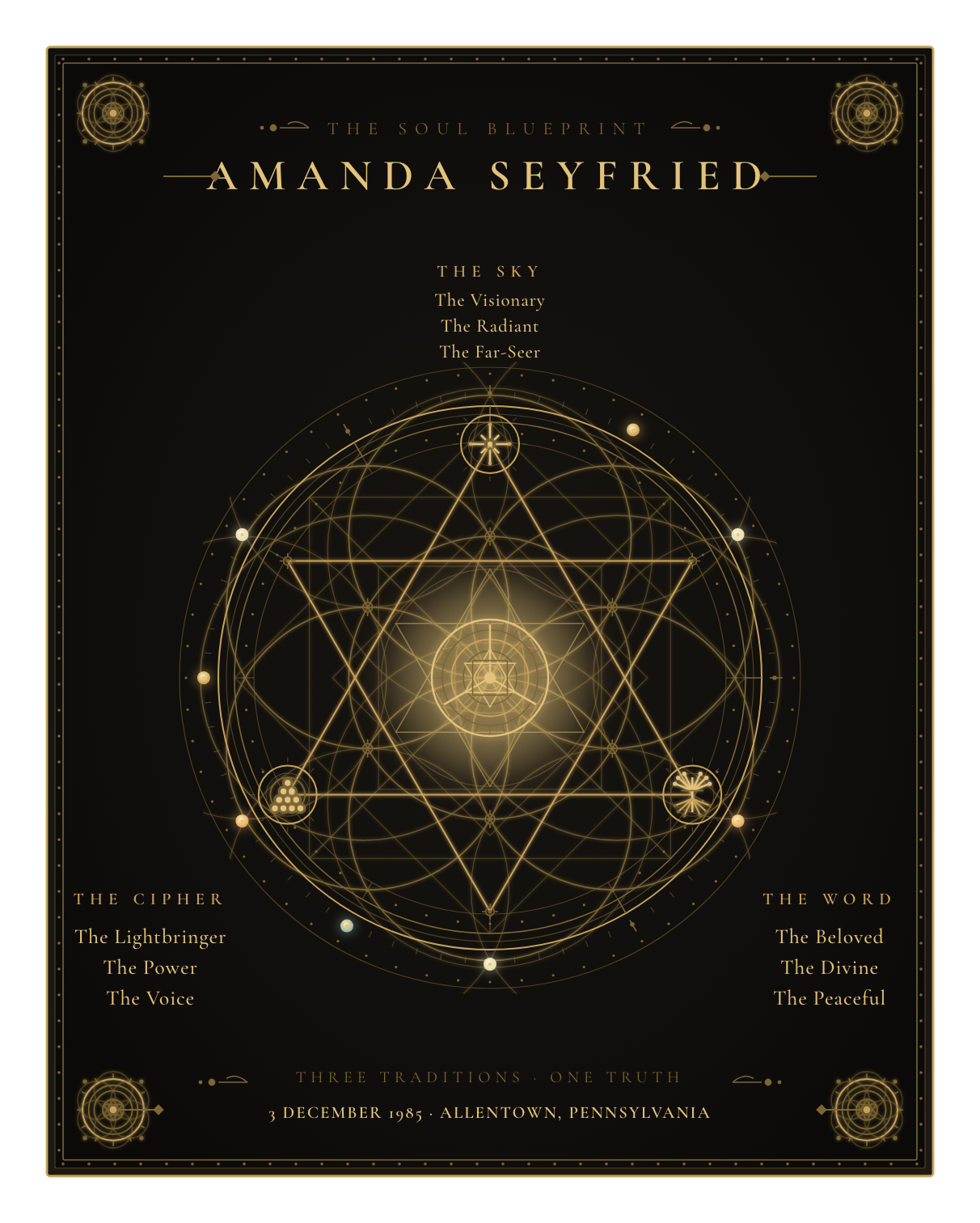
One seal, three languages. The sky she was born under at the apex, the numbers beneath her name at the lower left, the name itself at the lower right — three traditions engraved into one artifact. There is no rising sign, no houses, no angles: without a verified birth time they cannot be honestly drawn. What is true is what is shown.
At a Glance
- Full traditional name
- Amanda Michelle Seyfried
- Born
- December 3, 1985 · Allentown
- Sun
- Sagittarius 11.5° — the essential fire of the life
- Rising
- Birth time unverified — the Ascendant is offered conditionally, never asserted
- Moon
- Leo 21.2° — the inner life
- Mind · Value · Will
- Mercury Sagittarius · Venus Sagittarius · Mars Libra
- Discipline · Direction
- Saturn Sagittarius · North Node Taurus
- Life Path
- 11 — The Illuminator
- Title-name Destiny
- 8 — The Sovereign
- Birth-name Destiny
- 3 — The Communicator
- Master Numbers
- 11
- Soul archetype
- The Sovereign who lives the Illuminator’s path
It is 2004, and the light in the audition room is fluorescent and merciless. A young woman sits across from the casting director, her nervousness candid, her intelligence already visible in the way she listens. She reads the lines for Karen Smith—a character written as decorative, as comic relief—and something happens in the room that nobody expected: the character becomes inhabited, becomes true, becomes a vessel for something larger than the script. The filmmakers see not the surface they wrote, but the depths beneath it. Mean Girls will gross more than $130 million, and this moment—this single afternoon in a room with white walls—will mark the threshold between the life that was building in secret and the life the world will now witness.
But who arrives into such a threshold is not always the person whose name appears in the credits. The fragments the world calls them—the roles she plays, the red carpets, the magazine covers, the nominations and victories—these are the visible riverbed, the channel everyone can see and name. Yet beneath that channel moves the source: the deeper current that chose those stories, that understood which characters needed inhabiting, that moved through each one knowing something about the cost of being watched and the freedom hidden inside surrender. This reading descends below the visible riverbed to find the source itself—the essential blueprint that arrived on December 3, 1985, already carrying its own geometry, already knowing what it came to do.
A soul shaped by the same discipline that builds tested philosophies and enduring meaning—the kind of mind and heart that does not settle for surfaces, that seeks principles and growth even in the midst of performance. A life built in the public eye, yet anchored in something private and fiercely self-earned. A woman who modeled for companies whose names are forgotten, who waited tables in a retirement community, who played minor roles on daytime television before the audition that would change the light in every room she entered—and through all of it, she was building something, not waiting for it.
What follows is not the story the world tells about her. It is the story the soul itself is telling—the geometry underneath, the inheritance, the wound that became a gift, the calling that arrived dressed as performance, and the territories where her essential nature has been most alive. This is the reading of the source.
The reading moves through the eight chapters of the Soul Blueprint architecture — The Arrival, The Soul’s Inheritance, The Living of It, The Soul’s Calling, The Soul’s Territories, The Name You Carry, The Moment, and The Invitation — and at the end, the same instrument turns gently toward you.
Her soul has a blueprint.
So do you.
The same three languages — the sky, the numbers, the name — are waiting in your own.
The Arrival
There arrived, on the cusp of Sagittarius, a soul tasked with the same paradox that all seekers carry: the need to quest for meaning and eternal values while remaining rooted enough to actually live those values, to build them not as abstractions but as lived structures. The self that comes alive by seeking—by asking the far horizon what it means, what it matters, what cannot be bought or performed—and yet simultaneously bound by Saturn’s discipline to earn every conviction, to make sure that nothing she claims to believe has not been tested first by time and lived experience.
She did not arrive expecting to be looked at. She arrived expecting to understand. The mind came wired for synthesis, for grasping the large pattern and the principle underneath, for seeing how separate things connect into a coherent whole. The voice—when she found it—would be frank, enthusiastic, visionary: the voice of one who believes the truth is worth speaking, even when it costs something. This is the signature of a soul that came to be a communicator, a witness, an illuminator—not of surfaces, but of the depths underneath.
And yet the heart arrived with a different hunger entirely. The emotional nature needed to shine, to be met with warmth and recognition, to sing and roar when it was safe enough to do so. This created a particular kind of tension from the beginning: the mind reaching outward for universal meaning while the heart insisted on being truly seen, truly valued, truly met. That tension—between the philosophical mind and the radiant heart—would become the forge in which her entire life was built. It is the sound of a soul that came here to teach meaning while learning, over and over, what it costs to be truly beloved rather than merely admired.
The Soul’s Inheritance
She was born into the inheritance of steadiness and service. A mother who was an occupational therapist—a profession of careful presence, of helping people rebuild their own capacity to live—and a father who was a pharmacist, a keeper of precise knowledge, a maker of formulas that healed. These were not flashy inheritances, but they were rooted: the bloodline of the people who show up, who know the work, who understand that healing and service are patient disciplines, not performances.
And she had a sister who chose music—a musician in a rock band, someone who had already answered the call to expression and to being heard. So there was already in the household a template for what it meant to be an artist, to stand in front of people with your own voice, to take the risk of being known through your own creation. She was born into a family of Pennsylvania—Allentown, German ancestry, the industrial heartland of a nation that believed in making things with your hands, in hard work rendered visible.
The era was the late 1980s and early 1990s, the age of image beginning its slow colonization of consciousness. She began modeling at eight years old—not because she wanted to be famous, but because an agency saw something in her face and her parents said yes to the possibility. Limited Too. Sweet Valley High covers. The machine of image-making was already learning her face while her interior life was still forming. She studied art, took piano lessons, studied voice and opera as a teenager, trained with a Broadway coach. The inheritance was dual: the inheritance of her bloodline—people who made things—and the inheritance of an era that had learned to commodify the image of beauty itself. She did not choose that era. She was born into it.
The Living of It
The living of it began at eight years old and it was not gentle. To be modeled—to have your face circulated, reproduced, turned into product and advertisement—is a particular kind of violence disguised as opportunity. It teaches you early that your visible self is valuable to others, and that the invisible self—the one having feelings about it all—is mostly irrelevant. By seventeen, she had stopped. She needed to step back from being looked at and become instead a person who served—she took a job as a waitress in a retirement community. This was not failure. This was necessary recalibration. She was refusing the false acceleration, the premature shape that the machine wanted to impose.
Then came the acting. Small roles in daytime television—Guiding Light, As the World Turns, All My Children—the grind of soap opera work where you learn your lines and hit your marks and show up six days a week for years. There were no red carpets. There was only the discipline of the craft, the slow accumulation of skill, the daily practice of being someone else as a way of understanding something true. She enrolled at Fordham University in New York City—she was building a real education, not waiting for a break—and then the break came anyway, not because she was waiting, but because she had become the kind of person who could do the work.
Mean Girls arrived when she was nineteen, and the light changed overnight. This is the wound-becoming-qualification: she had spent her entire adolescence learning how to be watched and how to not be corrupted by it. She had refused the initial machine. She had worked in obscurity. She had built her own steadiness. So when the world finally did look at her, she was not empty, not desperate, not already hollowed out by early success. She was something else: she was ready. The cost was that she would never again be unknown, never again be allowed to be ordinary. The qualification was that everything inside her—all the discipline, all the study, all the refusal—could now serve something larger than herself.
If this is what was true for her, what might be true for you?
The Soul’s Calling
The calling that arrived was not to be beautiful—it was to be true. The synthesizing intelligence, the capacity to see the principle and the pattern underneath the surface of a story, the voice that is naturally frank and visionary—these arrived as instruments designed to do a specific work: to illuminate the depths underneath the surfaces that culture wants to celebrate.
She came to demonstrate what it means to inhabit a character so completely that the character becomes real, becomes a revelation of something true about human nature that the script only hinted at. Every role she has taken—from Karen Smith in Mean Girls onward—has been an excavation. She plays women trapped and women who break free, women who are lost and women who find their own ground. She plays Elizabeth Holmes and Marion Davies and Sophie Sheridan; she plays the guilty and the innocent and the complicated. Each time, she does the same thing: she goes down into the character’s interior and brings back the truth that lives there.
The calling is also to teach—through the way she chooses her roles, the way she commits to her craft, the way she has spoken publicly about her own anxiety and OCD and the stage fright that lasted years. She teaches by refusing the false brightness, by insisting on the real cost of the work, by demonstrating that an illuminating life is not a comfortable one. The calling is to use the visible platform—the roles, the magazines, the attention—as a lens to make the invisible visible. It is the Life Path of the illuminator, the messenger who brings light not by making things prettier, but by making them true.
The Soul’s Territories
The first territory where she is most alive is the territory of Character—the space where an actor becomes the inhabited vessel of another consciousness. In Mean Girls, in Veronica Mars, in Big Love, in Mamma Mia!, in The Dropout, she has demonstrated a particular gift: the capacity to enter a life that is not her own so completely that the boundary between performer and performed dissolves. The mind that synthesizes, that grasps the large principle, allows her to see what holds a character together—the deep logic beneath the contradictions. This is not impersonation. This is revelation.
The second territory is the territory of Growth and Expansion—the willingness to move into larger, more complex, more demanding roles as her capacity deepened. From comic supporting roles to leading roles, from ensemble pieces to one-woman performances, from film to television to the limited series that allowed for the kind of sustained investigation that could unlock Elizabeth Holmes or Ann Lee. Each expansion was not about becoming more famous; it was about becoming more capable of truth. This is the territory of the quest itself—the refusal to stay in any single shape.
The third territory is the territory of Service and Presence—less visible, but steady underneath. She is a board member of INARA, an organization providing medical services for children wounded in war zones. This is not the performance of charity; this is the inheritance of her mother the occupational therapist, the lineage of people who show up to help others rebuild their capacity to live. This territory holds what the public work sometimes obscures: the deep commitment to the lives of people who will never be famous, who will never be photographed, who simply need the steady presence of someone who knows how to help.
These three territories—character, growth, presence—weave together into a deeper personal mythology. They are not separate from the public work; they are what the public work serves. Every role deepens her capacity for presence. Every expansion of her craft makes her more useful to the people she serves.
There are twelve domains in the kingdom of any life: The Mark, The Unfolding, The Unseen, The Long Return, The Inheritance, The Encounter, The Alchemy, The Living Tension, The Sight, The Body’s Knowing, The Crossing, The Calling.
The Name You Carry
The name Amanda arrives from the Latin, carrying the meaning she who must be loved. Not she who is beautiful, not she who is talented, not she who performs well—she who must be loved. This is not a small thing. It is a declaration that love is not optional, not a bonus that arrives if you are successful enough, but necessary, essential, the ground beneath everything else. The name itself is an argument for the supremacy of being beloved over being admired. And this resonance matches something deep in her chart: the emotional nature that needs to shine and be met with warmth, that requires the heart to be truly seen in order to sing and roar freely.
Michelle carries within it the question Who is like God?—a name that points toward the divine, toward standards that exceed the human, toward something that cannot be domesticated or made comfortable. It is a name that suggests aspiration, transcendence, the reaching toward something larger than the personal self. This echoes the Sagittarian quest, the mind that seeks eternal values, the soul tasked with grasping the principle and the meaning that lives beyond the surface.
Seyfried is a name of German ancestry, practical and rooted, a name of people who made things with precision and care. It is a surname that suggests steadiness, groundedness, the inheritance of discipline and work. Together, these three names hold the entire paradox: she who must be loved, who reaches toward the divine, who is rooted in the steady practical work of showing up. The names themselves are a blueprint—demanding that she honor the heart’s hunger for recognition while never forgetting the philosophical reach, while remaining always anchored in real work, real presence, real service. The names refuse easy resolution. They insist on holding all three at once.
The Moment
The moment arrived in 2022, and it began in a basement in Silicon Valley. She was cast to play Elizabeth Holmes—the young founder of Theranos, a woman who built a lie so convincing that it fooled everyone, a woman whose intelligence was real and whose deception was absolute. To play this role, she had to understand the interior logic of someone who was simultaneously a visionary and a fraudster, a believer and a con artist, a woman with all the markers of genius and ambition except for the truth underneath.
This was not a role she could approach as she had approached so many others—by finding the humanity and the truth in the character’s interior. Elizabeth Holmes was the exploration of what happens when the inside and the outside are radically misaligned, when the face you show the world is a construction built on lies so deep they become indistinguishable from belief itself. To play this truthfully, Amanda had to hold that paradox without resolution: the genuine ambition and the calculated deception, the visionary impulse and the willingness to betray everyone who believed in her.
When the limited series aired in 2022, something happened that had never quite happened before. The performance was so complete, so unsparingly true, that it became the definitive cultural reading of who Elizabeth Holmes was. And simultaneously, Amanda herself became known not just as a beautiful actress, not just as a talented performer, but as an illuminator of the depths—as someone who could take the public story of a woman and excavate the interior truth until you could see the exact point where intelligence became ambition became deception became belief.
The Emmy arrived in 2022. The Golden Globe. The Critics’ Choice award. The Academy Award nomination. She was named one of the 100 most influential people in the world by Time magazine. The light in the room had changed again—but this time, she was not the object of the looking. She was the instrument of revelation. The moment revealed what all the years had been building toward: a soul that had learned how to use the visibility that arrived when she was eight years old and refused, at seventeen, and earned back through discipline and craft—to illuminate the truths that culture most needs to see.
The Invitation
Everything in this reading has been moving toward a single point. The doubleness named in the first chapter, the inheritance, the wound, the calling, the territory, the name, the moment. These are not seven separate truths about Amanda Seyfried. They are one truth, named from seven different angles. And they all converge here.
What is being asked of this soul, in the living present, is to continue the work of excavation while also excavating a new territory: the territory of what it means to be a woman who is visibly aging, visibly changing, visibly moving through the seasons of a life in the eyes of a culture that commodified her image before she was old enough to consent to it. The question that now arrives is whether she can maintain the same unsparring truthfulness about aging bodies, aging faces, aging women that she has brought to the excavation of moral complexity and emotional depth. This is not vanity. This is the deepest part of the calling: to refuse the false brightness of the industry that made her, and to insist instead on the real cost of time, the real beauty of survival, the real depths that arrive when you stop trying to be what others want you to be.
What is being released is the last traces of the girl who modeled for companies whose names are forgotten, the young woman who waited tables in a retirement community trying to become invisible again after having been made too visible too soon. What is being released is also the young actress who believed that the only way to prove her worth was through the intensity of her commitment, the sacrifice of her privacy, the willingness to disappear into other people’s stories. The release is into something more spacious: the capacity to hold the work and the life together, to be an actress and also a mother, to be visible and also rooted in something private and self-earned.
What is being called toward is the deepest part of the inheritance: the same steadiness that her parents carried—the pharmacist who knew the formulas, the occupational therapist who helped people rebuild their own capacity to live. She is being called toward a kind of presence that does not depend on being watched, that serves the people closest to her with the same unsparring attention she brings to the characters she inhabits. She is being called toward the completion of the quest: not toward a final answer, but toward a tested and grounded wisdom that no longer needs to prove itself through performance.
What became available because the Yes was said—the yes to each role, each risk, each excavation—is a kind of freedom that most people never touch. Not freedom from responsibility, not freedom from the weight of being known, not freedom from the cost. But freedom to choose what she inhabits now, freedom to say no to the roles that do not require her depths, freedom to use the platform she never asked for but has carried faithfully for twenty years as an instrument of something larger than herself. The freedom to be beloved not for her beauty or her talent, but for her willingness to go down into the depths and bring back the truth that lives there—and to share that truth with everyone who watches, even when it costs something.
She is being asked to trust that the steadiness underneath, the inheritance of service, the capacity to show up and do the work day after day without needing to be celebrated—that this is enough. That a life well-lived is not measured by the size of the role or the number of people watching, but by the unsparring honesty with which you inhabit whatever you have chosen to inhabit. This is what is being asked. And she is answering it by continuing to choose characters and projects that require her entire being, by continuing to speak truthfully about the cost of visibility and anxiety and age, by continuing to serve both the art and the people closest to her with the same devotion.
She was not late. She was exactly where the soul-clock said she should be. The mission had been inscribed at the threshold of her first breath. What was being asked of her, she has been walking. The naming has been done.
This Is Not Coincidence
Passage One: The astrology declares a mind and voice built for synthesis and the far horizon, rooted in discipline that has tested every conviction against the fire of time—three planets in Sagittarius, all anchored by Saturn’s refusal of easy answers. The numerology, reading an entirely different geometry, arrives at the Life Path 11, the Illuminator, the soul who came here to bring light to the hidden and the misunderstood. The etymology of her names demands that she be loved, that she reach toward the divine, that she remain grounded in honest work. Three entirely different languages. One truth: A soul designed to illuminate the depths by refusing all surfaces. Passage Two: The astrology shows the heart that needs to shine and roar when it feels truly met, the emotional nature that cannot settle for admiration alone but insists on being beloved—the Leo Moon that requires the warmth of true recognition. The numerology reads the Title Destiny 8, the Sovereign, and the Birth Destiny 3, the Communicator, speaking of a soul tasked with inhabiting complexity and speaking the truths that others refuse to name. The name Michelle whispers Who is like God?, the eternal question of someone reaching beyond the personal. Three entirely different languages. One truth: A woman who refuses false brightness in order to serve what actually matters.
Three entirely different languages. One truth.
This is not coincidence. This is what three independent systems do when they are all telling the truth about the same soul.
The Numbers, Decoded
The numbers are computed, not intuited — each letter takes its Pythagorean value, each name reduces, and any Master Number is preserved rather than collapsed.
You have sat with the chart and the numbers and the name of another soul, and watched how a wound becomes a calling, how the place of least belonging becomes the place of greatest gift, how a life too precisely configured to be coincidence reveals itself when three independent languages are read together.
The reading you have just received was, in its outer form, a reading of her soul. But its inner form was a reading written for yours. You did not arrive without a Blueprint either. May this reading be the beginning of the reading you finally receive of yourself. May the light you carry — in whatever particular, irreplaceable form it has taken inside the specific life you were given.
Some lives carry a pattern this clear.
Yours does too.
You’ve read the shape of her soul. The same three languages — the sky, the numbers, the word — are waiting in your own name and birth date. Begin yours, free, below.
Or, when you’re ready, begin your own full Soul Blueprint reading →
Frequently Asked Questions
What is Amanda Seyfried’s birth chart?
Amanda Seyfried was born on December 3, 1985 (time unverified), making her a Sagittarius Sun—the self that comes alive by seeking meaning, by questing into the vast territories of philosophy, principle, and eternal values. Her Mercury, Venus, and Saturn also occupy Sagittarius, creating a three-fold emphasis on expansive, synthesizing intelligence, adventurous and honest affection, and a discipline that has tested every belief against lived experience. Her Leo Moon (date-stable) shows an emotional nature that needs to shine and be truly met with warmth. Her Mars in Libra channels will and desire through fairness, diplomacy, and the championing of balance rather than domination. The birth time is unverified, so the rising sign cannot be fixed.
What is Amanda Seyfried’s numerology?
Amanda Seyfried carries three distinct numerological destinies. Her Title Destiny is 8, the Sovereign, indicating a soul tasked with holding power and complexity with integrity. Her Birth Destiny is 3, the Communicator, speaking to an essential gift for expression, presence, and bearing witness. Her Life Path is 11 (a Master Number, preserved as 11 rather than reduced to 2), the Illuminator—a soul who came here to bring light to the hidden depths and to speak the truths that others refuse to name. These three numbers together suggest a being designed to illuminate through honest communication and to wield the visibility she carries with sovereignty and care.
What does the name Amanda Seyfried mean?
The name Amanda carries the Latin root meaning ‘she who must be loved’—a declaration that being beloved is not optional but necessary, the ground beneath everything else. Michelle poses the eternal question ‘Who is like God?’, pointing toward transcendence and the reaching beyond the personal self. Seyfried, of German ancestry, is a practical surname suggesting steadiness, groundedness, and the discipline of honest work. Together, the three names form a blueprint that refuses easy resolution: demanding that she honor the heart’s hunger for true recognition while reaching toward something larger than the personal, while remaining anchored in real work and real presence.
What is a Soul Blueprint?
A Soul Blueprint integrates three independent traditions — Western natal astrology, Pythagorean numerology, and the etymology of the full birth name — into a single document written as a personal letter to the soul. When you’re ready, you can begin your own.
This reading was prepared in the lineage and methodology of the Soul Blueprint Method — Pythagorean numerology with master numbers preserved, Western archetypal astrology, and a researched etymological reading of the full name. Amanda Seyfried’s birth date (December 3, 1985) is sourced from the public record; the birth time is unverified, so the rising sign is offered conditionally and never asserted.
A Soul Blueprint reading · Astrology · Numerology · Etymology · shams-tabriz.com