
Rosalía’s Birth Chart, Numerology, and Name Decoded
Rosalía’s Birth Chart,
Numerology & Name Decoded
The Soul Blueprint Method — three traditions woven into one personal letter: Western natal astrology, Pythagorean numerology, and the etymology of the soul’s name. Learn the method →
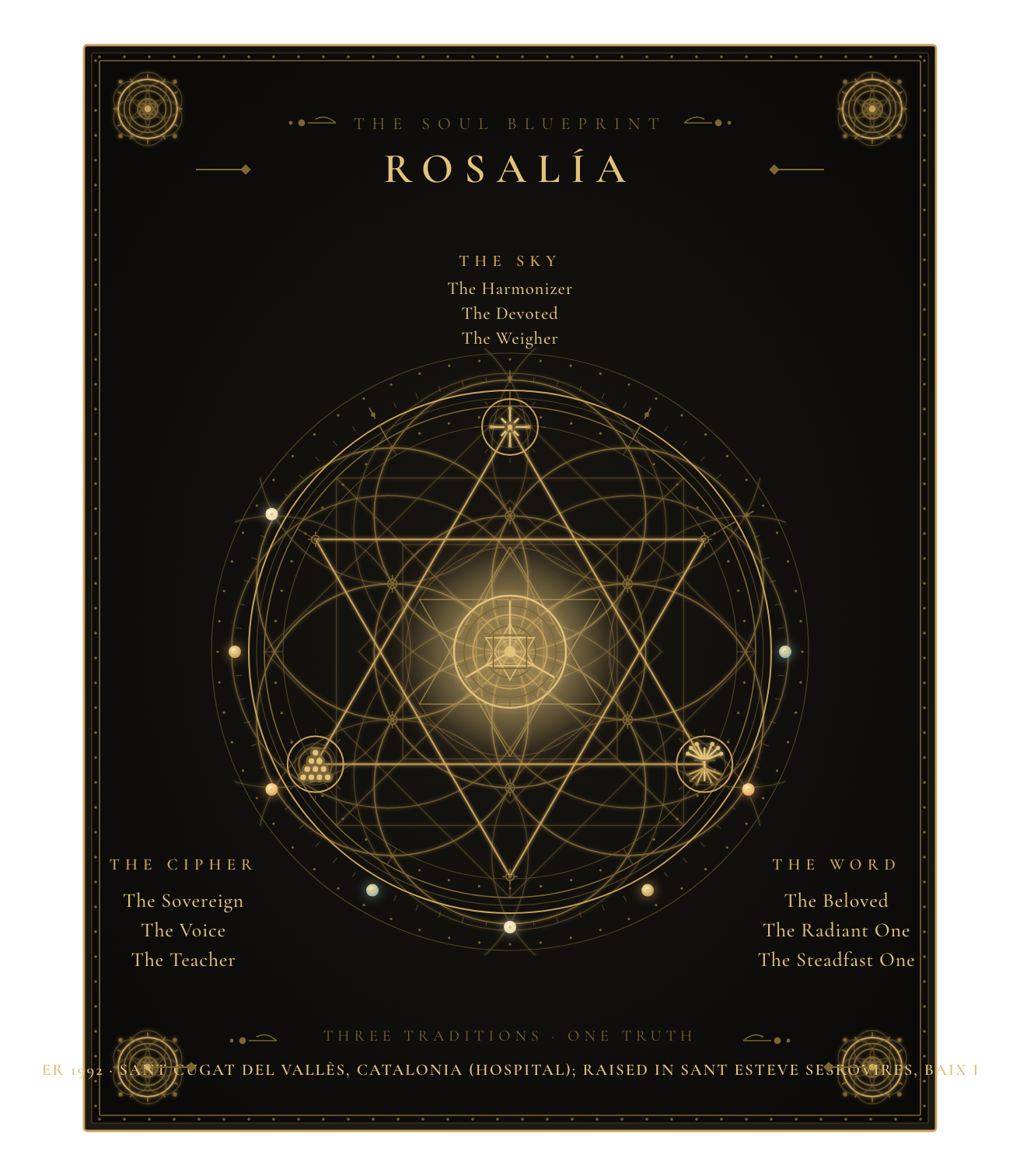
One seal, three languages. The sky she was born under at the apex, the numbers beneath her name at the lower left, the name itself at the lower right — three traditions engraved into one artifact. There is no rising sign, no houses, no angles: without a verified birth time they cannot be honestly drawn. What is true is what is shown.
At a Glance
- Full traditional name
- Rosalía Vila Tobella
- Born
- September 25, 1992 · Sant Cugat del Vallès
- Sun
- Libra 2.6° — the essential fire of the life
- Rising
- Birth time unverified — the Ascendant is offered conditionally, never asserted
- Moon
- Virgo 18.1° — the inner life
- Mind · Value · Will
- Mercury Libra · Venus Scorpio · Mars Cancer
- Discipline · Direction
- Saturn Aquarius · North Node Sagittarius
- Life Path
- 1 — The Pioneer
- Title-name Destiny
- 3 — The Communicator
- Birth-name Destiny
- 33 — The Master Teacher
- Master Numbers
- 33
- Soul archetype
- The Communicator who lives the Pioneer’s path
It is May 2018, and the light in Spain is sharp as a flamenco cry. A song called ‘Malamente’—badly, wrongly, in the manner of sorrow—breaks into the listening world like a shard of mirror, and with it arrives a young woman whose name begins to move from the regional toward the planetary. The fragments the world calls by—a voice that tore itself open and had to learn silence before it could sing again; a body dressed in the aesthetics of Romani tradition that she did not inherit; a technical mastery of a music that is not quite her bloodline; a restless intelligence that collects and collides languages, styles, forms—these are the visible pieces, the surface where light breaks. But beneath them moves a current that predates the moment, the year, the choice to sing flamenco rather than the pop songs playing in the cafés of Sant Esteve Sesrovires when she was a child. There is a source underneath the fragments. This reading goes there—not to the personality that performs, not to the controversy that follows her into rooms, not to the streaming numbers or the critical praise, but to the soul-configuration that arrived in a body in Catalonia in 1992 carrying a specific blueprint, a specific work. The world sees the pieces. We read the current beneath them, the Source that has been moving through her from the beginning, before the tears in her throat, before the television cameras, before she was anyone’s idea of a star.
The reading moves through the eight chapters of the Soul Blueprint architecture — The Arrival, The Soul’s Inheritance, The Living of It, The Soul’s Calling, The Soul’s Territories, The Name You Carry, The Moment, and The Invitation — and at the end, the same instrument turns gently toward you.
Her soul has a blueprint.
So do you.
The same three languages — the sky, the numbers, the name — are waiting in your own.
The Arrival
The self arrived carrying a fundamental paradox: the identity that becomes itself only by meeting the other, by stepping into relationship and discovering the individual unit within the Greater Whole. This is the Libran inheritance—not the soft compromise, but the fierce, active merging into situations, the soul that comes alive only when it is in genuine contact with something outside itself. She arrived wired for balance, for the weighing of perspectives, for the gracious voice that holds both sides and finds the just proportion. The life would be built on this: the capacity to meet another consciousness fully and take her place as a necessary part of something larger. But beneath this gift lay the signature wound that would become the qualification—the reigning need for clarity, precision, and truth that no surface balance could ever satisfy. The emotional nature that steadied itself through discrimination, through the wish to improve, through the relentless truth-telling that lives in the heart before it ever reaches the voice. The self found itself by meeting, always meeting—the other, the tradition, the music, the moment—and in that meeting discovering who it was. And from deep within that relational fire rose a will that was tender and fierce, protective and indirectly assertive, driven not by personal ambition but by the need to defend, to nourish, to hold safe what was fragile. The arrival, then: a soul whose identity bloomed in relationship, whose heart demanded truth, whose strength moved in service of protection, whose voice was built to mediate and balance and, when necessary, to speak the unspeakable.
The Soul’s Inheritance
She was born into a family of making—her mother at the helm of a company that shaped metal into the frames of windows, into the boundaries that let light through while holding a space intact. The Catalan inheritance, precise and industrial, a region that had learned to build systems and to survive by principle and discipline. Her grandmother carried a name that was her own—Rosalía—a lineage of women naming daughters and granddaughters with intention, and into this she arrived, the youngest, into a household where her sister was already a maker of vision, a stylist and creative director, someone who understood how image and intention could speak. Sant Esteve Sesrovires, the town where she was raised, was neither the coastal Barcelona nor the wild Pyrenean villages—it was the middle country, the practical place, where the family businesses ran and the light came in at ordinary angles. She grew up breathing the Catalan language as a native inheritance, the Spanish that came alongside it, and the English that would follow. The era: the 1990s and early 2000s in Catalonia, a region with its own fierce identity, its own music traditions, its own way of holding onto particularity within Spain. At fourteen, something opened in her—a deep enthralment with Spanish folk music, with flamenco, with a tradition that was not quite hers by blood but which called to her as if it had always been waiting. She was born into making, into principle, into the Catalan precision, into a household of women who built things and believed in craft. The source material was practical, disciplined, rooted in the real world of metalworks and systems—and into this she was placed like a seed that would grow toward something her inheritance had not quite named.
The Living of It
At seventeen, her vocal cord tore from the intensity of her own practice, from singing the flamenco music that had seized her at fourteen with the force of possession. A year of silence followed—not metaphorical, but actual, enforced, the voice she was learning to master suddenly forbidden. This was the signature wound becoming the qualification: the soul that arrived demanding clarity and truth, that descended into the body and found that truth required a price. The practice had been intense enough to tear tissue. The silence that followed taught her something the technique alone could never have—the intimate knowledge of what it means to be a voice without sound, a singer without song, a person whose identity was beginning to coalesce around a gift that had been temporarily annihilated. When she returned to singing, it was not the same throat, not the same will. It was a will that had learned caution and respect, that had felt its own fragility. Meanwhile, she was also living in a household where the practical, disciplined Catalan inheritance met something less orderly in the family itself—her parents would separate in 2019, though the fractures had always been present. She studied the tradition formally, earning honors in musicology, releasing her first album as a collaborative work with Raül Refree in 2017, then in 2018 releasing El mal querer as her baccalaureate thesis—not as a commercial venture but as proof that the learning had gone deep enough to speak. The life was lived as a series of chosen intensities: the intensity of practicing until the voice broke, the intensity of remaining silent until it could be trusted again, the intensity of studying a tradition not quite hers while building the technical mastery that would allow her to transform it. Every step cost something. Every step also built bone.
If this is what was true for her, what might be true for you?
The Soul’s Calling
The calling that arrived through this soul is double-threaded: to communicate, to be a voice that mediates and balances and speaks truth across what appears broken—and to be a teacher, to master not just a form but a way of being that could transmit to others, that could light a path. The intelligence that came with her was built for weighing, for holding both sides, for the gracious word that finds proportion. This is the diplomat’s gift, the mediator’s mind: the ability to speak in a voice that is diplomatic yet honest, to translate between worlds that believe they are separate, to find the just and proportionate response. But the calling goes deeper—it arrives as the need to commit to a larger vision, to release the endless collection of influences and facts and second-hand opinions and instead to stand for something, to live what one believes. The voice, then, is not decorative. It is a tool for meaning-making, for transmission, for building a coherent worldview and embodying it so thoroughly that it becomes music, becomes image, becomes the way a person walks through the world. She is a polyglot—English, Catalan, Spanish flow through her as native inheritances—and this gift of languages is itself the calling: to speak across boundaries, to be understood in multiple tongues, to translate between traditions and make something new that honors both. The work she came to do is the work of the bridge-builder who does not smooth the differences away but instead lets them collide and create something that neither tradition could have made alone.
The Soul’s Territories
The first territory alive in her is the territory of flamenco itself—the tradition she entered at fourteen not by blood inheritance but by soul-recognition, learning its forms with such intensity that at seventeen the voice broke under the pressure of its own devotion. This territory holds the ancestral, the Romani-rooted, the deeply feminine, the tradition of cante jondo—the deep song—that moves through heartbreak and survival. It is not hers by lineage, yet she has lived inside it long enough that her body knows its logic, her throat has learned its intervals. The second territory is the studio itself, the technical space where sound becomes craft becomes precision—where the emotional need for clarity and truth meets the machinery of recording, production, collaboration. El mal querer emerged from the studio with producer Raül Refree and with C. Tangana, her partner at the time, eight of its eleven songs co-written in that shared creative space. The territory of collaboration, of building something with another mind, another will, another vision—this is where her relational nature comes alive, where the identity that blooms only in meeting does its work. The third territory is the space of visual culture, of image, of fashion—the aesthetics of Lola Flores, the Met Gala, the carefully constructed visual presence that speaks without words. She moved this territory into being through her choices: the styling that echoes Romani custom, the silhouettes, the colors, the way a body can become a language. These three territories—the ancestral music, the technical studio, the visual speech—are not separate. They are different expressions of the same soul-work: the capacity to meet a tradition, to honor its truth, to transform it through the clarity of her own vision, and to offer it back to the world as something both loyal and radically new. In them lives her deeper mythology: the keeper who does not preserve but instead allows what is inherited to become something unprecedented.
There are twelve domains in the kingdom of any life: The Mark, The Unfolding, The Unseen, The Long Return, The Inheritance, The Encounter, The Alchemy, The Living Tension, The Sight, The Body’s Knowing, The Crossing, The Calling.
The Name You Carry
The name Rosalía carries within it the old root for rose—rosa—and the diminutive -ía, a feminizing suffix that suggests both the flower itself and the diminishment that makes it intimate, particular, hers. A rose is the symbol of love and mystery both, the bloom that must be earned through thorns, the fragrance that announces presence without needing to be seen. Her grandmother carried this name. She carries it forward, not as repetition but as continuation, a thread of intention passing through the lineage of women. Vila—the surname from her father’s line—derives from the Latin villa, the house, the dwelling, the estate, the place where a family is rooted and where its life unfolds. To be a Vila is to come from a lineage of place-making, of building and maintaining structures, though in her particular case it arrived as the name of a family in Galician-Castilian inheritance, a different regional bloodline than the Catalan where she was raised. Tobella, from her mother’s line, carries a less transparent etymology, yet in the sound itself there is a solidity, a name that speaks of craftsmanship and the Catalan precision—her mother runs Suprametal, shapes metal into forms. The full name—Rosalía Vila Tobella—holds the rose and the house and the shaped metal, the feminine bloom and the masculine structure, the Galician-Castilian and the Catalan both. In numerology, the public name Rosalía vibrates as the Communicator, the voice that speaks, the bridge between languages. The full birth name vibrates as the Master Teacher, the one who has been tested and emerges with something to transmit. The names together speak a soul whose work is to be both the delicate opening (the rose) and the foundational structure (the house, the metal), both the voice that speaks into the world and the teacher who builds systems for others to understand.
The Moment
The moment arrived in May 2018 with the release of ‘Malamente’—a song whose title announces wrongness, sorrow, the manner of something broken—and with it the entire album El mal querer, which she had completed as her baccalaureate thesis, which she had built in the studio with Raül Refree and with her then-partner C. Tangana, eight of its eleven songs co-written in that space where two wills met and created. The song rose from regional attention into national, then international consciousness. Critics began to listen. The Grammy Awards, which had never nominated a Spanish female artist for Best New Artist, took notice. The defining moment was not a single day but a season—the year 2018 turning into 2019, when she performed at the Grammy gala as the first Spanish female artist ever invited to do so, when she was nominated as Best New Artist, when her collaboration ‘Con altura’ with J Balvin became the most-watched music video by a female artist of that year. The moment revealed what her soul had been building toward: that it was possible to honor a tradition she had not been born into, to speak a language of music that was not her blood inheritance, to do this with such technical mastery and creative conviction that the world had to listen, had to take seriously both the form she was honoring and the transformation she was bringing to it. But the moment also revealed the cost. The controversy that followed—the accusations of cultural appropriation from Romani people, the debate about who has the right to speak a tradition, who can wear its aesthetics, whose body gets to sing its songs—this too was part of the revelation. The soul arrived carrying the task of meeting the other, of stepping into relationship and discovering herself within something larger. The moment of 2018–2019 was the moment when that meeting became public, when the stakes became visible, when the question ‘Who are you to speak this?’ became inseparable from the question ‘What have you made?’
The Invitation
Everything in this reading has been moving toward a single point. The doubleness named in the first chapter, the inheritance, the wound, the calling, the territory, the name, the moment. These are not seven separate truths about Rosalía. They are one truth, named from seven different angles. And they all converge here.
The invitation arrived not as whisper but as rupture—at fourteen, when the daughter of metalworkers and makers heard the old Spanish songs rising from before her own time, and something in her chest recognized them as her own instruction. She was being asked to become a translator between worlds, to take the fractured inheritance of flamenco—a music born in depths she had not lived but somehow already knew—and speak it forward into a form that had not yet been born. The soul was being called not to preserve in amber, but to merge the ancient with the urgent now, to let tradition and innovation meet as equals in the crucible of her own voice and vision.
That rupture deepened at seventeen, when her own throat betrayed her—the vocal cords tore from the intensity of her singing, and she entered a silence that lasted a year. She could not sing. She could only listen, learn, study the mathematics and theology of music itself through her formal training, and let the wound become a teacher. The body was teaching her that depth cannot be rushed, and that mastery demands not only the ecstatic yes but also the disciplined season of restraint. She was being invited to understand that the woman who would one day command the world’s ear would first have to surrender it entirely, would have to sit in the dark and learn to hear what could not yet be spoken.
And then the invitation shifted again: the work itself demanded she build a vision large enough to hold contradictions. By her early twenties, she had begun the long apprenticeship—studying at the Catalonia College of Music, teaching flamenco to others, working with Raül Refree to record the collaborative album that would become her capstone work. She was being asked to become a bridge-builder, someone who could hold the weight of inheritance on one shoulder and the lightning of innovation on the other, and walk between them without dropping either. Her intelligence moved naturally toward balance and proportion, toward hearing what both sides were saying and finding the just place where they could meet. Her voice, by nature, was diplomatic and fair—the kind of voice that could speak across divides because it genuinely wanted to understand both shores.
By 2018, when El mal querer arrived and Malamente rose to shake the ground beneath her, something had become available that had not existed before: she could now name her own vision without apology. She had studied the old songs until they lived in her bones. She had learned, through rupture and silence and patient rebuilding, to serve the music rather than be served by it. The invitation—which had been whispered at fourteen, torn into her at seventeen, methodically taught through study and collaboration in her twenties—had been accepted, and the acceptance made her a spokesperson for something larger than herself: a new sound, a new possibility for what Spanish music could be in the world, a permission that others—particularly women, particularly artists from her corner of the earth—could suddenly claim for themselves.
Since then, the invitation has continued to deepen in its demand. She has been called to speak not only through music but through presence: through her choice of collaborators, through her willingness to engage with the political and moral dimensions of her art, through her refusal to stay small or silent. She has had to learn to hold her ground against those who accused her of theft, who questioned whether a woman of her background had the right to speak flamenco’s language forward. And instead of retreating into the safety of apology, she has had to build a coherent vision—a life-philosophy rooted in the belief that music is universal, that art is always an act of translation and transformation, that the responsibility of an artist is to tell the truth as she sees it and let the music itself be the answer to the question of belonging.
The yes she said—at fourteen, then again at seventeen, then again in the study rooms and recording studios, then again on the stages of the Grammy Awards where she stood as the first Spanish-singing woman ever to be nominated for Best New Artist—that yes has made her a living example of what it means to receive an inheritance and remake it into prophecy. The invitation continues now, not yet finished, still asking her to go deeper, to reach wider, to speak on behalf of what wants to be born through her. And she is answering it.
She was not late. She was exactly where the soul-clock said she should be. The mission had been inscribed at the threshold of her first breath. What was being asked of her, she has been walking. The naming has been done.
This Is Not Coincidence
The astrology holds the figure born under the sign of relationship and balance, a soul who becomes herself by meeting the other fully and taking her place within something larger—the self discovered through the conscious meeting with what is outside itself. Mercury in Libra carries this further: the voice is diplomatic, fair-minded, genuinely able to hold both sides and speak a gracious truth; the intelligence is one that mediates, that translates, that finds the just proportion. Three entirely different languages. One truth: She was built to speak the language of between, to live in the space where traditions collide and ask what can be born there. The numerology echoes this independently: the public name vibrates as the Communicator, the one who speaks and bridges; the birth name vibrates as the Master Teacher, the one tested and matured into the authority to transmit; the Life Path is the Pioneer, the one who walks into unmapped territory and builds the path by walking it. Three entirely different languages. One truth: She arrived carrying the commission to translate, to teach, to walk where no footprints yet lay, and to leave a map for others. The names themselves resonate the rose—the delicate opening, the bloom earned through thorns—and the house, the structure, the foundations on which a family stands. Three entirely different languages. One truth: The architecture and the flowering both, the foundation and the fragrance, the place where tradition becomes shelter for something unprecedented to grow.
Three entirely different languages. One truth.
This is not coincidence. This is what three independent systems do when they are all telling the truth about the same soul.
The Numbers, Decoded
The numbers are computed, not intuited — each letter takes its Pythagorean value, each name reduces, and any Master Number is preserved rather than collapsed.
You have sat with the chart and the numbers and the name of another soul, and watched how a wound becomes a calling, how the place of least belonging becomes the place of greatest gift, how a life too precisely configured to be coincidence reveals itself when three independent languages are read together.
The reading you have just received was, in its outer form, a reading of her soul. But its inner form was a reading written for yours. You did not arrive without a Blueprint either. May this reading be the beginning of the reading you finally receive of yourself. May the light you carry — in whatever particular, irreplaceable form it has taken inside the specific life you were given.
Some lives carry a pattern this clear.
Yours does too.
You’ve read the shape of her soul. The same three languages — the sky, the numbers, the word — are waiting in your own name and birth date. Begin yours, free, below.
Or, when you’re ready, begin your own full Soul Blueprint reading →
Frequently Asked Questions
What is Rosalía’s birth chart?
Rosalía’s birth chart is anchored in Libra—her Sun sign, the core identity born to relate and discover itself through meeting the other fully. Mercury in Libra amplifies this gift: a diplomatic, fair-minded intelligence built for translation and mediation. Venus in Scorpio brings intense, transformative depth to love and value—emotional honesty that merges completely or not at all. Mars in Cancer expresses will as protection and provision, the warrior-strength that defends home and the vulnerable. Saturn in Aquarius speaks to the soul’s maturation through disciplined service to larger principles and systems. The birth time remains unverified, so the rising sign is not fixed. Her Moon is in Virgo, emotionally steadied by clarity, precision, and the need to improve—a reigning need for truth and useful service in the heart.
What is Rosalía’s numerology?
Rosalía’s numerology carries three primary vibrations: the public name Rosalía reduces to 3, the Communicator—the voice that speaks, translates, and bridges between worlds. Her birth name Rosalía Vila Tobella reduces to 33, the Master Teacher—the master number preserved, indicating a soul tested and matured into the capacity to transmit wisdom to others. Her Life Path, derived from her birth date September 25, 1992, is 1, the Pioneer—the one who walks into unmapped territory, who builds by walking, who blazes the path that others may follow. These three numbers together describe a soul whose work is to communicate across boundaries, to teach through living, and to pioneer new territory.
What does the name Rosalía mean?
Rosalía carries the old root rosa (rose) diminished into intimacy through the suffix -ía, holding the mystery and love of the flower, the delicate opening earned through thorns. Her grandmother carried this same name—a lineage of intention passing through women. Vila comes from the Latin villa, the house, the dwelling, the place-root—and in her case, a Galician-Castilian inheritance that grounds her. Tobella, from her mother’s line, speaks the Catalan precision and craftsmanship. Together, the full name—Rosalía Vila Tobella—holds the rose and the house, the delicate bloom and the foundational structure, the feminine opening and the masculine shelter. The names speak the work: to be both fragrance and architecture, both the voice that rises and the ground on which all standing rests.
What is a Soul Blueprint?
A Soul Blueprint integrates three independent traditions — Western natal astrology, Pythagorean numerology, and the etymology of the full birth name — into a single document written as a personal letter to the soul. When you’re ready, you can begin your own.
This reading was prepared in the lineage and methodology of the Soul Blueprint Method — Pythagorean numerology with master numbers preserved, Western archetypal astrology, and a researched etymological reading of the full name. Rosalía’s birth date (September 25, 1992) is sourced from the public record; the birth time is unverified, so the rising sign is offered conditionally and never asserted.
A Soul Blueprint reading · Astrology · Numerology · Etymology · shams-tabriz.com