
Ted Bundy’s Birth Chart, Numerology, and Name Decoded
Ted Bundy’s Birth Chart,
Numerology & Name Decoded
The Soul Blueprint Method — three traditions woven into one personal letter: Western natal astrology, Pythagorean numerology, and the etymology of the soul’s name. Learn the method →
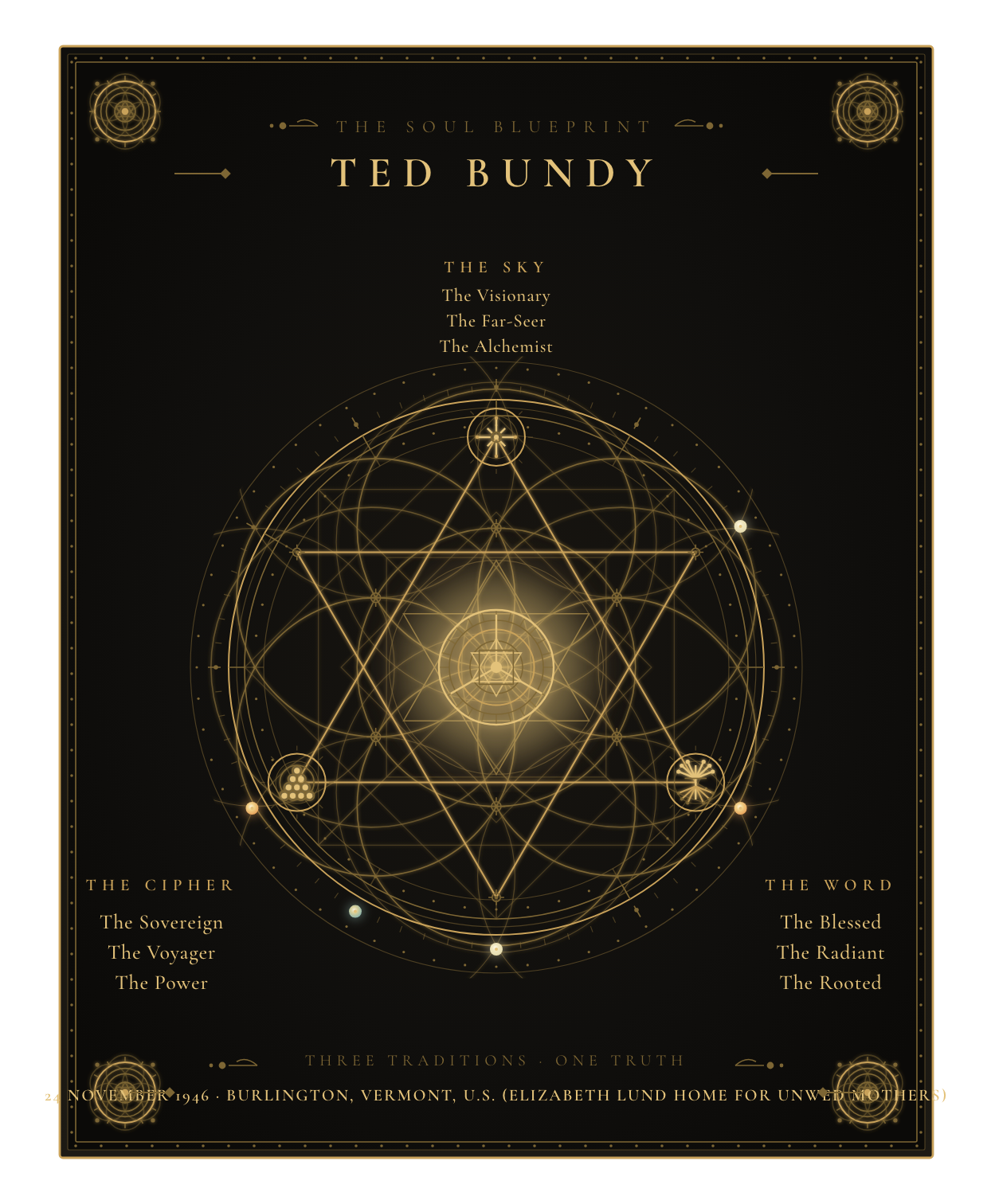
One seal, three languages. The sky he was born under at the apex, the numbers beneath his name at the lower left, the name itself at the lower right — three traditions engraved into one artifact. There is no rising sign, no houses, no angles: without a verified birth time they cannot be honestly drawn. What is true is what is shown.
At a Glance
- Full traditional name
- Theodore Robert Cowell
- Born
- November 24, 1946 · Burlington
- Sun
- Sagittarius 1.8° — the essential fire of the life
- Rising
- Birth time unverified — the Ascendant is offered conditionally, never asserted
- Moon
- Sagittarius 12.5° — the inner life
- Mind · Value · Will
- Mercury Scorpio · Venus Scorpio · Mars Sagittarius
- Discipline · Direction
- Saturn Leo · North Node Gemini
- Life Path
- 1 — The Pioneer
- Title-name Destiny
- 5 — The Free Soul
- Birth-name Destiny
- 4 — The Builder
- Master Numbers
- None preserved at the final layer
- Soul archetype
- The Free Soul who lives the Pioneer’s path
It is January 24, 1989, seven-sixteen in the morning at Florida State Prison in Raiford, and the light coming through that small window is the ordinary light of any other Tuesday — neither trembling nor darkening, just the slow accumulation of illumination that has nothing to do with what is happening in the room. The body in the chair knows what is coming. The witnesses in the gallery know. The guards know. The world outside, gathering in the pasture across the road, singing and dancing and setting off fireworks like a festival, knows. And yet the light remains exactly what light does: it arrives, it fills the space, it asks nothing of anyone.
This is how the world tends to read the fragments of a human life — as a sequence of acts, a catalog of what was done and what was suffered, the exterior biography sorted into before and after, criminal and victim, the pieces arranged like evidence on a table. But underneath the surface-reading, there runs something older and more obscure — a current that moves beneath the visible life like a river moving beneath its own banks, carrying in its depths the original design, the soul’s architecture, the pattern that was laid down before any choice was made. The fragments the world calls them are loud and terrible and entirely real; but they are not the whole water. To read the source — to follow the current backward toward where it rises — is to ask a different question entirely. Not what happened, but why this particular shape, this particular gift, arrived carrying what it carried.
This letter reads that source. It does not excuse it, and it does not celebrate it; it witnesses it. To understand a pattern is not to approve of it, and to see clearly is not to endorse what one sees. But the blueprint that arrived in this life — the astrology, the numerology, the inheritance, the calling — asks to be read whole, not sanitized or buried. The eight chapters below follow the thread from arrival through the defining moment to the reckoning that came, reading the same architecture that in another configuration might have been drive, focus, hunger, magnetism — and reading instead how it was turned, refused integration, and became the instrument of profound harm to others.
Read this as a cautionary diagram of a soul’s possibility, not an invitation toward it.
The reading moves through the eight chapters of the Soul Blueprint architecture — The Arrival, The Soul’s Inheritance, The Living of It, The Soul’s Calling, The Soul’s Territories, The Name You Carry, The Moment, and The Invitation — and at the end, the same instrument turns gently toward you.
The Arrival
He arrived carrying an essential contradiction: a soul built for the quest for ultimate meaning, for the far horizon, for the search beyond personal boundary into the vast uncharted terrain of what matters most—and yet that very gift for reaching toward the absolute was tethered to a mind that probed relentlessly beneath the surfaces of things, seeing through pretense to hidden motive, incisive and fearless in naming what others avoided. The sun in his chart burned with the pilgrim’s fire, the seeker’s need to touch eternal values and move always toward something larger than the self; but that same heat was shadowed by a mercury that cut through to the real bone of things, that saw the mechanism underneath the mask.
A will animated by belief and crusade, by the hunger to explore the far goal, lived alongside a capacity for love that demanded everything or nothing—total merging, absolute intensity, no half-measures. To know him was to be known all the way or not at all. And beneath the whole configuration ran a quiet terror: the fear of being seen truly, of being found unworthy of attention or light, of failing the test of one’s own visibility. So the soul arrived carrying both the drive to reach toward transcendence and the penetrating ability to see through it—the visionary and the detective in a single vessel, neither capable of restraint, each amplifying the other. It was not two natures at war; it was one nature divided against its own purpose, spiraling toward integration it would never achieve.
The Soul’s Inheritance
He was born into the borderlands of legitimacy—delivered in an unwed mothers’ home in November 1946 in Vermont, his arrival itself a threshold between kept and hidden, named and unspoken. The biography of his blood carried uncertainty and secrecy: his father’s identity disputed, his paternal line clouded in rumor and competing claims, the grandfather described in contradictory whispers—a man characterized variously as a tyrannical bully or as fine, the stories themselves unable to settle on what had actually lived in that body. His grandmother underwent electroconvulsive therapy; the family inheritance was carried in treatment and silence and the fragmentation of what could be openly spoken. His mother moved through the world as Eleanor Louise Cowell, then as Eleanor Nelson, and he grew up watching how a name could change and how a woman could remake her circumstances and her story.
The family he was raised in came later—a stepfather who worked in the hospital kitchen, a steady man in a limited world, neither a visionary nor a crusader. And so the boy born into disputed paternity was raised in the careful, ordinary rhythms of working people, the kind of household where mystery and grandeur were not the native language. He attended school, was arrested as a teenager on suspicion of burglary and motor vehicle theft—records expunged, forgotten by the official world before he turned eighteen. The era was the postwar American expansion, the suburbs, the possibility machine. He grew up in the shadow of the great war his biological father had fought in, inheriting a lineage of violence and trauma he could not name, in a family that specialized in not naming things.
The Living of It
The living of it began in the ordinary world: he attended university, studied the far-reaching discipline of Chinese language, dropped out, worked minimum-wage jobs, volunteered for political campaigns, drove a lieutenant governor’s candidate, wrote pamphlets on rape prevention while working for a state agency tasked with searching for missing women. The early biography reads like a man trying to find his place, trying to touch meaning through proximity to power and purpose. He applied to law schools and was accepted despite mediocre LSAT scores, the letters of recommendation from political figures and professors indicating a persuasiveness, a kind of magnetism that made people want to open doors for him. He took the acceptance and began his first year at law school in the autumn of 1973, the ambitious boy moving toward some kind of visibility and light.
And then, between the start of his studies and April of 1974, something in the architecture broke open—or perhaps became fully operational. By February 1974, Lynda Ann Healy was dead, likely the first, though the numbering was unclear even to him afterward. The victim profile formed itself over the months: young, white, college-age women with long hair parted in the middle, aged most often between fifteen and twenty-five. The living of it became a double existence, a chameleon competence, the ability to present an entirely different face in different rooms. To his professors and colleagues, he was capable and impressive; to the women he chose, he was charming and apparently safe. To himself, he became a collector. The cost was paid entirely by others—by the lives he took, by the families left without answers, by the women he selected and chose and murdered. By what he did to their bodies. By what he kept.
Every soul arrives with a blueprint. What a life does with it is the whole of the reckoning.
The Soul’s Calling
His calling arrived not as one voice but as a chorus of opposing urgencies—the penetrating mind that could see through any pretense, the investigative force that needed to know the mechanism behind the mask, the incisive voice that was unafraid of saying what lay beneath the surface. He was called to work in the space between law and crime, to understand and possibly to name the hidden structures of human motivation. He volunteered at rape prevention work; he worked for the state agency searching for missing women; he moved toward law school with what appeared to be genuine purpose. The calling was the detective’s calling, the depth-mind’s hunger to probe beneath and see the real motive, to be the one who knows. And all of this was authentic—there was no conscious deception in the early ambitions. The soul that arrived was built to pursue meaning relentlessly, to reach toward the absolute, to expand consciousness toward eternal values. The fatal architecture was that this same soul was also built to probe beneath every surface without restraint, to see through everything, to refuse the comfortable lie—and to act on everything it saw.
The Soul’s Territories
The territory of persuasion and access was where he lived most intensely alive—the ability to move through the world with a magnetism that made people lower their guard, that made professors write letters on his behalf, that made volunteers trust him, that made women get into his vehicle. He understood the mechanism of trust and how to weaponize it, how to present the carefully calibrated self that disarmed suspicion. The territory of the investigation was equally alive—the work with law enforcement, the deep interviews with detectives after his arrest, the discussions of methodology and psychology, the way he could talk about crime and motive with the authority of someone who understood it from the inside. He was most animated when analyzing the mechanics of what he had done, when discussing the why beneath the act, when operating in that liminal space where knowledge and confession met. The territory of the hunt itself held him in a state of heightened being—the selection, the luring, the consumption, the documentation, the keeping of photographs and the returning to bodies until they could no longer be touched. This was where the architecture of his soul found its most complete expression: in the predatory alignment of patience, vision, intelligence, and action toward a single chosen target.
There are twelve domains in the kingdom of any life: The Mark, The Unfolding, The Unseen, The Long Return, The Inheritance, The Encounter, The Alchemy, The Living Tension, The Sight, The Body’s Knowing, The Crossing, The Calling.
The Name You Carry
Theodore—the gift of God, the name carrying within it a promise of divine blessing, of something bestowed—was the name given at birth, the formal name, the name that would never quite fit because it spoke of grace and blessing and the presence of the sacred. Robert spoke of bright fame, of reputation earned and light reflected—the name of the self as it appears in the world, visible and known. And then Bundy, the name he was raised with and the name that became famous, the name that moved away from the Greek invocation of the sacred and the Germanic promise of brilliance into the vernacular, the ordinary, the almost affectionate diminishment. The three names together tell the story of a fractured self: born into a promise of divine gift, expected to carry the brightness of earned reputation, living instead under a name that made him seem almost boyish, almost harmless.
The names are a blueprint for the central paradox—a soul built for transcendence, named as if touched by God, yet carrying through the world under a name that belonged to no one’s aristocracy, no one’s inheritance. The names speak to the split between what was promised and what arrived, between the eternal reach of the first name and the diminishment of the last, between the gift of God and the very ordinary face that would meet you at a roadside. The numerology embedded in these names—the titles and destinies they carried—only amplified the contradiction: the soul as pioneer, as builder, as the free spirit—all of it arriving in a body that learned early that to be seen was dangerous, that visibility required careful control, that the light itself could expose you.
The Moment
The defining moment arrived in February 1974, with Lynda Ann Healy, or perhaps it had already arrived earlier—even Bundy could not settle the exact origin, could not place with certainty where the crossing had happened. But by the middle of the decade, the architecture had become fully operational: he was arrested in August 1975 during a routine traffic stop, the car containing suspicious items, the officer Bob Hayward noting something that did not fit. He was convicted of aggravated kidnapping and assault in the Carol DaRonch case in March 1976, sentenced to prison in June. In June 1977, he escaped from a courthouse window in Glenwood Springs, jumping from the second story during a preliminary hearing, and the double life became briefly triple—the imprisoned man, the escaped man, the man still being sought. He escaped again in December, sawing through ceiling bars, and moved to Florida, where the moment crested and broke in January 1978.
The Chi Omega murders on January 15, 1978, were the public reckoning, the moment where the pattern became visible to the world in a way it could no longer hide. He murdered Margaret Elizabeth Bowman and Lisa Janet Levy in the sorority house, and the violence of it, the precision of it, the refusal of any restraint or mercy, revealed the architecture operating at full intensity. Three weeks later, on February 9, he kidnapped and murdered Kimberly Dianne Leach, a twelve-year-old child, establishing the absolute boundary of what the soul had become capable of. He was arrested on February 15, driving near the Alabama border, and the moment of visibility was complete. The trials that followed, the convictions, the death sentences stacked upon each other—all of it was the inevitable accounting, the machinery of consequence finally catching up to the will that had believed itself invisible.
The Invitation
Everything in this reading has been moving toward a single point. The doubleness named in the first chapter, the inheritance, the wound, the calling, the territory, the name, the moment. These are not seven separate truths about Ted Bundy. They are one truth, named from seven different angles. And they all converge here.
What was being asked of this soul—the precise and specific question that the architecture itself posed—was whether a gift for reaching toward meaning and eternal values could integrate with the capacity to see through all pretense to the hidden motive beneath. Could a will that burned to explore the far goal, that was built for crusade and conviction, learn to turn that energy toward genuine understanding rather than domination? Could the penetrating mind that saw through every surface learn to develop genuine curiosity about what it found there, rather than only contempt and the hunger to prove itself superior? Could the soul that carried both the visionary fire and the detective’s unflinching gaze learn to hold both without weaponizing either one?
What was being released, what the soul was being asked to let go of, was the absolute certainty—the over-mastered conviction in its own reading of the far horizon, the refusal to question its own conclusions about what it had seen beneath the surface, the righteous confidence that it alone understood the mechanism, that it could judge and sentence without ever learning from actual particulars. The soul arrived carrying a need to reach toward the absolute, a need to feel the far horizon, a need for meaning so complete that it would not settle for the incomplete or the particular. This need, when refused integration, became the hunger to control and to consume—to make others match the blueprint of understanding, to force them into the shape of his vision. What was being called toward was the opposite: genuine listening, actual curiosity about the details and the near facts rather than the abstract principle, the willingness to be surprised by what another person actually was rather than what the theory predicted.
But Bundy refused the invitation—not consciously, not at any moment where a clear choice presented itself, but through the daily, hourly, moment-to-moment choice to turn away from integration, to double down on the compartmentalization, to wall off the seeing from the feeling, to make the penetrating mind serve the will to dominate rather than the will to understand. The available path was to develop the curiosity, the listening, the capacity to hold questions rather than to pronounce answers—the medicine for a soul over-certain in its own vision. Instead, he chose theft—not just the physical stealing that animated him throughout his life, the compulsive taking of what was not his, but the deeper theft of agency, the taking of choice, the removal of other people from their own lives and their own becoming. He chose to photograph what he had taken, to document and to keep, the Polaroids themselves an act of possession, a way of saying: This is mine. I did this. I made this happen. I was here.
What became available because he said no to the actual invitation was a kind of terrible freedom—the freedom to operate in the gap between what he appeared to be and what he was doing, to move through the world in a state of complete compartmentalization, to present the capable law student and the volunteer and the charming date while simultaneously operating a systematic machinery of harm. He became a living diagram of the soul that has refused its own medicine, that has weaponized its gifts, that has taken the architecture of meaning-making and turned it into the architecture of control. He became the demonstration of what happens when the soul built for integration instead chooses to perfect the art of living in fragments, when the gift for seeing through pretense is turned into the tool for practicing perfect deception, when the will to reach toward the absolute becomes the will to reduce another person to an object that serves one’s own vision. The testimony he gave later—the confessions, the interviews with the detectives, the final statement about pornography and media—was itself a continuation of the same refusal, a final attempt to locate the responsibility outside himself, to find an external cause rather than to accept what the blueprint had carried and what he had chosen to do with it.
He was not late. He was exactly where the soul-clock said he should be. The mission had been inscribed at the threshold of his first breath. What was being asked of him, he has been walking. The naming has been done.
This Is Not Coincidence
The astrology speaks in fire and depth simultaneously: a sun that seeks eternal meaning and a mind that penetrates to the hidden structure beneath—a soul designed to pursue absolute truth while also seeing through every claim to it. The numerology names this through the archetype of the Pioneer meeting the Builder meeting the Free Soul—a force that breaks new ground, that establishes what lasts, that refuses to be bound by the existing order. The names themselves echo the same paradox: a promise of divine gift, an expectation of earned brightness, a collapse into the vernacular, the ordinary, the disguised. Three entirely different languages. One truth: A soul arrived built to seek the absolute and to see through it, released toward meaning yet refusing the listening that alone could integrate the gift.
Three entirely different languages. One truth.
This is not coincidence. This is what three independent systems do when they are all telling the truth about the same soul.
The Numbers, Decoded
The numbers are computed, not intuited — each letter takes its Pythagorean value, each name reduces, and any Master Number is preserved rather than collapsed.
You have sat with the chart and the numbers and the name of another soul, and watched how a wound becomes a calling, how the place of least belonging becomes the place of greatest gift, how a life too precisely configured to be coincidence reveals itself when three independent languages are read together.
The reading you have just received was, in its outer form, a reading of his soul. But its inner form was a reading written for yours. You did not arrive without a Blueprint either. May this reading be the beginning of the reading you finally receive of yourself. May the light you carry — in whatever particular, irreplaceable form it has taken inside the specific life you were given.
Some lives carry a pattern this clear.
Yours does too.
The Soul Blueprint reads any life through the same three languages — the sky, the numbers, the name.
Or, when you’re ready, begin your own full Soul Blueprint reading →
Frequently Asked Questions
What is Ted Bundy’s birth chart?
Ted Bundy was born with the Sun in Sagittarius, a position that ignites the need to pursue meaning and reach toward eternal values beyond the personal. His Mercury is in Scorpio—a penetrating, investigative mind unafraid of the taboo—and his Venus is also in Scorpio, expressing a love that is intense, transformative, all-or-nothing. His Mars is in Sagittarius, a will animated by crusade and the hunger for the far goal. His Saturn is in Leo, a position that carries the fear of being seen and the task of earning one’s own light. The birth time is unverified, so the rising sign cannot be reliably fixed.
What is Ted Bundy’s numerology?
Ted Bundy’s numerology carries three distinct archetypal forces: the Title Destiny (from Ted Bundy) is the 5, the Free Soul, a number of movement, refusal of constraint, and radical autonomy. The Birth Destiny (from Theodore Robert Cowell) is the 4, the Builder, a force that establishes, structures, and creates lasting form. The Life Path (from the birth date, November 24, 1946) is the 1, the Pioneer, the number of initiation, breakthrough, and the will to move first into unmapped territory. Together they describe a soul arrived to pioneer new ground, to build what endures, yet to refuse all binding structures.
What does the name Ted Bundy mean?
Theodore means ‘gift of God,’ invoking the presence of divine blessing and grace bestowed. Robert means ‘bright fame,’ speaking to reputation earned through visible achievement and reflected light. Cowell is an English surname, likely of place or occupational origin, grounding the formal names in the vernacular. The three names together compose a paradox: the promise of sacred gift, the expectation of earned brightness, the collapse into the ordinary—a blueprint for a self divided between transcendence and the everyday.
What is a Soul Blueprint?
A Soul Blueprint integrates three independent traditions — Western natal astrology, Pythagorean numerology, and the etymology of the full birth name — into a single document written as a personal letter to the soul. When you’re ready, you can begin your own.
This reading was prepared in the lineage and methodology of the Soul Blueprint Method — Pythagorean numerology with master numbers preserved, Western archetypal astrology, and a researched etymological reading of the full name. Ted Bundy’s birth date (November 24, 1946) is sourced from the public record; the birth time is unverified, so the rising sign is offered conditionally and never asserted.
A Soul Blueprint reading · Astrology · Numerology · Etymology · shams-tabriz.com