
Bad Bunny’s Birth Chart, Numerology, and Name Decoded
Bad Bunny’s Birth Chart,
Numerology & Name Decoded
The Soul Blueprint Method — three traditions woven into one personal letter: Western natal astrology, Pythagorean numerology, and the etymology of the soul’s name. Learn the method →
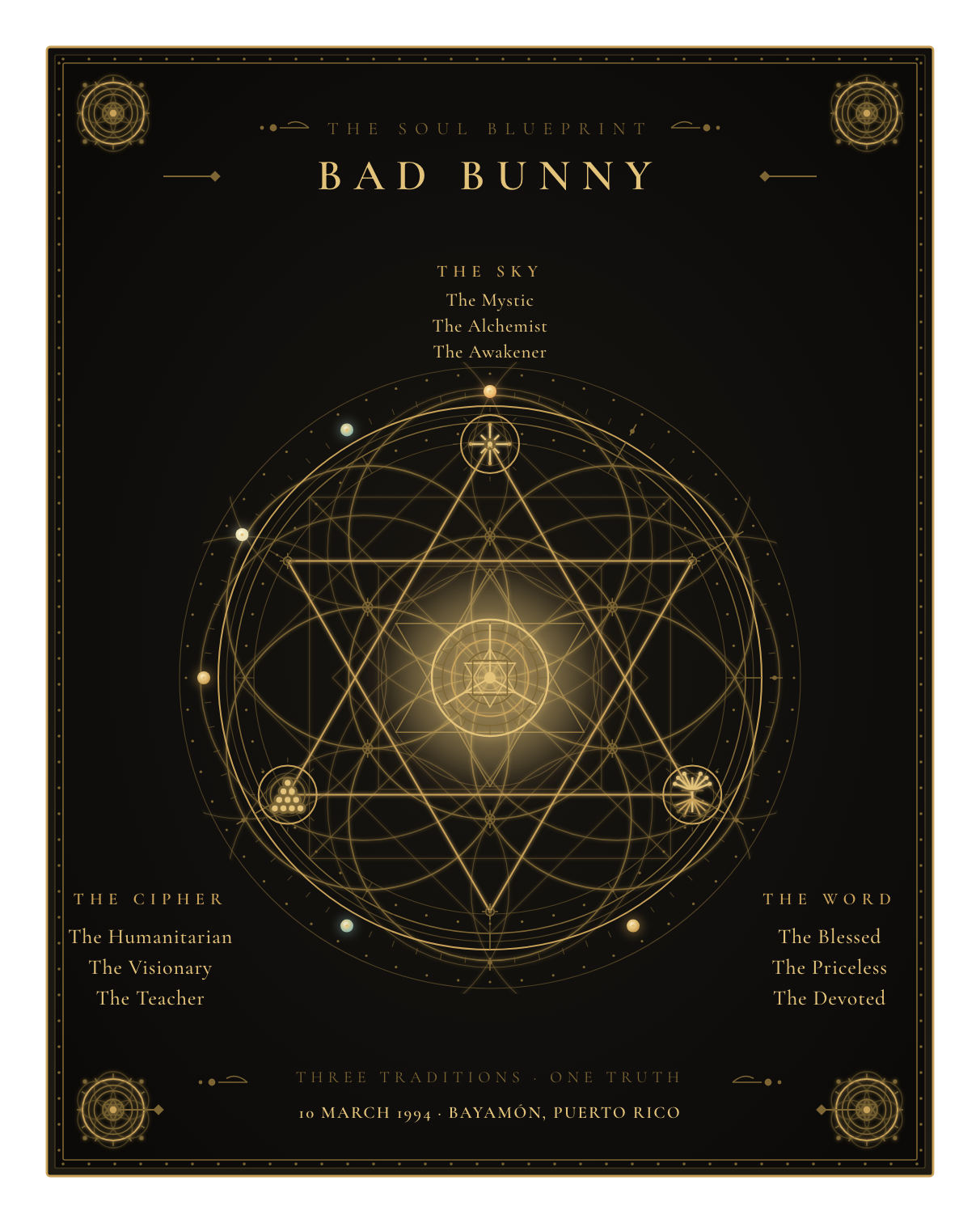
One seal, three languages. The sky he was born under at the apex, the numbers beneath his name at the lower left, the name itself at the lower right — three traditions engraved into one artifact. There is no rising sign, no houses, no angles: without a verified birth time they cannot be honestly drawn. What is true is what is shown.
At a Glance
- Full traditional name
- Benito Antonio Martínez Ocasio
- Born
- March 10, 1994 · Bayamón
- Sun
- Pisces 19.9° — the essential fire of the life
- Rising
- Birth time unverified — the Ascendant is offered conditionally, never asserted
- Moon
- Date-dependent across the unverified birth day — not fixed without a confirmed time
- Mind · Value · Will
- Mercury Aquarius · Venus Aries · Mars Pisces
- Discipline · Direction
- Saturn Pisces · North Node Scorpio
- Life Path
- 9 — The Humanitarian
- Title-name Destiny
- 11 — The Illuminator
- Birth-name Destiny
- 33 — The Master Teacher
- Master Numbers
- 11, 33
- Soul archetype
- The Illuminator who lives the Humanitarian’s path
It is December 2018, and the light in Puerto Rico carries that particular weight it always does after the rains—a child receives a record for Christmas, the vinyl spinning in a house where prayers are spoken aloud, where the radio sings in Spanish, where music is not entertainment but a language older than words. That child is five years old, and the album—Aquel Que Había Muerto by Vico C—will become the first memory of his own soul recognizing itself in sound. Twenty years later, that same child, now called Bad Bunny, will release his debut album on Christmas Eve, as if returning to the source. The world sees fragments: a reggaeton artist, a cultural rebel, a man who has broken open every category he was given. But beneath the names the world calls him—the trap beats, the collaborations, the defiant performances—there flows a single, constant current. This is the source we read now: not the surface that glitters and shifts, but the deep structure, the river that has always been moving underneath, carrying him toward his own becoming.
The reading moves through the eight chapters of the Soul Blueprint architecture — The Arrival, The Soul’s Inheritance, The Living of It, The Soul’s Calling, The Soul’s Territories, The Name You Carry, The Moment, and The Invitation — and at the end, the same instrument turns gently toward you.
His soul has a blueprint.
So do you.
The same three languages — the sky, the numbers, the name — are waiting in your own.
The Arrival
He arrived as a Piscean soul—one whose self comes alive by surrender and service, whose identity dissolves into something larger than the boundary of skin. This is not weakness; it is the paradox that the Piscean carries from birth onward. The self that surrenders is the self that becomes redemptive. He was born into a generation flooded by possibility and fragmentation alike—the child of a truck driver and a schoolteacher in Bayamón, in a Puerto Rico that was itself shifting beneath the weight of its own history. From his earliest years, music was not a choice but an inheritance, a current running through the family like blood. He sang in church until adolescence, baptized in the language of devotion before he was old enough to understand why his voice wanted to break into something wilder. The Piscean gift—the permeable self, the empathy that has no walls—would become both his liberation and his daily work: how to stay open to the whole world while the whole world demanded he choose a shape, a lane, a marketable form. His arrival announced a soul built to dissolve boundaries, to move through what others stood still against, to find the sacred in the spaces between. This is his signature: not a person who masters the world, but one who lets the world move through him and becomes transformed in the letting.
The Soul’s Inheritance
He was born into the inheritance of Puerto Rico itself—a place carrying its own dissolution and reinvention, its own history of being unmade and remade by forces larger than itself. His father was a truck driver, a man moving goods between places, and his mother was a teacher, a woman who gave language to children and who carried her faith into the ordinary world. He grew up in a devoutly Catholic household, attending church weekly, singing in the choir until the moment adolescence called him elsewhere—toward the secular, the rebellious, the undeclared. This is the inheritance: a home built on prayer and work, on the devotional and the practical, on the belief that what you do matters because it serves. He received a record as a child, an album that spoke in a voice he did not yet understand but recognized as true. This too was inheritance—not wealth, but the recognition that art carries truth that doctrine cannot contain. He was born into the generation of streaming, of the internet as a democracy of voice, where a teenager with a laptop and ambition could reach the world without gatekeepers. He grew up in Bayamón, in a moment when reggaeton itself was still being born, when Puerto Rico was learning how to make itself heard globally through rhythm and defiance. His inheritance was both humble and limitless: the poverty of beginning, the richness of a culture that had already taught the world how to move.
The Living of It
The living of it began in rooms where music was made before he had permission to make it. At fourteen, he began writing and creating music in the solitude that artists require—the solitude that discipline demands. After high school, he enrolled in a program in audiovisual communications, imagining a path toward broadcast, toward the radio host’s voice reaching into homes. But the pull was already stronger than the plan. He worked part-time as a bagger and cashier at a supermarket while creating music in the hours between—the double life that so many artists live, the split between survival and calling. Then came the moment: he left the university without finishing his degree. This was the cost—the security abandoned, the credential not earned, the visible path rejected for an invisible one. He posted music online, to the void at first, and then in 2016, a song called ‘Diles’ was heard by someone who mattered—DJ Luian, who recognized not just a talent but a vision. The living of it meant moving through collaborations, building a sound that was entirely his own while using every available form. It meant the rapid ascent: from regional recognition to global platforms in months, from unknown to Spotify’s most-streamed artist in a few years’ time. But the cost was constant—the price of visibility is exposure, the price of breaking boundaries is that everyone wants to know who you are, and he has spent years refusing to answer. The soul that came to dissolve boundaries has lived in the exhaustion of being asked constantly to solidify into something nameable, knowable, marketable. This is the wound that became his qualification: he learned to stay permeable while the world demanded he become fixed.
If this is what was true for him, what might be true for you?
The Soul’s Calling
The voice that arrives in this soul comes alive not by accepting what the powerful have already decided, but by stepping back far enough to see the whole pattern beneath the noise—the hidden architecture that everyone else has agreed to ignore. His mind reaches for the systemic, the objective, the view from thirty thousand feet where convention loses its grip and the genuine structure becomes visible. This is a consciousness that asks the question no one was supposed to ask, that names the pattern no one was supposed to name. The voice does not seduce or convince through feeling; it convinces through clarity, through the clean revelation of how things actually work when you stop pretending.
And yet this voice is not cold. The soul’s calling—what he came here to do—is woven from a different thread: to serve, to dissolve the boundaries between self and the suffering around him, to let his own form become permeable to the needs of others. The calling is to illuminate the invisible architecture while standing inside the vulnerability of those who have no map. He was born at the moment when the soul’s growth is asking him to go deeper than comfort, to trade the settled and familiar for transformation through intimacy and shared risk—and this medicine arrives as a calling to speak from the edge, to use the systemic mind not for mastery but for mercy.
The humanitarian arc of his life pulls all of this into a single urgency: to see the whole system clearly enough to dismantle what breaks people, and to serve those the system has abandoned. The voice is the instrument. The clarity is the gift. The surrender is the discipline. This is why the soul came.
The Soul’s Territories
Three territories glow most vividly in his living: the studio and the song itself, the place where sound is shaped into meaning—where a voice and a beat and a vision converge into something that did not exist before. This is the laboratory of his soul, the place where the Piscean surrender meets the Saturnian discipline, where the boundless is given form. The stadium and the stage, where the music travels out into the body of the crowd, where the private work becomes public ceremony. He has headlined stadiums across the world, performed at the Super Bowl in his own language, brought the entire thing home to Puerto Rico in a residency that will draw hundreds of thousands. This is the territory of presence, of the soul made visible, the moment when what was imagined becomes shared reality. And third: the foundation, the direct work of putting tools into the hands of youth—musical instruments, art supplies, the materials of expression themselves. Since 2018, Bonita Tradición has become a seasonal ritual, a way of saying: I have been given much, and the giving back is not charity but kinship, not performance but belonging. These three territories—the made thing, the witnessed gathering, the gift given—form a single arc: the movement from private vision into shared transformation, from the solitary self dissolved into art, into the gathered self reflected back in the eyes of thousands, into the self finally made whole through giving to others what it received. Beneath all three runs a deeper current—a mythology of return, of coming home not as a destination but as a practice, of staying rooted in one’s own ground while speaking to the whole world.
There are twelve domains in the kingdom of any life: The Mark, The Unfolding, The Unseen, The Long Return, The Inheritance, The Encounter, The Alchemy, The Living Tension, The Sight, The Body’s Knowing, The Crossing, The Calling.
The Name You Carry
The name he carries—his birth name, Benito Antonio Martínez Ocasio—holds the weight of family, of lineage, of the everyday Spanish names that anchor him to his people and his place. There is no glamour in these names, only truth: the truck driver’s son, the schoolteacher’s child, the ordinary made sacred through living. But the world came to know him as Bad Bunny, a name born from a moment of imposed costume, from a time when he was forced to wear a bunny suit and thought: this will market well, this strange thing will become my calling card. The paradox is perfect—the soul that dissolves boundaries arriving in a form that is entirely synthetic, entirely constructed, entirely the opposite of earnestness. And yet the name held true to the deeper thing. A bunny is vulnerable, alert, small in the grand scheme of things—not a predator or a conqueror, but a creature that moves through the world by agility and grace, by knowing how to slip through small spaces, by living in the margin between the seen and the hidden. The name Bad Bunny carries a refusal: I will not be serious for you, I will not perform gravitas, I will meet you in the space where playing is its own form of truth-telling. Bad suggests the transgressive, the one who breaks the rules—but a bad bunny is still a bunny, still a creature defined by its own sweetness and vulnerability, its own inability to dominate. The name became prophetic: he would indeed be bad in exactly the way that mattered—bad to the systems that contain, bad to the boundaries that constrain, bad to the silence that protects the powerful. The two names—the birth name rooted in family and place, the chosen name rooted in play and transgression—form the two poles of his soul: the one who belongs to his people, and the one who refuses to stay in the shape they carved for him.
The Moment
In July 2019, as the summer broke open into protest and rage, Puerto Rico rose against its own government in response to leaked private messages—a scandal called Telegramgate that revealed the contempt in which the island’s leadership held its own people. He joined the streets. He sang at a benefit concert wearing a shirt that criticized the sitting president. In that moment, the Piscean soul—the one designed to dissolve, to serve, to surrender—became weaponized into something else: an instrument of collective will. This was not the moment he became political; he had always been shaped by the urgency of his place. But it was the moment the private conviction became public declaration, when the soul stopped protecting itself through ambiguity and said: I stand here, I see this, I will use what I have been given to name what is being done to us. The seasons that followed deepened the revelation. In 2020, he released a music video performing in drag, challenging the masculine codes of reggaeton itself—the genre born from his own streets, the music that had made him. He performed at the Super Bowl in Spanish, choosing to center his own language in the most-watched moment of American broadcasting. He kissed a male dancer on stage at the MTV Video Music Awards. Each act was an announcement: I will not be contained by what you expect of me, and my refusal is not selfish but a gift to everyone who has been contained alongside me. The moment revealed that the Piscean capacity for dissolution was not weakness but courage—the courage to let go of the self the world had built around him, to become permeable to what his people needed, to say: I am not just an artist, I am a platform, and I will stand in the place where the vulnerable stand. This moment is still unfolding; each album, each performance, each choice is a continuation of the same revelation—that art is not separate from life, that beauty and politics are not opposites but the same gesture, that the marginalized can speak from the center and remake the whole thing with their voice.
The Invitation
Everything in this reading has been moving toward a single point. The doubleness named in the first chapter, the inheritance, the wound, the calling, the territory, the name, the moment. These are not seven separate truths about Bad Bunny. They are one truth, named from seven different angles. And they all converge here.
What is being asked of him is the most difficult thing: to remain permeable—to stay open to his people, to his community, to the pain of Puerto Rico and the LGBTQ+ youth who see themselves in him—while navigating a global industry built on extraction. The industry wants to use him; his people want him to remember them; the world wants him to be multiple things at once—the superstar and the grounded one, the commercial force and the revolutionary, the singer and the symbol. The ask is to keep these things in tension without resolving them into a comfortable answer. It requires him to refuse certain paths: in 2025, he declined U.S. tour dates because of concerns about ICE targeting his fans at concerts—a choice that subordinates profit to the safety of the people who come to be with him. This is the demand of the Piscean soul in its maturity: not to transcend the world but to serve it, knowing that service means sometimes saying no to the largest stage in order to protect the smallest among us.
What was being released through this asking was the fantasy of being separate—the idea that he could be a global superstar without being accountable to his island, that he could be successful without being implicated in the systems that both enabled and harmed his community. With each album released, with each public stance taken, with each refusal of silence, he was releasing the grip of innocence, the possibility of non-involvement. The release was not loss but clarification: he was being shown that his life could not be private, that visibility was already a choice, that neutrality was a form of collaboration.
What was being called toward was the demonstration that art made from the margins can reshape the center—that Spanish-language music could be the most-streamed music on the planet, that a Puerto Rican could headline the Super Bowl in his own language with 128 million watching, that Debí Tirar Más Fotos could become the first Spanish-language album to win the Grammy for Album of the Year. These are not just commercial facts; they are prophecies fulfilled. They say: the margins have the power, the language that was supposed to remain small has become global, the voice that was supposed to be contained has become the world’s most-listened-to voice. The calling was toward making this visible, toward proving it in the material world—not through argument but through numbers, streams, sold-out stadiums, the economic reality of his presence.
What became available because the Yes was said—because he left university, because he posted that first song online, because he chose to show up in drag and kiss men and speak about his people’s suffering—was the transformation of the spaces themselves where he moved. The reggaeton genre, which had been coded as purely masculine and heterosexual, became permeable. The global music industry was forced to contend with the reality that its future was plural, non-English, and shaped by voices it had marginalized. His foundation distributed tens of thousands of instruments and art supplies to Puerto Rican youth, not as charity but as restoration—the giving back of what had been extracted. The residency announced for 2025 in San Juan will draw hundreds of thousands of his own people into an experience of collective belonging, an economy of care flowing back into the place where he began.
What became available, most crucially, was a model of visibility without compromise—the proof that you could be globally successful and still rooted, that you could break boundaries without assimilating into the system that wanted to contain you, that surrender (the Piscean’s native language) could be the most powerful form of resistance. He has become, in the living of it, what the astrology and numerology announced at birth: an illuminator, a master teacher, a humanitarian—not through abstract virtue but through the daily practice of choosing his people, of using his platform to make visible what the systems wanted to keep hidden, of putting tools into the hands of youth and saying: make something, transform yourselves, we are not finished.
He was not late. He was exactly where the soul-clock said he should be. The mission had been inscribed at the threshold of his first breath. What was being asked of him, he has been walking. The naming has been done.
This Is Not Coincidence
The astrology says: Sun and Saturn both in Pisces, the gift forged under discipline—the soul built to dissolve boundaries, trained through time and constraint into a form that can hold the boundless without breaking. Mercury in Aquarius sees the system; Mars in Pisces fights for the vulnerable and the dream. Three entirely different languages. One truth: The visionary who has been schooled by necessity into an instrument of transformation. The numerology says: Title Destiny 11 (the Illuminator), Birth Destiny 33 (the Master Teacher), Life Path 9 (the Humanitarian)—the soul announced from birth as one who would make visible what was hidden, teach what had been forbidden, serve the whole at the cost of the particular self. Three entirely different languages. One truth: The life that can only be lived by becoming the beacon that draws others into their own light.
Three entirely different languages. One truth.
This is not coincidence. This is what three independent systems do when they are all telling the truth about the same soul.
The Numbers, Decoded
The numbers are computed, not intuited — each letter takes its Pythagorean value, each name reduces, and any Master Number is preserved rather than collapsed.
You have sat with the chart and the numbers and the name of another soul, and watched how a wound becomes a calling, how the place of least belonging becomes the place of greatest gift, how a life too precisely configured to be coincidence reveals itself when three independent languages are read together.
The reading you have just received was, in its outer form, a reading of his soul. But its inner form was a reading written for yours. You did not arrive without a Blueprint either. May this reading be the beginning of the reading you finally receive of yourself. May the light you carry — in whatever particular, irreplaceable form it has taken inside the specific life you were given.
Some lives carry a pattern this clear.
Yours does too.
You’ve read the shape of his soul. The same three languages — the sky, the numbers, the word — are waiting in your own name and birth date. Begin yours, free, below.
Or, when you’re ready, begin your own full Soul Blueprint reading →
Frequently Asked Questions
What is Bad Bunny’s birth chart?
Bad Bunny was born on March 10, 1994, with the Sun in Pisces—the self that comes alive through surrender and service, permeable to what is larger than itself. His Mercury is in Aquarius (the mind that sees systems and questions the given), Venus in Aries (love expressed as bold, ardent desire), Mars in Pisces (will that flows through imagination and compassion), and Saturn also in Pisces (the discipline of giving form to the boundless). The birth time is unverified, so his rising sign cannot be assigned with certainty.
What is Bad Bunny’s numerology?
Bad Bunny’s numerology carries three master numbers: his Title Destiny is 11 (the Illuminator), his Birth Destiny is 33 (the Master Teacher), and his Life Path is 9 (the Humanitarian). These three archetypes—the one who makes visible, the one who teaches what others refused to speak, the one who serves the whole—form the core pattern of his soul’s arrival and unfolding.
What does the name Bad Bunny mean?
The name Bad Bunny originated from a moment when he was forced to wear a bunny costume and he thought: this will market well. The paradox is exact: a synthetic name, entirely constructed, that carried hidden truth. A bunny is vulnerable and small, moving through the world by grace and agility, living in the margins. ‘Bad’ adds the transgressive—the one who breaks the rules. Together, the name became prophetic: he would indeed be bad to the systems that contain, bad to the boundaries that constrain, bad to the silence that protects the powerful.
What is a Soul Blueprint?
A Soul Blueprint integrates three independent traditions — Western natal astrology, Pythagorean numerology, and the etymology of the full birth name — into a single document written as a personal letter to the soul. When you’re ready, you can begin your own.
This reading was prepared in the lineage and methodology of the Soul Blueprint Method — Pythagorean numerology with master numbers preserved, Western archetypal astrology, and a researched etymological reading of the full name. Bad Bunny’s birth date (March 10, 1994) is sourced from the public record; the birth time is unverified, so the rising sign is offered conditionally and never asserted.
A Soul Blueprint reading · Astrology · Numerology · Etymology · shams-tabriz.com