
Nick Fuentes’s Birth Chart, Numerology, and Name Decoded
Nick Fuentes’s Birth Chart,
Numerology & Name Decoded
The Soul Blueprint Method — three traditions woven into one personal letter: Western natal astrology, Pythagorean numerology, and the etymology of the soul’s name. Learn the method →
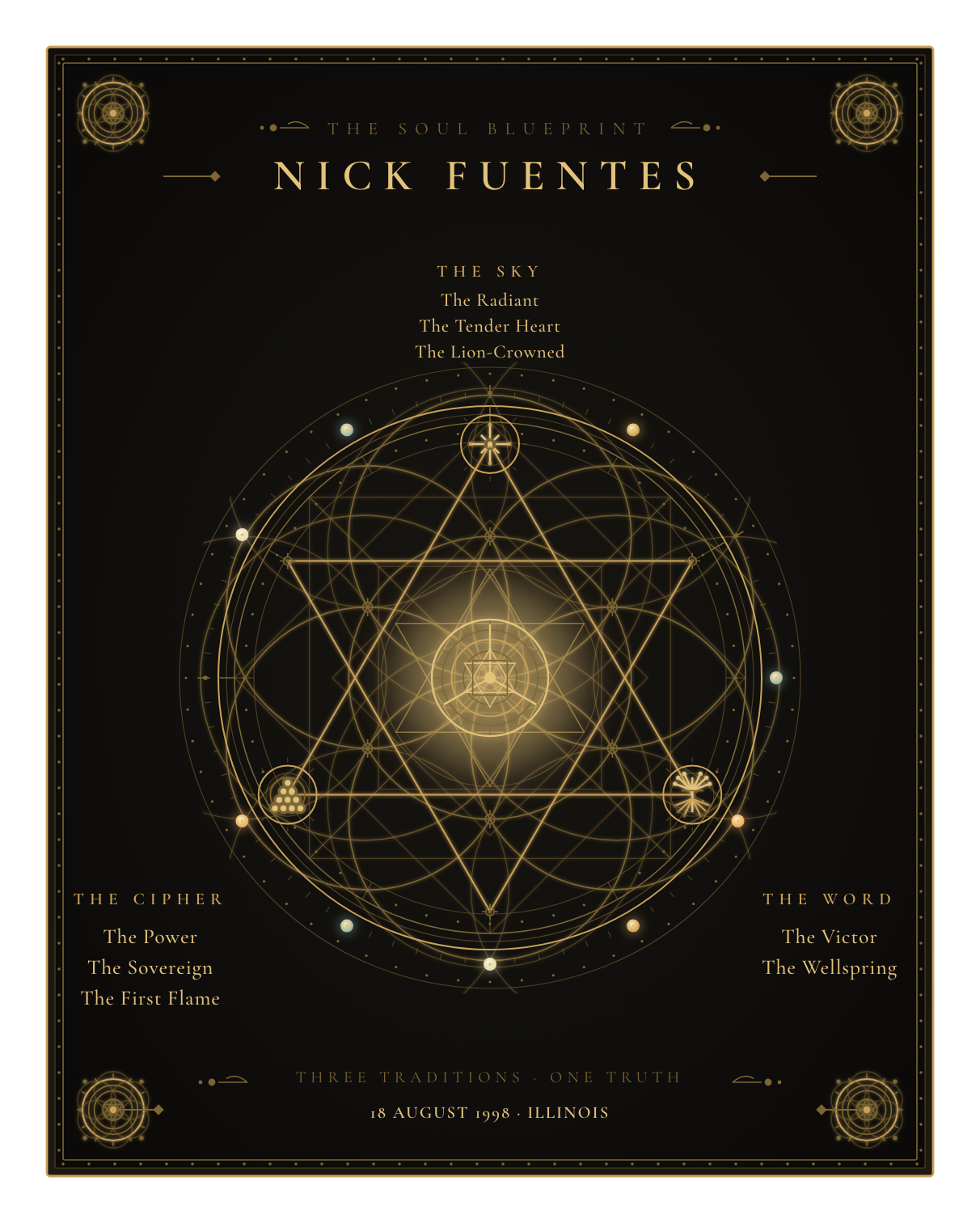
One seal, three languages. The sky he was born under at the apex, the numbers beneath his name at the lower left, the name itself at the lower right — three traditions engraved into one artifact. There is no rising sign, no houses, no angles: without a verified birth time they cannot be honestly drawn. What is true is what is shown.
At a Glance
- Full traditional name
- Nick Fuentes
- Born
- August 18, 1998 · Illinois
- Sun
- Leo 25.5° — the essential fire of the life
- Rising
- Birth time unverified — the Ascendant is offered conditionally, never asserted
- Moon
- Cancer 15.2° — the inner life
- Mind · Value · Will
- Mercury Leo · Venus Leo · Mars Cancer
- Discipline · Direction
- Saturn Taurus · North Node Virgo
- Life Path
- 8 — The Sovereign
- Title-name Destiny
- 1 — The Pioneer
- Birth-name Destiny
- 1 — The Pioneer
- Master Numbers
- None preserved at the final layer
- Soul archetype
- The Pioneer who lives the Sovereign’s path
It is November 2020, and the basement of a house in Illinois holds a streaming setup — a young man in his early twenties, broadcasting live, the blue glow of the camera the only sun in the room. The voice coming through is assured, commanding, layered with conviction; the audience is building. Above him, the house settles into evening. Outside, the nation is fractured. He is 22 years old, and he has already walked through fire — Charlottesville, the death threats, the university left behind, the platforms that have cut him off. Now he is beginning again, smaller, colder, more focused.
The world calls him a livestreamer, a political agitator, a voice of a fringe movement. The fragments it holds are inflammatory: white nationalism, antisemitism, the breach at the Capitol, the arrest, the pepper spray. These are the shapes the harm took. But beneath the fragments, in the source — in the architecture of the soul that arrived in August 1998 — there is something the world’s labels do not touch. There is a particular signature, a creative force bent toward radiance and certainty, a will to build and protect, a mind that thinks in vivid wholes and sees itself as the center of its own narrative. The fragments are real. The harm they have caused is real and documented. But to read the soul blueprint is to look past the wreckage to the original design — to ask what was given at birth, what was asked of it, and what it chose to do with the fire.
This reading reads the source. It does not excuse what was built from it — understanding is not endorsement, and clarity about the pattern is not celebration of the harm. But it looks at the foundational architecture: the Leo Sun that came alive by radiant creative expression, the mind that sees in big pictures and speaks with warmth and certainty, the will to protect and provide for those it loves, the growth medicine that was offered and refused. The soul blueprint does not explain away. It illuminates.
What follows is the long reading of Nick Fuentes — not as the world’s fragments hold him, but as the soul’s original design arrived, lived, and continues to be lived.
The reading moves through the eight chapters of the Soul Blueprint architecture — The Arrival, The Soul’s Inheritance, The Living of It, The Soul’s Calling, The Soul’s Territories, The Name You Carry, The Moment, and The Invitation — and at the end, the same instrument turns gently toward you.
The Arrival
A Leo Sun carries the paradox of the self that comes alive by radiant creative expression — the ‘I am’ that projects outward to create and to be recognized, the dramatic exteriorization of personality that has no choice but to be seen. This is the soul’s fundamental fire: the drive to bring something to life and give it form, the warmth that literally gives life to others. In its own domicile the Sun is both gift and trap — the creativity that builds becomes the certainty that cannot bend, the generosity becomes the need to be the center, the warmth becomes the heat that burns everything that refuses to reflect it back.
Nick Fuentes arrived carrying this signature: a creative force that had to express itself, a voice that had to be heard, a vision of itself as the protagonist of its own narrative. The Three numbers that govern his life — the Pioneer (Title and Birth), the Sovereign (Life Path) — wove themselves into this solar fire as a singular image: the soul that comes to break new ground, to make itself a kingdom, to radiate outward with such conviction that others must choose to follow or resist. There is no standing neutral around such a fire.
This is not villainy at birth; it is architecture. The Leo Sun has no malice in its need to be radiant and seen. But the signature arrives complete with its own peculiar danger: the creative expression that does not include discernment becomes propaganda; the certainty that does not include humility becomes fanaticism; the fire that does not learn to warm rather than consume becomes a weapon against everything it has decided is not worthy of its light.
The Soul’s Inheritance
He arrived into a household already shaped by the crossing of bloodlines — Italian and Irish threads on one side, Mexican ancestry on the other, a paternal grandfather who carried that Mexican American inheritance forward. The soul was not born into isolation but into a family constellation: a father named William, a mother Lauren (née Chicco) who carried her own lineage into the marriage, and a twin sister Melissa who would share the womb-time, the earliest mirroring. Twin birth itself is a sovereignty unto itself — two souls arriving simultaneously into the same threshold, each one a mirror-witness to the other’s beginning.
The home was Illinois, the Midwest heartland, a place of solid ground and settled rhythms. He was raised in the Roman Catholic faith, which meant the soul received a inheritance of ritual, of sacred objects and ceremonies, of a cosmos that organized itself around redemption and the body of Christ. This is a particular gift — not abstract spirituality but embodied faith, form given to the invisible. The era into which he was born was 1998, the tail end of the twentieth century, a time when the internet was becoming the nervous system of American life but had not yet become the sole container of human attention.
There is a particular gift in the soul born to protect what it loves — and the will to defend runs deep through the inherited blood. The family structure itself became the first kingdom he knew, the first place where his warmth and creative force could be directed, where the instinct to shield and provide could begin its shaping. The household held him, held the twin, held the parents’ own stories — and in that held space, the soul began to understand itself not as isolated but as part of a lineage that had survived crossings and stayed whole. This inheritance — family, faith, the blood of multiple peoples — was the material from which his consciousness would be forged.
The Living of It
The will to protect arrives in him not as choice but as compulsion—a guardian’s instinct that moves through feeling rather than raw force, that defends the home and the vulnerable with a tenacity bound to the heart itself. Yet this same protective fire, when it cannot find its proper object, turns inward and becomes something else: the assertion becomes rigid, the care becomes control, the shield becomes a cage. The soul that guards must learn when to release the thing it guards. He arrived at young manhood with a clarity of conviction—the mind that sees and communicates in vivid wholes, that speaks with warmth and personal authority—and this gift found immediate channel through public voice, through livestream and platform, through the gathering of adherents around a vision he held as shelter for his own becoming. The drive to bring something to life and give it form burned bright in him; the creative self-actualization of his nature sought recognition, sought to radiate outward and build a kingdom of meaning around the things he valued.
But the protection-wound opened differently than he may have expected. The fierce guardianship that should have defended hearth and kin became instead a vigilant ideology—boundaries drawn not to shelter but to exclude, to mark the inside from the infinite threat of the outside. The will to nourish and hold safe, when it cannot distinguish between self-defense and domination, hardens into something that costs him: the loss of platforms, the severing of relationships, the legal consequence, the isolation that comes when the guardian turns into the thing it feared. The heart that instinctively seeks a felt foundation—that longs for the quiet restoration of home and genuine belonging—found itself instead locked in an architecture of antagonism, always asserting, always defending, always performing the radiant self for an audience that fed the compulsion to speak. The calling to learn discernment, to develop the grounded practicality that refuses the boundless drift, to find humility in useful service—this direction the soul moves toward even as the outer life seemed to move away from it. The wound became his qualification: he knows the cost of the guardian turned rigid, the price of conviction untempered by mercy.
Every soul arrives with a blueprint. What a life does with it is the whole of the reckoning.
The Soul’s Calling
The voice that arrives in him is not whispered or tentative — it comes alive as vivid conviction, whole and burning, the kind of thought that sees the completed shape before the details are named. His mind does not dabble in abstraction; it moves in storytelling and presence, in the warm architecture of an argument that asks to be felt as much as heard. This is the calling of a voice that compels, that gathers listeners not through careful qualification but through the sheer radiance of conviction itself — the natural performer whose thoughts arrive as living drama, not mere information.
Yet the soul’s deeper arc invites him toward a discipline he did not inherit. The direction he is meant to travel — the medicine the Source offers — is toward grounded discernment, practical boundary, and the humility of concrete work. The visionary fire that burns in him must learn to distinguish, to order, to serve something real and measurable rather than dissolve into the boundless or the escapist. The calling is not to lose the warmth and expressive power; it is to harness them toward genuine utility, toward tasks that hold and heal, toward the kind of devotion that does not require applause to sustain itself.
This is the sovereign work: to build something that lasts — not by charm alone, but by the patient assembly of actual security, real boundaries, and the self-earned worth that comes from making something true. The voice is his inheritance; the craft of discernment is his threshold. The soul came to radiate, yes — but also to learn when silence serves better than speech, when listening heals more than performance, when the real kingdom is built in the small, the daily, the grounded.
The Soul’s Territories
The territories most alive in Nick Fuentes’ soul-map are three, and each tells a different story of what he is called to hold and protect.
First arrives the territory of Eloquence and Conviction — the mind that sees the whole in vivid, burning clarity and has the gift to speak it aloud with warmth and force. His thought does not whisper; it announces. The voice that emerges from him carries the confidence of someone who believes deeply in the images he carries, and when he speaks, there is a kind of radiance in the telling — the natural gift of the storyteller, the performer, the one who can make an invisible idea suddenly visible to a crowd. This is where his warmth lives, in the expressive power of language itself, the ability to convince through the heat of conviction. Here the mind becomes presence; here thought becomes a lived and breathing thing.
Second comes the territory of Protection and Provision — the fierce, tender will that arises in defense of what he has decided to love and shelter. This is not a softness; it is a strength that moves through feeling, that knows what needs guarding and refuses to let go. The will to provide, to hold the circle safe, to be the one others can lean into — this runs through him like an underground stream, a hunger to make solid what is fragile.
Third appears the territory of Creative Self-Actualization — the need to bring something into being, to give form and life to what is only image in the mind. To create is to be recognized, to stand in the light of one’s own making. There is a royalty in this impulse, a demand for the world to witness what he brings forth.
These three territories — the voice, the guardian’s will, the creative fire — form the visible landscape of his soul. Beneath them moves a deeper mythology still, one that speaks to the true inheritance he carries: the soul that must learn to build something lasting, something real, something that does not dissolve.
There are twelve domains in the kingdom of any life: The Mark, The Unfolding, The Unseen, The Long Return, The Inheritance, The Encounter, The Alchemy, The Living Tension, The Sight, The Body’s Knowing, The Crossing, The Calling.
The Name You Carry
Nicholas carries within it the ancient meaning: victory over people, the Greek nike and laos woven together into a single word. Not victory in the abstract, but victory made social, made collective — the name arrives already asking: who will you lead? What will you make them believe? There is a quietness in Nicholas that is absent in Nick; the full name holds a formality, a gravity. But Nick — the shortened form, the one he has chosen — is friendlier, more immediate, more like a voice calling across a room. Nick Fuentes is the name of someone who wants to be known, not as a formal authority but as a peer, a friend, someone close enough to use the informal form.
Fuentes itself means fountains or sources — the plural wells from which water flows, the origin points. It is a Spanish surname, and it arrives carrying the mixed inheritance: his paternal grandfather was half-Mexican American, yet the public identity he has built has centered on white nationalism, a ideological positioning that explicitly rejects the inheritance the name carries. There is an estrangement built into the very act of saying his own name — Fuentes, sources, fountains — while building a movement that denies the legitimacy of the sources he comes from. The name says mixture; the ideology says purity. The name says origins; the movement says an origin story that excludes him.
Together they form a paradox: Nicholas Fuentes is the name of a soul called to victory through others and to speak from the sources, yet the life has been lived as a denial of the very multiplicity, the very mixing, the very plurality of sources that the name itself announces. A simpler soul might have lived that contradiction as a quiet grief, an internal fracture. But the Leo Sun does not do quiet. It radiates the contradiction outward, makes it visible, makes it the organizing principle of the public self.
The Moment
November 22, 2022: Nick Fuentes attended a private dinner with Donald Trump and Kanye West at Mar-a-Lago. It was a moment that appeared, at first, like a culmination — the basement streamer, the voice from the margins, now sitting at the table with the former president, now visible in the rooms where power actually dwells. The photograph existed; the moment was real; the world saw it and recoiled. Domestic and international condemnation arrived immediately. The moment was brief. The consequences were not.
But November 2022 was only the visible eruption of something that had been building for years. By that date, he had already organized the ‘Groyper War’ in 2019, directing supporters to confront conservative speakers at Turning Point USA events — a coordinated campaign of harassment and intimidation dressed as grassroots protest. He had been present among the crowds that breached the Capitol grounds on January 6, 2021, standing in the wreckage of the democratic process. He had built a movement inside a movement, a shadow network of believers who saw him as their spokesman, their leader, their voice.
The Mar-a-Lago dinner revealed what was already there: that he had become exactly what he appeared to be. The moment was not a turning point; it was a threshold crossed without return. After that dinner, the platform appearances continued, the donors kept sending money (nearly $900,000 according to The Washington Post by 2026), the audience kept watching. The January 6 presence, the October 2025 Tucker Carlson interview, the December 2025 Piers Morgan appearance — each one was another radiance, another assertion of centrality, another refusal to be silenced or diminished. But the basement was behind him now. He had left it, not for something larger, but for something stranger: a public life built entirely on the endorsement of those who had also been rejected, a kingdom made of anger and certainty and the unshakeable belief that he was right.
The Invitation
Everything in this reading has been moving toward a single point. The doubleness named in the first chapter, the inheritance, the wound, the calling, the territory, the name, the moment. These are not seven separate truths about Nick Fuentes. They are one truth, named from seven different angles. And they all converge here.
The invitation arrived not as a whisper but as a fire that could not be contained — the summons to stand, to speak, to make himself heard in the theater of the present moment. From the beginning, this soul carried the architecture of the radiant one: the self that comes alive by pouring itself outward, by dramatizing conviction, by making the invisible visible through sheer force of presence and word. But the invitation he has been living into — the one that has pulled him again and again into the arena of public speech, the livestream, the stage — asks something more precise and harder. It asks him to take that creative fire, that natural gift for vivid storytelling and warm, compelling expression, and to build from it something that lasts, something grounded and defensible, something that can withstand the weight of scrutiny and time.
For decades, the soul’s deeper work has been the work of learning where the line lies between the impulse to merge, to dissolve into an imagined collective, to drift into boundarylessness — and the call to discern, to select, to know what truly serves and what poisons. This is the ancient medicine the soul inherited: the direction toward practical order, healthy limits, the humility of useful work done well. The invitation has not been gentle in delivering this teaching. It has come through deplatforming, through the loss of access, through the repeated severing of connection — each silence a teacher, each removal a threshold. The soul has been asked to learn what cannot be outsourced, what cannot be streamed away, what cannot be delegated to a collective echo chamber: the capacity to discern for itself, to know its own mind not as a broadcaster knows an audience but as a craftsman knows the grain of wood.
What was being released — what the soul has had to surrender, again and again — was the fantasy of boundless reach, the dream of a voice that could merge with the crowd and never be alone, the merger-impulse that says if I can just dissolve my edges into the collective, I will be safe. The invitation has been relentless in shattering that. The platforms fell away. The visibility became notoriety. The warmth of recognition turned to heat of condemnation. And in each fall, something fundamental was being asked: Can you stand alone and know your own worth? Can you build something that is real, not just reflected in the eyes of others? Can you develop the discernment to know what you are actually building, and for what purpose?
What has been called toward is the harder path — the path of the builder, not the broadcaster; the path of the soul that learns to ground itself in something it has made, something solid and self-earned, not borrowed from the approval of the multitude. The teaching has come in the form of a need to provide, to protect, to hold something safe — the fierce protectiveness that comes from feeling, the will to nourish, even when the nourishing must first be turned inward, toward the self. The soul has been invited into the work of learning what it means to have boundaries, to say no, to select whom and what to serve — not the fantasy of serving all, but the concrete work of serving something real, something chosen, something that can be held in the hands and examined in daylight.
What became available when the soul began to say yes to this invitation — when he began to move toward discernment rather than away from it, toward useful work rather than boundless expression — was a different kind of power: not the power of the crowd, but the power of the one who knows what he is actually building and why. The livestream became a tool he had chosen, not a channel through which he was chosen. The platform became a responsibility, not a mirror. The audience became something he had to serve with integrity rather than simply be reflected by. A kind of maturation became possible — the maturation that comes when a soul stops asking Will they love me? and starts asking Am I building something worth the building? Am I serving something that is real? The invitations to speak, to appear, to stand before the world — these continued, but the soul’s interior relationship to them shifted. They became no longer the proof of existence but the expression of existence, the outpouring of something already made solid inside.
The soul stands now in the middle of that work, neither fully released from the old patterns nor yet fully arrived at the new ground. The invitation continues to be specific and relentless: Learn to build. Learn to choose. Learn to know the difference between what feels like connection and what actually serves. Learn to stand.
He was not late. He was exactly where the soul-clock said he should be. The mission had been inscribed at the threshold of his first breath. What was being asked of him, he has been walking. The naming has been done.
This Is Not Coincidence
The astrology says: a Leo Sun in its own domicile projects the ‘I am’ outward to create and be recognized, dramatic exteriorization of personality; a Mercury in Leo that thinks in vivid wholes and speaks with compelling warmth; a Mars in Cancer that protects and provides but risks the fierce protection that becomes control; and a North Node in Virgo that asks for the medicine of discrimination, boundaries, useful service — the very medicine most difficult for such a solar signature to receive. The numerology independently says: a Life Path 8, the Sovereign, called to build empires and demonstrate authority; a Title Destiny and Birth Destiny both 1, the Pioneer, the soul that breaks new ground and makes itself the center — three numbers woven into a single governing image of radiance, leadership, the refusal to be contained. The name says: Nicholas, victory over people, the collective will shaped by a single vision; Fuentes, fountains and sources, the mixed inheritance, the plurality he carries and the purity he denies. Three entirely different languages. One truth: the soul arrived with a fire meant to illuminate and the gift of voice meant to serve, and instead chose to burn. The blueprint shows not why he became what he became — choice is always free, and understanding is not excuse — but what was given at birth, what was asked of it, and what it refused. The Leo Sun will continue to radiate; the Mercury will continue to speak; the Mars will continue to protect what it has decided to protect. But the North Node medicine of discernment, boundaries, and useful service remains unintegrated, remains refused, remains the path not taken.
Three entirely different languages. One truth.
This is not coincidence. This is what three independent systems do when they are all telling the truth about the same soul.
The Numbers, Decoded
The numbers are computed, not intuited — each letter takes its Pythagorean value, each name reduces, and any Master Number is preserved rather than collapsed.
You have sat with the chart and the numbers and the name of another soul, and watched how a wound becomes a calling, how the place of least belonging becomes the place of greatest gift, how a life too precisely configured to be coincidence reveals itself when three independent languages are read together.
The reading you have just received was, in its outer form, a reading of his soul. But its inner form was a reading written for yours. You did not arrive without a Blueprint either. May this reading be the beginning of the reading you finally receive of yourself. May the light you carry — in whatever particular, irreplaceable form it has taken inside the specific life you were given.
Some lives carry a pattern this clear.
Yours does too.
The Soul Blueprint reads any life through the same three languages — the sky, the numbers, the name.
Or, when you’re ready, begin your own full Soul Blueprint reading →
Frequently Asked Questions
What is Nick Fuentes’s birth chart?
Nick Fuentes was born with the Sun in Leo, the sign of radiant creative expression and dramatic self-actualization. His birth time is unverified and circulated, so his rising sign cannot be reliably determined. He also carries Mercury in Leo (a warm, dramatic, persuasive mind that thinks in vivid wholes), Venus in Leo (love expressed with warmth, generosity, and devotion), Mars in Cancer (a will oriented toward protection and provision for those he loves), and Saturn in Taurus (the Great Work of building real, lasting security and self-worth).
What is Nick Fuentes’s numerology?
Nick Fuentes’s Title Destiny (from his name) is 1, the Pioneer — the soul called to break new ground and make itself the center. His Birth Destiny (from his birth name) is also 1, the Pioneer. His Life Path (from his birth date, August 18, 1998) is 8, the Sovereign — the archetype of authority, empire-building, and the demonstration of power. Together, these three numbers weave the image of the soul called to lead, to radiate outward, and to establish itself as central.
What does the name Nick Fuentes mean?
Nicholas is derived from the Greek Nikolaos, composed of ‘nike’ (victory) and ‘laos’ (people) — literally, victory over people or victory made collective. Fuentes is a Spanish surname meaning ‘fountains’ or ‘sources,’ derived from ‘fuente’ (fountain), signifying the origins or wellsprings. Together, the name announces a soul called to move people through a singular vision while carrying within it a mixed heritage and plurality of sources — a paradox his chosen path has explicitly denied.
What is a Soul Blueprint?
A Soul Blueprint integrates three independent traditions — Western natal astrology, Pythagorean numerology, and the etymology of the full birth name — into a single document written as a personal letter to the soul. When you’re ready, you can begin your own.
This reading was prepared in the lineage and methodology of the Soul Blueprint Method — Pythagorean numerology with master numbers preserved, Western archetypal astrology, and a researched etymological reading of the full name. Nick Fuentes’s birth date (August 18, 1998) is sourced from the public record; the birth time is unverified, so the rising sign is offered conditionally and never asserted.
A Soul Blueprint reading · Astrology · Numerology · Etymology · shams-tabriz.com